Rococo vs Baroque Architecture: Key Differences Explained
Quick Answer
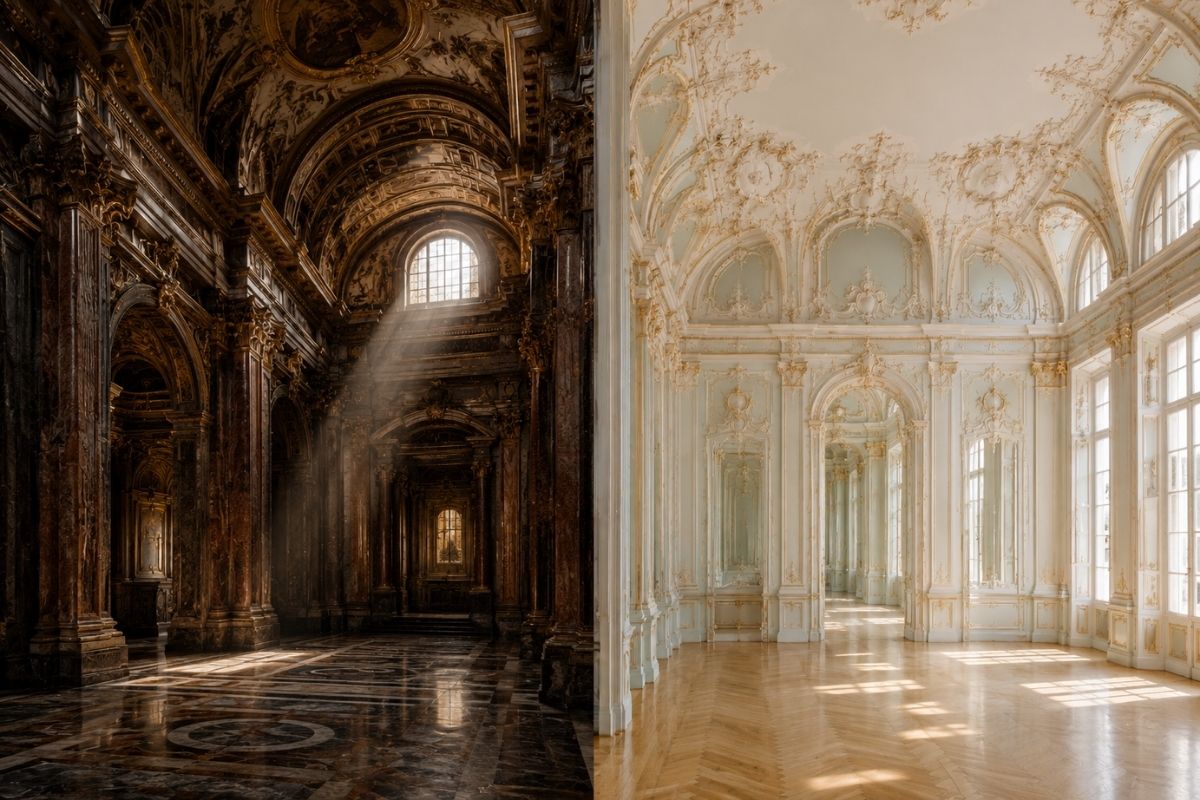
Baroque architecture (approximately 1600–1750) uses heavy, symmetrical ornament, bold contrasts of light and shadow, grand imposing scale, and dramatic movement. Rococo architecture (approximately 1715–1775) is lighter, uses asymmetrical shell-and-scroll ornament, pale palettes, and intimate scale. Rococo developed from Baroque as a more refined and playful interior style, not a replacement of Baroque exterior architecture.
Historical Timeline
Understanding Rococo and Baroque requires understanding that they are not simply competing styles — they are sequential, with one growing from and reacting to the other.
Baroque (approximately 1600–1750) emerged in Rome in the early 17th century as a response to the restrained, intellectual character of Renaissance art and architecture. The Counter-Reformation Catholic Church embraced Baroque’s dramatic emotional power and sensory richness as tools for inspiring religious awe and demonstrating the Church’s authority.
From Rome, Baroque spread across Catholic Europe — Spain, France, Germany, Austria, and the Spanish colonies in the Americas — during the 17th and early 18th centuries. Each region developed a distinctive Baroque character: Italian Baroque is theatrical and painted; French Baroque under Louis XIV is formal and monumental; German and Central European Baroque is ornate and plastic.
Rococo (approximately 1715–1775) emerged in France following the death of Louis XIV in 1715. The shift represented a change in social context as much as a change in aesthetic preference. The grand ceremonial Baroque of Versailles under Louis XIV had expressed royal absolute authority. The more intimate Rococo that developed under Louis XV expressed a different mode of aristocratic life: private, pleasurable, and intellectually playful.
Rococo began as an interior style — a new approach to decorating private rooms — and never fully displaced Baroque in exterior architecture. A building might have a Baroque exterior and Rococo interior state apartments.
Rococo declined from the 1760s onward as Neoclassicism emerged, bringing a return to symmetry, classical discipline, and rational order.
Visual Differences
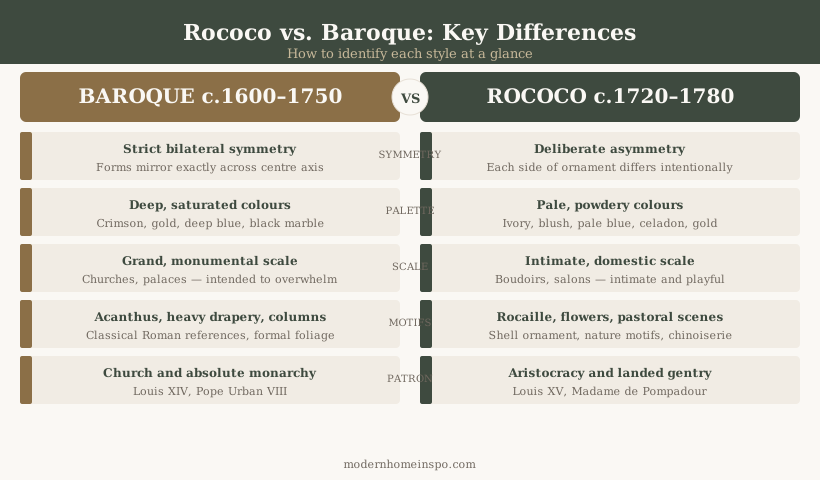
The quickest way to distinguish Baroque and Rococo visually:
Look at the ornament:
- Baroque ornament is symmetrical, heavy, and uses classical motifs: columns, pediments, acanthus leaves, putti (cherubs), and allegorical figures.
- Rococo ornament is asymmetrical, lighter, and uses organic motifs: shells, rocks, scrolls, flowers, and abstract flowing forms (rocaille).
Look at the color:
- Baroque interiors use deep, rich colors: dark reds, deep greens, heavy gilding on dark grounds.
- Rococo interiors use pale, light colors: off-white, pale gray, sage green, cream, with gilding on pale grounds.
Look at the scale:
- Baroque spaces are grand, tall, and imposing — designed to create awe.
- Rococo spaces are more intimate and human-scaled — designed for comfort and elegance.
Baroque Architecture Characteristics
Dramatic Scale and Movement
Baroque architecture uses scale as a rhetorical tool. The facades, interiors, and spatial sequences of Baroque buildings are designed to produce an emotional response — awe, reverence, submission. The spaces feel larger than they are because of forced perspective, diagonal axes, and trompe-l’oeil ceiling paintings that appear to open into the sky.
Curved walls and facades — concave and convex surfaces in alternation — create a sense of movement in the building mass itself. This dramatic spatial dynamism is one of the most distinctive features of Italian Baroque architecture.
Chiaroscuro in Architecture
Baroque architects used deep relief ornament, heavy projecting cornices, and dark recessed surfaces to create strong contrasts of light and shadow across facades and interiors. This architectural chiaroscuro — borrowing the painting term for light-and-dark contrast — gives Baroque facades their characteristic drama.
Classical Ornament
Baroque ornamentation draws heavily on classical antiquity: engaged columns and pilasters, elaborate entablatures and cornices, triangular and segmental pediments, cartouches, swags, putti, and allegorical figures. This classical vocabulary is deployed at a larger scale and with greater plastic relief than Renaissance classicism.
Religious and Royal Authority
The program of Baroque architecture is typically connected to religious or political authority. Baroque churches aim to inspire devotion and submission. Baroque palaces — Versailles is the defining example — aim to assert the power and authority of the monarch.
Rococo Architecture Characteristics
Interior Focus
Rococo is primarily an interior style. The most characteristic Rococo spaces are interiors — the salons, boudoirs, and cabinets of French aristocratic houses and the state apartments of Central European palaces — rather than facades or exterior volumes.
Rococo exterior architecture exists — principally in Germany and Central Europe — but is far less characteristic and widespread than Rococo interior decoration.
Asymmetrical Ornament (Rocaille)
The defining formal characteristic of Rococo is the asymmetrical shell-and-rock ornamental vocabulary called rocaille. Rocaille ornament flows asymmetrically across ceiling plasterwork, wall panels, mirror frames, and furniture — in deliberate contrast to the symmetrical classical ornament of Baroque.
This asymmetry was intentional and was recognized as the distinguishing innovation of the Rococo style at the time. The designer Juste-Aurèle Meissonnier and the ornamentalist Nicolas Pineau codified and published the Rococo asymmetrical ornamental vocabulary in the 1730s, and these published designs were copied by craftsmen across France and Europe.
Pale Palette
Rococo architecture and decoration use pale, light palettes: off-white, pale gray, sage green, pale blue, cream, and gold on pale grounds. This palette served a practical purpose — maximizing light reflection in rooms lit by candles — as well as an aesthetic one. The lightness of Rococo color is a direct rejection of the heavy, saturated palette of Baroque.
Lightness and Elegance
Where Baroque communicates authority, Rococo communicates elegance. The structural elements become lighter and more refined. Columns are replaced by pilasters and painted panels. Heavy cornices become delicate moldings. The overall effect is of refinement and sophistication rather than power and grandeur.
Side-by-Side Comparison
| Feature | Baroque | Rococo |
|---|---|---|
| Period | c.1600–1750 | c.1715–1775 |
| Origin | Rome, Italy | Paris, France |
| Symmetry | Strongly symmetrical | Asymmetrical ornament |
| Scale | Grand, imposing | Intimate, elegant |
| Ornament type | Classical (columns, pediments, acanthus, putti) | Organic (shells, scrolls, rocks, flowers) |
| Color palette | Rich, deep, saturated | Pale, light, soft |
| Ceiling treatment | Dramatic painted scenes with trompe-l’oeil | Pale plasterwork with light asymmetrical ornament |
| Wall treatment | Heavy marble, tapestry, dark paneling | Pale boiserie with gilded carved detail |
| Dominant mood | Power, awe, authority | Elegance, intimacy, pleasure |
| Primary context | Churches, palaces (exterior and interior) | Aristocratic private rooms (primarily interior) |
| Key countries | Italy, France, Spain, Germany, Austria | France (origin), Germany, Central Europe |
Key Architectural Examples
Baroque Examples
Palace of Versailles (France, 17th century exterior): The Hall of Mirrors, the garden facade, and the Grand Appartements represent French Baroque at its most monumental. The exterior of Versailles is a defining Baroque building. Some later interior rooms at Versailles were redecorated in Rococo style.
St. Peter’s Basilica (Rome, 17th century): Bernini’s colonnade and baldachin (the bronze canopy over the altar) are among the defining works of Italian Baroque architecture and design.
Church of the Gesù (Rome, 1568–1584): The prototype Baroque church — the model for the facade and interior arrangement of Jesuit churches across the Catholic world. The elaborately painted and gilded interior is a key example of the Baroque integration of architecture and decoration.
Rococo Examples
Deep profiles of each Rococo building — visitor information, what to look for, room-by-room analysis — are in the Most Beautiful Rococo Palaces and Castles guide. This section focuses on what each building demonstrates about the Baroque–Rococo contrast specifically.
Sanssouci vs Versailles: Sanssouci (Potsdam, 1745–1747) and Versailles (exterior Baroque, 1660s) are both palaces built for absolute monarchs within 80 years of each other. Versailles is formal, symmetrical, and designed to assert power. Sanssouci is a single-story curved garden building designed for Frederick the Great’s private pleasure. They represent the full distance between Baroque intent and Rococo intent — authority versus comfort.
Amalienburg vs Church of the Gesù: The Amalienburg hunting lodge (Munich, 1734–1739) and the Church of the Gesù in Rome represent opposite emotional registers using equivalent levels of ornamental density. The Gesù is designed to inspire religious awe and submission. The Amalienburg’s silver and blue Hall of Mirrors is designed to delight. Baroque ornament creates gravity; Rococo ornament creates pleasure.
Würzburg Residence: The most instructive example of both styles coexisting in one building. The palace exterior and main spatial sequence are Baroque in structure. Many interior apartments are Rococo in palette and ornament. The staircase ceiling fresco by Tiepolo — illusionistic Baroque ceiling painting in a Rococo plasterwork setting — makes both styles visible simultaneously. This combination is common in Central European buildings of the 1720s–1750s.
Pilgrimage Church of Wies (1745–1754): Compared against Italian Baroque churches, the Wieskirche illustrates the Rococo emotional shift most clearly. Baroque religious interiors use chiaroscuro and heavy ornament to produce awe. The Wieskirche uses white and gold plasterwork, large windows, and pastel frescoes to produce joy. Both building types are intensely decorated — the difference is entirely in palette, light, and emotional intent.
How to Tell Them Apart
Three questions to ask when looking at a space or object:
1. Is the ornament symmetrical or asymmetrical? Symmetrical = Baroque or Neoclassical. Asymmetrical shells, scrolls, and flowing rock-like forms = Rococo.
2. What is the color palette? Rich, deep, saturated = Baroque. Pale, light, soft = Rococo.
3. What is the scale and mood? Grand, imposing, designed to awe = Baroque. Intimate, elegant, designed to delight = Rococo.
Note
Note that many spaces combine both styles — particularly in Central European palaces and churches where Baroque exteriors have Rococo interior decorative schemes. The two styles are not mutually exclusive in the same building. When identifying a space, focus on the specific element being described: the exterior might be Baroque while the interior plasterwork is Rococo.
The distinction matters most when making design decisions: if you are inspired by the heavy symmetrical grandeur of Baroque, the appropriate furniture and ornament choices are different from if you are inspired by the light, asymmetrical elegance of Rococo. Choosing Rococo furniture for a Baroque-inspired room — or vice versa — produces a confused aesthetic rather than a coherent one.
Frequently Asked Questions
- Is Rococo a type of Baroque?
- Rococo developed from Baroque and shares some characteristics, but it is generally treated as a distinct style rather than a subset of Baroque. Rococo emerged in France in the early 18th century as a lighter, more intimate alternative to the heavy grandeur of Baroque, and differs significantly in ornament, scale, color, and intent.
- Which came first, Baroque or Rococo?
- Baroque came first. Baroque architecture and design developed from approximately 1600 in Italy and spread across Europe through the 17th and early 18th centuries. Rococo developed in France around 1715–1730 and represents a refinement and reaction to Baroque, not a concurrent style.
- What are examples of Baroque architecture?
- Major Baroque architectural examples include St. Peter's Basilica in Rome, the Palace of Versailles (exterior), the Palais Royal in Paris, St. Paul's Cathedral in London, and the Church of the Gesù in Rome.
- What are examples of Rococo architecture?
- Major Rococo architectural examples include the Sanssouci Palace in Potsdam (Germany), the Amalienburg hunting lodge in Munich, the Würzburg Residence in Bavaria, the Hôtel de Soubise in Paris, and the Pilgrimage Church of Wies in Bavaria.
- Can a building be both Baroque and Rococo?
- Many buildings combine elements of both, because Rococo was primarily an interior style that was applied to buildings whose exteriors were already Baroque in construction. The Palace of Versailles exterior is Baroque; several of its state apartments were redecorated in Rococo style in the 18th century.