Most Beautiful Rococo Palaces: Sanssouci, Versailles & Schönbrunn
Quick Answer
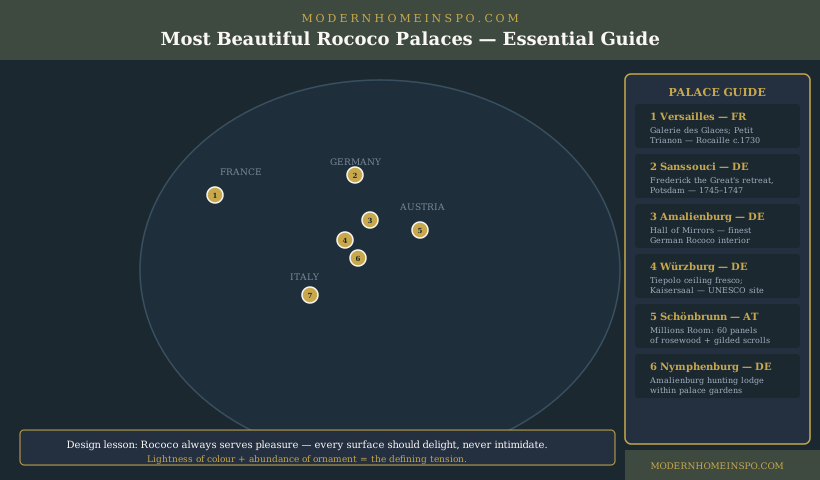
The most significant Rococo palaces are Sanssouci (Potsdam, Germany), the Amalienburg hunting lodge (Munich, Germany), Schloss Augustusburg (Brühl, Germany), the Würzburg Residence (Germany), Schönbrunn Palace (Vienna), and the petits appartements of Versailles (France). German and Central European examples are the most fully Rococo; Versailles shows the contrast between its Baroque exterior and Rococo interior redecorations.
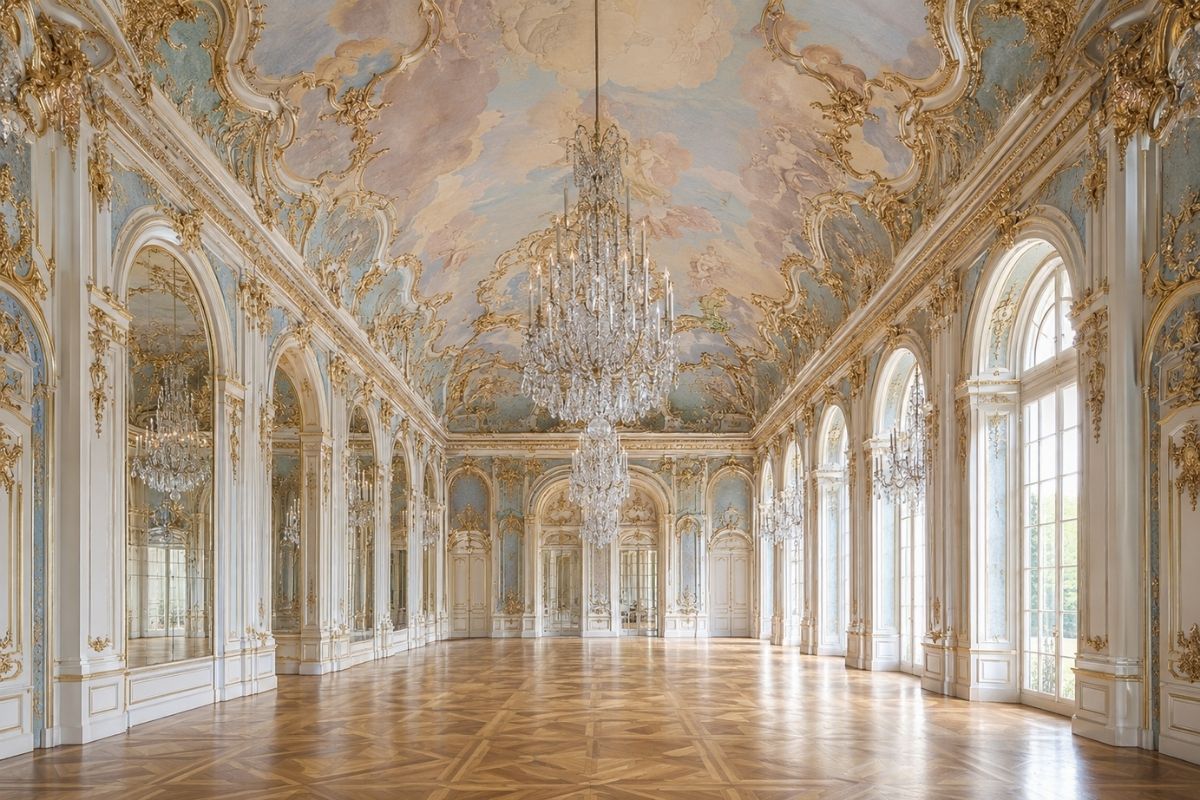
The greatest Rococo palaces are not the largest buildings ever built. They are the buildings where the Rococo design vocabulary — asymmetrical plasterwork, pale palettes, large windows, gilded ornament, intimate scale — is most fully and coherently expressed.
The most significant Rococo buildings are concentrated in Germany and Central Europe, where the French Rococo style was adopted with particular enthusiasm by the 18th-century German princely courts.
Sanssouci Palace
Potsdam, Germany | 1745–1747 | Architect: Georg Wenzeslaus von Knobelsdorff
Sanssouci — the name means “without worry” in French — was Frederick the Great’s summer retreat, designed as a personal sanctuary away from the formality of the Berlin court. It is the defining example of Rococo palace architecture.
What makes it exceptional:
The garden facade is the most reproduced image of Rococo exterior architecture: a single-story building curved in plan, with six large arched windows separated by paired caryatids, and restrained ornamental detail across the cornice and window surrounds. The building is not large — it was never intended to be — but its proportions, its integration with the terraced vineyard below it, and its perfect expression of the Rococo intent (private, pleasurable, and anti-monumental) make it architecturally definitive.
The interior rooms — the Marble Hall, the Library, the Music Room, and the Royal Chambers — show the full range of German Rococo interior design, from the more formal central rooms to the intimate private chambers decorated with carved and gilded boiserie.
What to look for: The curved plan of the main building (visible from the garden), the large windows that maximize natural light in the rooms, the intimate scale of the private chambers, and the asymmetrical ornamental plasterwork in the interior rooms.
Sanssouci is part of the Palaces and Parks of Potsdam and Berlin UNESCO World Heritage Site.
Amalienburg
Munich, Germany (Nymphenburg Palace grounds) | 1734–1739 | Architect: François de Cuvilliés
The Amalienburg is a small hunting lodge in the grounds of Nymphenburg Palace, designed by the French-born architect François de Cuvilliés for the Electress Maria Amalia. It is arguably the finest Rococo interior in existence.
What makes it exceptional:
The building’s exterior is deliberately restrained — a simple single-story pavilion that gives no indication of what awaits inside. The interior Hall of Mirrors, however, is one of the most celebrated Rococo rooms anywhere: a circular room with mirrored panels from floor to cornice, silver and blue ornamental plasterwork in asymmetrical flowing forms, and an overall sense of airy, shimmering elegance that no photograph fully captures.
Cuvilliés — who trained in Paris and brought the most current French Rococo design sensibility to Munich — created an interior that exceeded its French models in ornamental richness and spatial effect. The contrast between the plain exterior and the extraordinary interior is characteristic of the Rococo emphasis on private, interior experience over public display.
What to look for: The circular Hall of Mirrors (the central room), the integration of mirrors and plasterwork, the silver-blue palette (unusually saturated for Rococo but extraordinarily effective in this room), and the transition between the plain exterior approach and the ornate interior.
The Amalienburg is part of the Nymphenburg Palace complex, which is open to visitors.
Würzburg Residence
Würzburg, Germany | 1720–1744 | Architect: Johann Balthasar Neumann
The Würzburg Residence is a large episcopal palace — built for the Prince-Bishop of Würzburg — that demonstrates the coexistence of Baroque spatial architecture with Rococo interior decoration. It is a UNESCO World Heritage Site.
What makes it exceptional:
The Residence is famous above all for its staircase: a single grand staircase hall with the largest ceiling fresco in the world, painted by the Venetian artist Giambattista Tiepolo between 1752 and 1753. The architectural structure of the staircase is Baroque in its grandeur; the ceiling fresco — representing the four continents under an allegorical sky — is Baroque in iconography but executed with a Rococo lightness and pale palette.
The interior rooms — the White Hall (Weissersaal), the Imperial Hall (Kaisersaal), and the palace apartments — show the full range of German Rococo decoration. The White Hall in particular, with its grey and white stucco ornament by Antonio Bossi, is a masterwork of Rococo plasterwork.
What to look for: The staircase hall and Tiepolo ceiling fresco (the primary attraction), the White Hall stucco ornament, the Imperial Hall ceiling and walls, and the way the Baroque architectural framework contains Rococo interior decoration.
Schloss Augustusburg
Brühl, Germany | 1725–1768 | Multiple architects, including François de Cuvilliés
Schloss Augustusburg in Brühl, near Cologne, is a UNESCO World Heritage Site and one of the most complete Rococo palace complexes in Germany.
What makes it exceptional:
Augustusburg’s staircase hall — designed by Johann Balthasar Neumann and decorated with frescoes and stucco ornament — is one of the finest architectural interiors of the German Rococo. Unlike the Würzburg staircase (also by Neumann), the Augustusburg staircase is lighter and more intimate in character, with pale plasterwork and an overall quality of elegant refinement rather than monumental grandeur.
The palace apartments, redecorated under the direction of François de Cuvilliés in the Rococo manner, show the full decorative vocabulary: asymmetrical plasterwork, pale painted boiserie, mirrored surfaces, and the silk-covered furniture that was originally commissioned with the rooms.
What to look for: The staircase hall (comparing it with the Würzburg staircase reveals the range of expression within Neumann’s work), the Rococo apartment decoration, and the formal garden design by Dominique Girard.
Schönbrunn Palace
Vienna, Austria | Construction 1696–1713; Rococo redecorations throughout 18th century
Schönbrunn is the primary Habsburg imperial summer palace — a vast complex comparable to Versailles in scale, with a complex architectural history spanning from its initial construction through extensive 18th-century redecorations. It is a UNESCO World Heritage Site.
What makes it exceptional:
Schönbrunn’s Rococo character is concentrated in the interior apartments, redecorated throughout the reign of Maria Theresa (1740–1780). The Millions Room (Millionenzimmer) — a small cabinet room paneled in rosewood with carved Rococo frames around Indo-Persian miniature paintings — is one of the most remarkable Rococo rooms in Austria.
The Great Gallery, the Chinese Cabinets, and the Carousel Room all show aspects of the Viennese Rococo style, which is distinctly different in character from French or German Rococo — somewhat heavier and more colorful than French examples, but sharing the asymmetrical ornament, pale palette, and emphasis on intimate decoration.
What to look for: The Millions Room (a highlight of any visit), the Great Gallery ceiling frescoes, the Chinese Cabinets (an excellent example of the Rococo fashion for chinoiserie), and the garden facade and formal garden.
Versailles: Rococo Interiors
Versailles, France | Rococo redecorations: 1730s–1750s
The Palace of Versailles as a whole is Baroque — its exterior, the Hall of Mirrors, and the Grand Appartements are among the defining works of French Baroque. But a number of interior rooms, redecorated under Louis XV in the 1730s–1750s, are Rococo in ornament and palette.
The Rococo rooms at Versailles:
The Petits Appartements du Roi: The private suite of rooms used by Louis XV for daily life — distinct from the ceremonial Grand Appartements. These rooms, considerably smaller in scale than the public rooms, were decorated in the Rococo manner: pale boiserie, gilded carved detail, intimate scale.
The Cabinet de la Pendule: A small private room with Rococo boiserie panels and the famous astronomical clock by Passement and Dauthiau.
The Chambre de la Reine (in later redecorations): The Queen’s chamber was redecorated multiple times; the later 18th-century version incorporates Rococo ornamental elements.
What to look for: The contrast between the Baroque Grand Appartements (heavy, symmetrical, dark) and the Rococo private rooms (lighter, more intimate, paler palette) demonstrates the historical shift from Baroque to Rococo more clearly than almost any other single location.
Note
Versailles is often the first reference point for discussions of both Baroque and Rococo — but the building is best understood as a record of stylistic change over time rather than as an example of a single style. The contrast between different parts of the palace is itself the most valuable lesson it offers about the difference between Baroque and Rococo.
Other Notable Examples
Nymphenburg Palace, Munich
The main Nymphenburg Palace is Baroque in its principal rooms; several of the garden pavilions — including the Amalienburg and the Pagodenburg and Badenburg (earlier, more transitional) — show the progression toward Rococo. The Nymphenburg complex as a whole is the best single location for seeing the transition from Baroque to Rococo in German court architecture.
Pilgrimage Church of Wies (Wieskirche), Bavaria
Not a palace, but the most celebrated example of Bavarian Rococo religious architecture. The interior is one of the most extraordinary Rococo spaces: white and gold plasterwork, pastel frescoes, large windows flooding the oval nave with light, and an overall quality of joyful, transcendent lightness. A UNESCO World Heritage Site and one of the most visited churches in Germany.
Hôtel de Soubise, Paris
The principal surviving French Rococo interior in Paris, now part of the French National Archives. The oval salon by Germain Boffrand (c.1735–1740) contains the integrated plasterwork, painting, and carved wood paneling that defines the French Rococo interior at its most refined. The scale is intimate — closer to a large private room than a ceremonial hall — which makes it an unusually direct demonstration of the Rococo spatial intent.
Residenztheater, Munich
Designed by François de Cuvilliés (the same architect as the Amalienburg), the Cuvilliés Theatre is one of the finest surviving Rococo theater interiors. Four tiers of curved boxes with gilded carved ornament create a complete Rococo decorative environment at a scale appropriate for performance.
What to Look For
When visiting Rococo palaces, the most instructive comparisons are between:
Exterior and interior. In most German Rococo palaces, the exterior is relatively restrained or formally Baroque; the interior is where the full Rococo vocabulary appears. Noticing this contrast clarifies why Rococo is primarily understood as an interior style.
Scale. Rococo rooms are smaller and more intimate than comparable Baroque rooms. The contrast is often visible within the same building: compare the grand staircase hall (Baroque spatial drama) with the private apartments (Rococo intimacy) in the Würzburg Residence or Augustusburg.
Plasterwork asymmetry. Look at the ceiling ornament of any room described as Rococo and find the axis of symmetry — or the deliberate lack of one. Rococo plasterwork flows asymmetrically. Baroque and Neoclassical plasterwork is organized on strict axes.
Palette. Rococo palace rooms are pale — off-white, cream, pale gold, silver-blue, sage green. The pale palette is consistently visible across French, German, and Austrian Rococo interiors and is the clearest single visual identifier when comparing rooms across a palace that spans multiple periods.
Frequently Asked Questions
- What is the most famous Rococo palace?
- Sanssouci Palace in Potsdam, Germany (1745–1747), designed for Frederick the Great, is the most internationally recognized example of Rococo palace architecture. Its garden facade — a single-story curved building with large arched windows and restrained asymmetrical ornament — is the defining image of Rococo exterior architecture. The Amalienburg hunting lodge in Munich is smaller but often considered the finest Rococo interior.
- Is Versailles a Rococo palace?
- Versailles is primarily Baroque. The exterior and original state apartments (Grand Appartements, Hall of Mirrors) are French Baroque from the Louis XIV period (late 17th century). Several later interior rooms — the Petits Appartements du Roi and the Chambre de la Reine in their 18th-century redecorations — are Rococo in ornament and palette. The palace spans both periods because construction and decoration extended from the 1660s through the 1780s.
- Which Rococo palaces can be visited today?
- Most of the major Rococo palaces are open to visitors: Sanssouci (part of the Sanssouci Park UNESCO World Heritage Site in Potsdam), Nymphenburg Palace and the Amalienburg hunting lodge (Munich), the Würzburg Residence (a UNESCO World Heritage Site), Schloss Augustusburg (Brühl, Germany), and Schönbrunn Palace (Vienna, a UNESCO World Heritage Site). Versailles, with its Rococo interior rooms, is also open.
- What country has the most Rococo palaces?
- Germany — particularly Bavaria and Prussia — has the greatest concentration of Rococo palaces and buildings. French Rococo was primarily an interior style applied to existing buildings. German Rococo was adopted with great enthusiasm by the German princely courts, resulting in complete Rococo buildings with matching exterior and interior design.