French Rococo Furniture: A Collector's Guide
Quick Answer
French Rococo furniture is defined by its Louis XV period origin (1715–1774), the maker's guild stamp (estampille) on seat furniture, hand-cut dovetail construction, asymmetrical carved ornament, cabriole legs, pale or gilded finishes, and marquetry veneers on case pieces. Period pieces command significant prices at major auction houses; most available pieces are 19th-century Rococo Revival reproductions.
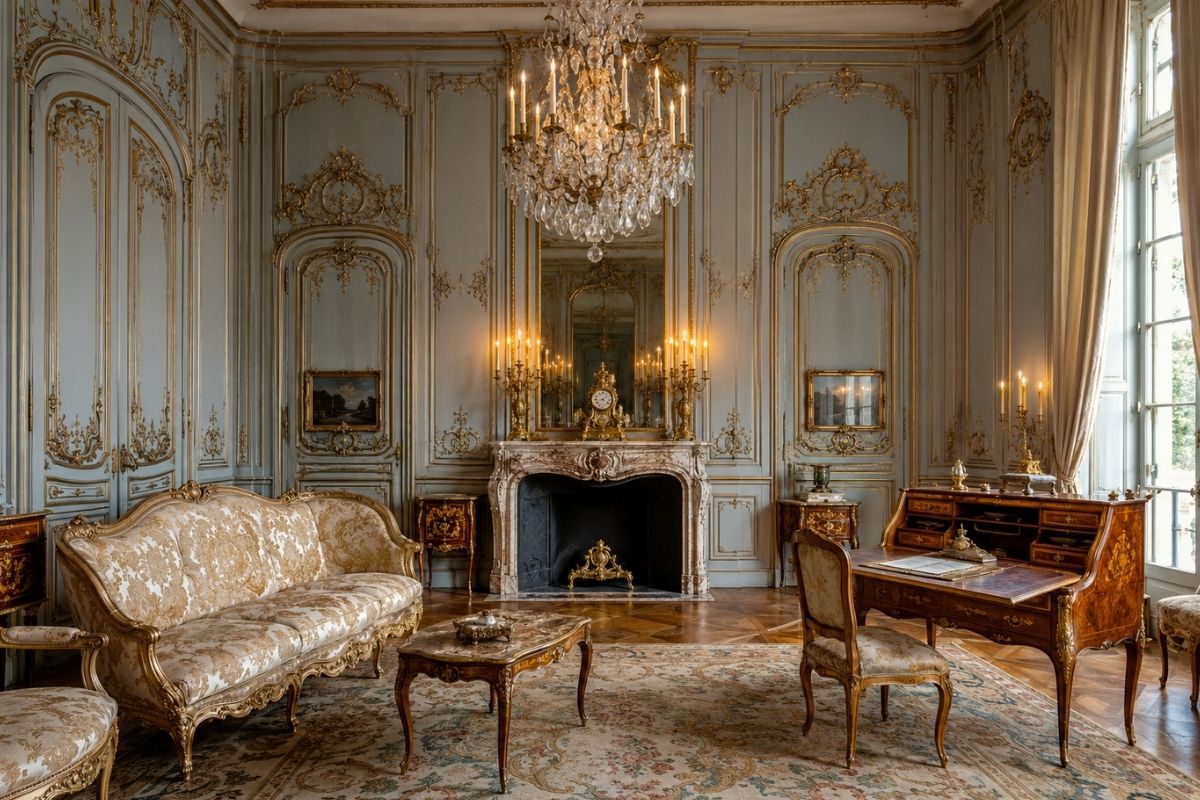
Historical Context
French Rococo furniture developed in two distinct phases, each reflecting a shift in French social organization.
The Régence (1715–1723): The transitional period following the death of Louis XIV. The rigid ceremonial formality of Versailles relaxed. The court moved back to Paris, and aristocratic social life became more intimate and private. Furniture became slightly lighter and more curved in response — but the break from heavy Baroque was gradual.
The full Louis XV period (1723–1774): The mature Rococo style crystallized around 1730. Designers Juste-Aurèle Meissonnier and Nicolas Pineau published the first explicitly asymmetrical ornamental vocabularies — what would later be called rocaille — and their designs were adopted by Parisian furniture workshops and spread across Europe through engraved design sheets.
By the 1750s, Rococo was the dominant decorative style across France, Germany, Italy, England, and the Netherlands. Each country adapted it: German Rococo became more elaborate and theatrical; English Rococo (absorbed into the Chippendale style) was more restrained; French Rococo at its peak was the most refined.
The style declined from the 1760s as Neoclassicism emerged — its advocates dismissed Rococo as frivolous and lacking rational order. The transition was gradual: many pieces from the 1760s–1770s show elements of both styles, with straighter legs and more classical ornamental motifs appearing alongside curved forms.
The Guild System and Makers’ Stamps
Understanding French Rococo furniture requires understanding the guild system that regulated its production.
The Two Guilds
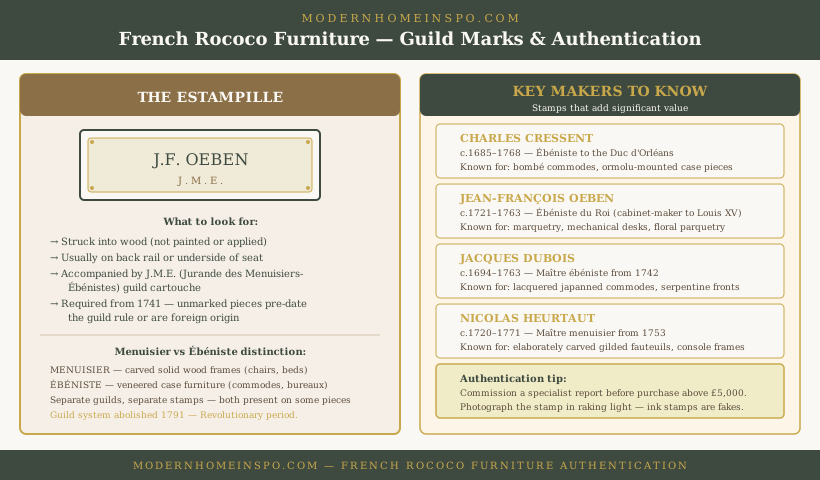
Menuisiers (joiners) made the structural wooden frames of seat furniture — chairs, armchairs, sofas, and beds. They worked in solid wood, producing the carved frames that were then upholstered by a separate craftsman.
Ébénistes (cabinetmakers, from the French word for ebony) made case furniture — commodes, armoires, secrétaires, writing desks, and similar pieces — using veneer and marquetry techniques rather than solid wood construction.
The two guilds were legally separate trades with different regulations, and a piece of furniture required the work of both if it had both a structural frame and applied surfaces (which most did not — seat furniture was the domain of menuisiers; case furniture the domain of ébénistes).
The Estampille System
A royal decree of 1743 required all guild members to stamp their work with an estampille — a maker’s mark — before selling it. The mark was typically the maker’s initials or full surname, struck into a less visible part of the piece: under the seat rail of a chair, on the back of a drawer side, inside an armoire door.
The Corporation des Arts (the guild regulatory body) also struck its own mark — a wax seal — alongside the maker’s stamp, confirming that the piece had been inspected and met guild standards.
What this means for collectors:
- An estampille on a piece does not prove it is period — estampilles can be faked, and the system was not perfectly enforced
- The absence of an estampille does not prove a piece is not period — some makers did not stamp consistently, and stamps are sometimes lost to later repairs
- An estampille identifies the maker’s workshop, not necessarily the craftsman who made a specific piece — workshops employed multiple craftsmen
Key French Rococo Ébénistes to Know
- BVRB — Bernard II van Risenburgh. One of the most sought-after Louis XV ébénistes. Works command exceptional prices at auction.
- Charles Cressent — Régence and early Louis XV. Known for elaborate gilt-bronze (ormolu) mounts, sometimes made in violation of guild rules.
- Jean-François Oeben — Mid Louis XV period. Known for complex marquetry and mechanical furniture (hidden compartments, combined functions).
- Roger Vandercruse Lacroix (RVLC) — Mid to late Louis XV. Prolific; pieces appear regularly at auction.
- Pierre Roussel — Known for elegant commodes and secrétaires with restrained marquetry.
Regional Styles
French Rococo was not uniform. Different regional centers produced distinctive interpretations.
Paris
Parisian ébénistes produced the most refined and restrained French Rococo furniture. The Faubourg Saint-Antoine district was the center of the trade — a concentration of workshops producing furniture for the royal court, the aristocracy, and wealthy bourgeoisie.
Parisian Rococo at its best is characterized by:
- Restrained marquetry using two or three woods rather than elaborate multi-wood compositions
- Precisely proportioned cabriole legs with refined carving at the knee
- Elegant gilded bronze (ormolu) mounts by specialist fondeurs-ciseleurs (bronze casters and chasers) — separate craftsmen from the ébénistes
Provincial French
Provincial French Rococo is different in character from Parisian work. It uses the same vocabulary — cabriole legs, curved forms, organic ornament — but in simplified or regional interpretations.
Provincial pieces:
- More solid wood construction than veneer (walnut and oak rather than marquetry)
- Heavier, more robust proportions
- Less elaborate ormolu — often carved and painted wood mounts rather than gilded bronze
- Regional wood types — walnut in Burgundy and Lyon, fruitwood in Alsace
Provincial French pieces are often misidentified as Parisian (to inflate their apparent value). The construction method — more solid wood, simpler joinery — and the absence of Parisian-style ormolu are the clearest differentiators.
German Rococo (Influence)
German Rococo furniture from the major courts (Munich, Würzburg, Berlin, Dresden) developed a more elaborate, theatrical character than French equivalents. German pieces use:
- More elaborate carved ornament with deeper relief
- Painted surfaces in more vivid pale colors (turquoise, pale yellow, pale green)
- More figurative ornament — flowers, birds, and scenes within cartouches
German Rococo is sometimes sold as “French” in international markets. The carving style, the wood choices (German linden versus French beech), and the ornamental character differ significantly for a trained eye.
Key Furniture Forms
Commode
The commode — a wide, low chest of drawers with two to four drawers and a marble top — is the defining luxury case piece of the French Rococo period. The best examples use:
- A bombé or serpentine front (the drawer fronts curve outward in three dimensions)
- Full marquetry panels using exotic veneers (kingwood, tulipwood, rosewood)
- Elaborate gilded bronze mounts at the corners, keyholes, and feet
- A marble top in pale-veined marble (white, gray, brèche d’Alep)
Commodes range from simple two-drawer pieces with minimal ornament (which appear at regional auctions) to major works by documented ébénistes with full marquetry and ormolu mounts (which appear at major London and Paris auction houses at significant prices).
Bureau Plat
The bureau plat — a flat-topped writing desk — is the defining executive desk form of the period. A period Louis XV bureau plat typically has:
- A leather-covered writing surface
- Three frieze drawers (one in the center, one at each end)
- Cabriole legs with ormolu mounts at the knee and foot
- Marquetry on the drawer fronts and frieze
The bureau plat was paired with a cartonnier (a fitted paper/document organizer) set at one end of the desk.
Bergère and Fauteuil
The bergère and fauteuil (see the Rococo furniture guide for full descriptions) are the defining seat furniture forms of the Louis XV period.
What to look for on period seat furniture:
- Carved frame in beech or walnut (not solid oak — oak was too difficult to carve)
- Hand-carved asymmetrical ornament at the crest rail and arm terminals
- Curved cabriole legs with a carved scroll or pad foot
- Evidence of original or period-appropriate upholstery: old nail holes, traces of webbing or stuffing materials in the seat rail
- Estampille under the seat rail
Bonheur-du-Jour
The bonheur-du-jour — a small writing table with a raised gallery of small drawers and shelves at the back of the writing surface — is associated particularly with women’s private rooms. It represents a late Louis XV/transitional form, with some pieces already showing Neoclassical influence in their slightly straighter legs.
Identifying Period Pieces
The following indicators distinguish authentic period (18th-century) French Rococo from later reproductions:
Construction
Joinery: Hand-cut dovetail joints in period pieces show slight irregularity — the angles are not perfectly uniform, the spacing is not machine-perfect. Machine-cut dovetails (post-1850s) are perfectly regular and uniform.
Secondary wood: In period pieces, the hidden structural parts — drawer sides, drawer bottoms, backboards — use inexpensive secondary wood: oak, poplar, or pine. The secondary wood in a genuine period piece will show appropriate aging (color, patina, smell). Modern reproductions often use plywood, MDF, or uniformly-colored modern pine.
Tool marks: Period furniture shows hand-plane marks, hand-saw marks, and hand-chisel work in hidden areas. Machine marks (circular saw marks, sanding machine scratches) indicate later reproduction.
Gilding
Gold leaf versus gold paint: Period gilding uses real gold leaf applied over gesso and bole (a red clay primer). Gold leaf gilding shows natural wear at contact points — arm terminals, leg knees, drawer pulls — where handling has worn through the gold to the red bole below. Gold paint shows uniform coverage without natural wear patterns.
Ormolu mounts: Period gilded bronze mounts have a warm, slightly matte gilding from the mercury-fire gilding process used until the 19th century. This process was banned when its toxic hazards were recognized. Later gilded bronze uses electroplating, which produces a brighter, more uniform surface.
Ornament
Carved detail: Period hand-carved ornament shows slight asymmetry and variation between matching elements. A pair of matching chairs from the same workshop will not have perfectly identical carving — there will be minor differences in the depth and shape of matching shell or scroll forms. Cast resin reproductions are exactly identical across matching pieces.
Patina: Genuine period carved wood develops a patina over 250 years — a slight darkening in recessed areas, a smoothing of high points from handling. The patina on genuine pieces cannot be perfectly reproduced by aging treatments, though it can be approximated.
Rococo Revival: The 19th-Century Reproductions
The most important distinction in the French Rococo furniture market is between period pieces (18th century) and Rococo Revival pieces (19th century, predominantly 1840s–1880s).
The Rococo Revival was a genuine 19th-century style — not a conscious deception. Manufacturers and craftsmen in France, England, Germany, and the United States produced furniture in the Rococo manner because it was fashionable in the mid-19th century, not because they were trying to pass it as period.
Key differences from period Rococo:
| Feature | Period (18th c.) | Rococo Revival (19th c.) |
|---|---|---|
| Construction | Hand-cut joinery, secondary solid wood | Machine-cut joints, earlier plywood |
| Scale | Lighter, more refined proportions | Heavier, more robust (different room scale) |
| Ornament | Asymmetrical, inventive | Symmetrical versions of Rococo motifs |
| Wood | Beech, walnut frames; kingwood/tulipwood veneers | Walnut predominates; rosewood also common |
| Gilding | Gold leaf on gesso, worn naturally | Electroplated or gold paint |
| Upholstery | Original frames only (upholstery replaced); light fabrics | Often original Rococo Revival velvet survives |
Rococo Revival pieces are legitimate antiques (150+ years old) with their own collecting market. They are not inferior to period pieces in the context of use — many are well-made, attractive, and practical. They are inferior only when sold as “period French Rococo” or “Louis XV” without clarification, which misleads buyers about age, rarity, and value.
Buying Guide
Major Auction Houses
Christie’s, Sotheby’s, and Bonhams hold dedicated European furniture sales twice yearly in London and New York. These are the primary market for significant period French Rococo pieces. Prices are highest here but provenance and condition are best documented.
Drouot (Paris) — the French national auction house — holds furniture sales regularly at lower average price points. Significant pieces appear, often with French provenance documentation (inventory records, estate sales) that international auction houses may not have.
Specialist Dealers
Reputable specialist dealers in French furniture:
- Can identify period versus revival with certainty
- Provide condition reports, provenance, and in some cases export documentation
- Price accordingly (no bargains, but reliable authentication)
The Carré Rive Gauche area of Paris (a dealer collective on the Left Bank, near the Musée d’Orsay) concentrates dealers in 18th-century French furniture and decorative arts.
Regional Auction Houses
For Rococo Revival pieces and lower-value period pieces, regional auction houses in France, England, and the United States offer productive buying opportunities. The trade knowledge in regional markets is variable — both bargains and misrepresented pieces appear.
Research before bidding: Use Christie’s and Sotheby’s auction records (publicly searchable online) to check sale prices for comparable pieces. If a regional auction lists a piece as “period Louis XV” at a price well below comparable Christie’s results, investigate the discrepancy carefully — either it is a bargain (possible but rare) or it is Rococo Revival sold as period (more common).
Important
Be skeptical of any piece described as “period Louis XV” at prices below $2,000–3,000 for seat furniture or below $5,000–10,000 for case furniture. Genuine period French Rococo pieces of reasonable quality command significant prices at specialist auction. A piece priced much below comparable auction results is almost certainly Rococo Revival, a later reproduction, or has significant damage or restoration not disclosed in the description.
What to Inspect Before Buying
For any piece sold as period French Rococo:
- Ask for the estampille location — request to see it if present. If the seller cannot identify a stamp location, investigate whether the piece is actually stamped.
- Inspect joinery in person — look inside drawers at the dovetails. Hand-cut irregularity is legible once you know what to look for.
- Examine secondary wood — the drawer sides and bottom should be solid secondary wood with appropriate age. Any plywood indicates post-1890s construction at earliest.
- Check gilding at wear points — arm terminals, knee carvings, leg feet. Look for red bole under gold leaf at worn areas. Uniform gold coverage without bole suggests paint or plating.
- Get a condition report in writing — legitimate sellers provide written condition reports documenting all repairs, replacement parts, and restoration. Be skeptical of any seller who cannot or will not provide one for a piece claimed to be period.
Frequently Asked Questions
- What is the difference between Louis XV and Rococo furniture?
- Louis XV furniture and French Rococo furniture refer to the same period and the same style. 'Louis XV' is the period designation (the reign of Louis XV, 1715–1774) used in auction and antiques contexts; 'Rococo' is the stylistic designation used in art history. Both terms describe the same furniture: curved cabriole legs, asymmetrical ornament, lightweight proportions, and pale or gilded finishes.
- What is an estampille on French furniture?
- An estampille is a maker's stamp — a mark struck into the wood of a piece by its maker. French furniture guild regulations from 1743 required menuisiers (seat furniture makers) and ébénistes (cabinetmakers) to stamp their work with their initials or name before selling it. Finding an estampille on a piece is a key indicator of authenticity for period French furniture.
- How do I know if French Rococo furniture is period or reproduction?
- Period (18th-century) French Rococo furniture shows: hand-cut dovetail joints with slight irregularity, gold leaf gilding with natural wear at contact points, secondary woods (oak, poplar) in drawer interiors, hand-carved ornament with slight asymmetry, and signs of old age in the wood. Reproductions show: machine-cut joints, uniform gold paint, plywood or modern engineered wood, cast resin ornament, and no signs of age or use in hidden areas.
- What are the most valuable types of French Rococo furniture?
- The most valuable are commodes with documented maker's stamps from major ébénistes (BVRB — Bernard II van Risenburgh, Charles Cressent, Jean-François Oeben), writing desks (bureau plat) with original marquetry, and pairs of bergères or fauteuils with their original gilding and upholstery frames. Documented provenance — particularly from royal or aristocratic collections — adds significant premium.
- Where can I buy authentic French Rococo furniture?
- Authentic period pieces appear at Christie's, Sotheby's, Bonhams, and Drouot (Paris) in their European furniture sales. Reputable antiques dealers in Paris (Carré Rive Gauche area), London (Mayfair and Kensington), and New York carry both period and high-quality revival pieces. For revival pieces, regional antiques fairs and auction houses are productive at lower price points.