Modern Rococo Interior Design: How to Apply It in a Contemporary Home
Quick Answer
Modern Rococo interior design uses one or two curved, ornamented statement pieces in a neutral contemporary room — a curved sofa, ornate mirror frame, bergère-style chair, or gilded console — without attempting a full period reconstruction. The key is restraint: Rococo detail in a calm, modern space, not museum staging.
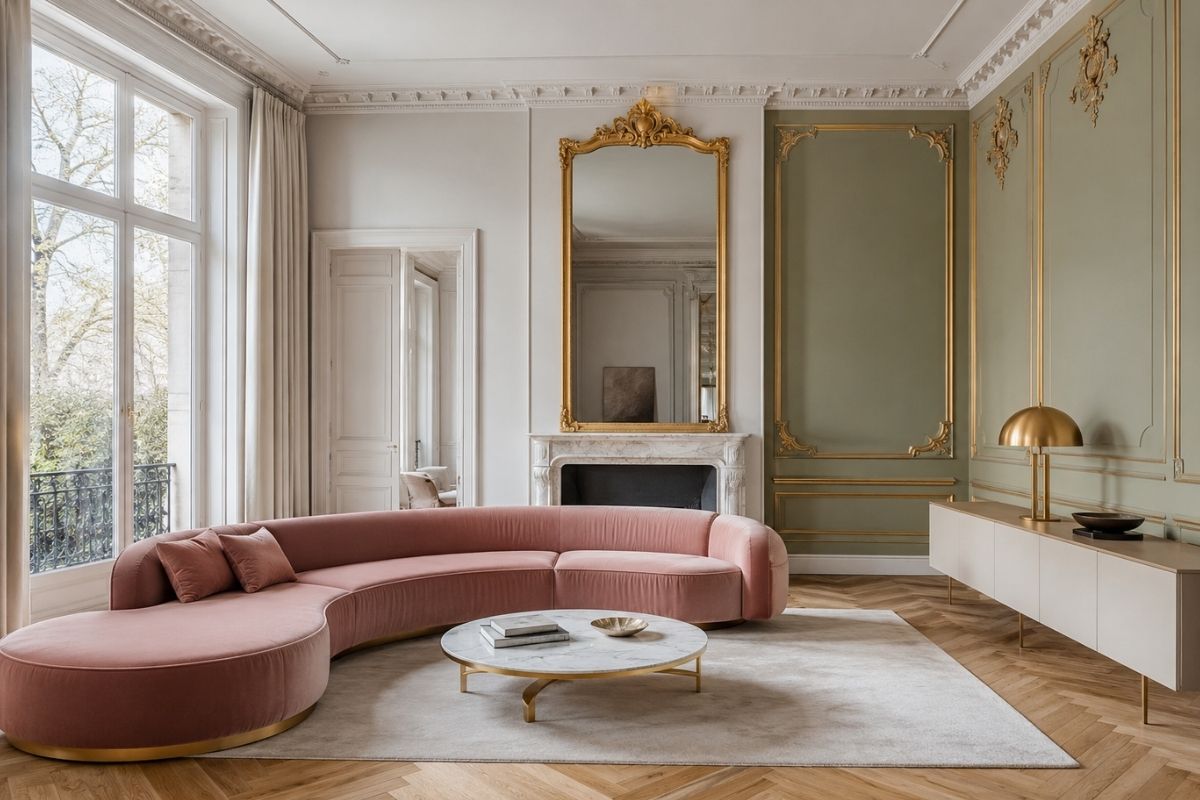
What Modern Rococo Means
The challenge with applying Rococo to a contemporary home is the gap between what Rococo requires to work historically and what is realistic in a modern interior. Authentic Rococo interiors needed carved boiserie wall paneling, parquet floors, silk wall panels, museum-quality furniture, and rooms of specific proportions. None of these are available in the average modern home.
Modern Rococo is not an attempt to replicate those conditions. It is an approach to importing Rococo character — elegance, lightness, curved ornamentation, gilded warmth — into a contemporary space that does not pretend to be a French palace.
The practical translation:
What carries over: Curved silhouettes. Ornate framed mirrors. Pale neutral palettes. Gilded or brass accents. Textural richness within a muted palette.
What doesn’t translate: Asymmetrical plasterwork ceilings. Boiserie paneling. Full silk wall hangings. Figurative cherub ornament. An all-over pastel pink-and-gold scheme without the architectural support that makes it legible.
The working formula: One or two Rococo-referenced statement pieces, set against a calm, neutral modern room. The contrast between the ornate piece and the clean surroundings makes both more effective — the Rococo piece reads as considered, not as clutter; the neutral room reads as intentional, not as bare.
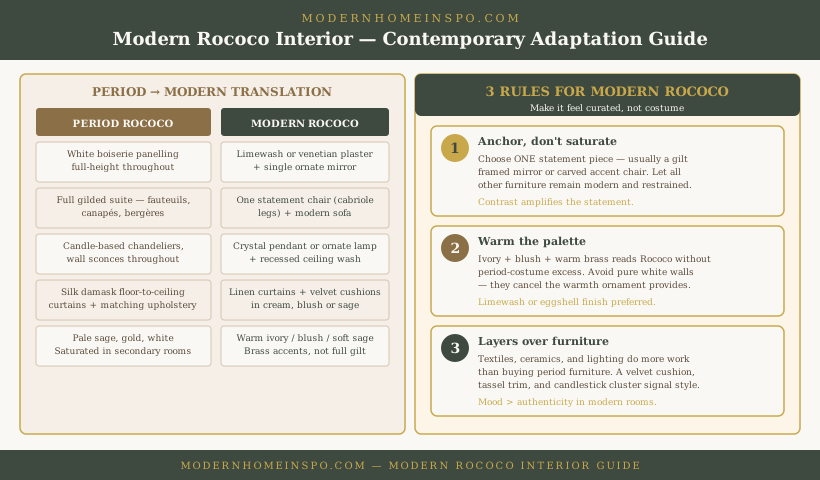
The Foundation Palette
Modern Rococo rooms work best on a warm neutral foundation. This references the historical Rococo palette (pale boiserie panels, off-white plasterwork) while remaining livable in a contemporary context.
Wall colors that anchor modern Rococo well:
- Off-white or warm cream — closest to historical Rococo plasterwork. Works best in rooms with good natural light.
- Warm greige — the most versatile choice. Provides a neutral ground that doesn’t compete with ornate pieces.
- Pale sage green — references the sage boiserie panels found in French Rococo interiors. Works particularly well with gilded mirrors and warm wood.
- Warm pale gray — more contemporary in feel; works if the gray has a warm (beige-adjacent) undertone rather than a cool blue-gray undertone.
Accent palette within the neutral base:
- Muted brass or burnished gold — the contemporary version of Rococo ormolu gilding. Warm and sophisticated rather than brassy.
- Soft dusty blush or pale rose — used in small quantities only (a cushion, a small vase). Becomes costume in large doses without period architecture.
- Warm off-white upholstery — for larger upholstered pieces, keeps the room from becoming too dark while maintaining the pale Rococo palette.
Important
Avoid using the full historical Rococo pastel palette — pale pink, pale blue, pale gold — simultaneously in a modern room. Without carved boiserie wall panels, ornate ceiling plasterwork, and period-accurate furniture density, those colors together read as a theatrical costume rather than a design choice. Pick one pale accent tone, not three.
Furniture Choices
Furniture is where modern Rococo character is most effectively established. The following pieces carry Rococo character into a contemporary room without requiring a complete room overhaul.
The Curved Sofa
A sofa with curved, rounded arms and a slightly curved or tufted back is the single most transformative Rococo-referenced piece in a living room. Curved sofas reference the Rococo canapé form while remaining entirely livable in a contemporary room.
What to look for:
- Rounded, padded arms (not square)
- A continuous curved back (not straight-backed with bolster cushions)
- Upholstered in linen, velvet, or a textured weave in off-white, warm cream, or a muted pale tone
- Cabriole-style or tapered leg details — not chunky block legs
One curved sofa in a neutral room immediately shifts the room’s visual character without adding any other ornate element.
The Ornate Accent Chair
A bergère-style chair — wide upholstered seat, closed upholstered sides, curved legs — brings Rococo character to a corner of a room. In a contemporary context, look for:
- Closed, upholstered arms (the defining bergère form)
- A carved or detailed wooden frame in gilded, pale-painted, or natural wood
- Upholstery in a fabric with some texture — velvet, boucle, or jacquard — in a muted tone
A single ornate accent chair in a neutral room is enough Rococo furniture for most contemporary spaces. Adding a second matching chair risks tipping from considered to theatrical.
Tables
Gilded or carved console table: A slim console table with carved legs and a gilded or painted finish, placed against a wall with a mirror above it, is a classic Rococo placement that works in contemporary entry halls and living rooms.
Round side table with curved legs: A small round guéridon-style side table with tapered or cabriole legs brings Rococo detail at a small scale — easy to add without structural commitment.
Avoid: Glass-topped tables with ornate bases — the combination of heavy ornate base and transparent top creates visual confusion rather than elegance.
Mirrors and Wall Detail
If a single piece can establish Rococo character in a contemporary room, it is an ornate framed mirror.
An ornate carved mirror — in gilded wood, painted wood with gilded details, or a combination of both — brings the most recognizable visual element of Rococo interiors without requiring furniture replacement or wall treatment changes. It functions as both a light-multiplying practical object and a decorative statement.
Placement that works:
- Above a fireplace, extending to approximately two-thirds of the chimney breast width
- Above a console table in an entry or living room — the mirror-above-console combination is a direct Rococo reference
- Above a dresser or behind a bathroom vanity — introduces Rococo character in a space where it is unexpected and therefore most effective
- Leaned against the wall (floor-to-ceiling) in a bedroom — contemporary in staging, Rococo in ornament
Frame characteristics to look for:
- Asymmetrical or flowing carved detail (not a plain rectangular frame)
- Gilded or partial-gilded finish — burnished gold rather than high-gloss gold
- Adequate scale — a small ornate mirror in a large room reads as an afterthought; the mirror should be proportional to the wall it occupies
What to avoid:
- Multiple ornate mirrors in the same room — one is a statement, two or more is clutter
- Matching ornate mirror + ornate frame + ornate console all in the same finish — too coordinated, reads as a bought set rather than a curated room
Lighting for Modern Rococo
Rococo interiors were lit by candles — which created warm, flickering light that made gilded surfaces shimmer and pale walls glow. Modern lighting can approximate this effect.
The key parameter: Use 2700K warm white bulbs throughout a modern Rococo room. This color temperature is closest to candlelight, warms pale walls and gilded surfaces, and creates the evening atmosphere that makes Rococo references work.
Fixture choices that support Rococo character:
Chandelier: A chandelier — even a small one for a domestic room — is the most direct Rococo lighting reference. A chandelier with arm branches, small shades, and a muted brass or antique gold finish works in contemporary rooms if it is proportioned correctly (not too heavy for the ceiling height).
Table lamps with decorative bases: A ceramic or metallic lamp base with a linen or paper shade introduces decorative detail at eye level. Look for lamp bases with surface texture or color rather than plain column shapes.
Wall sconces: Sconces with small shades or exposed bulbs on a decorative arm bring Rococo-referenced detail to walls without the scale commitment of a chandelier.
Floor lamp: A floor lamp with a curved arm and a detailed base — rather than a plain straight pole — fits the Rococo aesthetic without being period-specific.
The Gilded Surface Effect
In a modern Rococo room lit with 2700K bulbs, the warm light hitting gilded or muted brass surfaces creates the shimmer effect characteristic of historic Rococo interiors. This is why mirror placement matters: a gilded mirror near a 2700K lamp creates exactly the candlelit shimmer the original style was designed around.
Room-by-Room Guide
Living Room
The living room offers the most space for Rococo character. The formula: pale walls (off-white, cream, or warm greige) → curved sofa in neutral linen or velvet → one accent piece only (bergère chair OR gilded console, not both) → ornate mirror above the fireplace or console → all lighting at 2700K → layered pale cushions with texture contrast.
For sofa selection specifics, furniture layout relative to the fireplace, how to handle a living room without a fireplace, and rug sizing, see the Rococo living room guide.
Bedroom
The bedroom is the most natural contemporary setting for Rococo references — the original Rococo boudoir and cabinet were private rooms of approximately bedroom scale.
Effective bedroom applications:
- Ornate mirror: A carved, gilded mirror above a dresser or leaning against a wall
- Upholstered headboard: A curved, tufted headboard in off-white, pale blush, or warm velvet introduces soft Rococo character
- Bedside tables: Small tables with curved legs (guéridon reference) rather than straight-sided box tables
- Textiles: Layered bedding in pale neutrals with some texture — linen, cotton, velvet cushion. Avoid flat single-fabric looks.
See the full Rococo bedroom guide for room-specific detail.
Entry Hall
Entry halls are the most effective small-scale Rococo application. The entry console + ornate mirror combination is a direct and immediately recognizable Rococo reference.
The formula:
- A slim console table with carved or gilded legs against the wall
- An ornate framed mirror above it, proportioned to fill the wall space between the console and ceiling
- A ceramic vase or single object on the console
- A sconce or wall light on either side of the mirror, if the space allows
This arrangement works in any entry from small apartment hallway to large foyer — scale the mirror and console to the wall.
Bathroom
Bathrooms are underused for Rococo character. An ornate mirror above a vanity — in a space where most bathrooms use plain rectangular mirrors — reads as deliberate and unexpected.
Additional bathroom applications:
- Gilded or muted brass fixtures (taps, towel rail, cabinet hardware) — the bathroom version of ormolu detailing
- A decorative ceramic piece on the vanity
- Pale wall color (cream, off-white, pale sage) rather than the cold white typical of bathrooms
What to Avoid
Modern Rococo fails when it tips from curated to costumed. The specific traps:
Multiple ornate pieces in the same room. One curved sofa + one ornate mirror + one bergère chair + one gilded console + one chandelier in the same room stops reading as a Rococo-influenced room and reads as set dressing. Edit to one or two statement pieces maximum.
Cherubs, figurines, and animal motifs. Figurative ornament — cherubs on lamp bases, animal figurines, decorative figures on console tables — reads as decoration overload in a contemporary context. The original Rococo used these in context (as part of a complete allegorical interior scheme). In isolation they look miscellaneous.
Pale pastel multi-color schemes without period architecture. Using pale pink walls + pale blue accents + gold + white together in a room with standard ceilings and no boiserie paneling looks like a nursery color scheme, not a Rococo interior. Without the architectural context, the palette becomes childlike.
Heavy reproduction pieces in a contemporary room. Full reproduction French Rococo furniture — heavy gilded frames, floral-pattern silk upholstery on multiple matching chairs — requires a room that can accommodate the scale and formality. In a normal apartment, it creates a visual mismatch with the contemporary architecture that reads as staging, not design.
Oversized chandeliers. A chandelier scaled for a palace ceiling in a room with 8-foot ceilings creates visual clutter and physical obstruction. Scale the chandelier to the actual room: the bottom of the fixture should clear head height by at least 7 feet in a circulation path.
Note
The most effective modern Rococo rooms are primarily neutral and calm. The Rococo elements — one curved piece, one ornate mirror, gilded accents — stand out precisely because the surrounding room is restrained. If the whole room is ornate, nothing reads as a deliberate statement.
Frequently Asked Questions
- What is modern Rococo interior design?
- Modern Rococo interior design applies the visual characteristics of 18th-century Rococo — curved silhouettes, ornate carved details, gilded accents, pale palettes — to contemporary homes without attempting historical reproduction. It typically means one or two curved statement pieces (a sofa, a mirror, an accent chair) in an otherwise clean, neutral room.
- How do I make a room look Rococo without it looking dated?
- Use one or two Rococo-referenced pieces against a calm neutral background. An ornate gilded mirror above a modern console, or a curved velvet sofa against plain walls, reads as considered rather than dated. Avoid multiple figurative objects, cherubs, and an all-over pale pink-and-gold palette — those read as costume, not design.
- What colors work for a modern Rococo room?
- Warm neutrals are the best foundation: off-white, warm cream, warm greige, pale sage. These reference the Rococo pale palette while staying livable in a modern home. Gilded accents (muted brass or burnished gold) bring warmth. Full pastel pink or baby blue Rococo palettes are harder to execute without period-accurate architecture to support them.
- What furniture pieces introduce Rococo character most effectively?
- An ornate framed mirror is the easiest single introduction — it adds Rococo character without changing the room structure. After that: a curved sofa or loveseat with rounded arms, a bergère-style accent chair with closed upholstered sides, or a gilded console table with cabriole legs.
- Can Rococo work in a small apartment?
- Yes — Rococo was originally designed for smaller private rooms (cabinets and boudoirs), not grand halls. In a small apartment, one ornate mirror, a curved chair, and a pale neutral palette can create Rococo character without overwhelming the space. The risk in small spaces is overcrowding with multiple ornate pieces.