Rococo Revival Interiors: The 19th-Century Continuation of Rococo Style
Quick Answer
The Rococo Revival (c.1830–1880) was a 19th-century reinterpretation of 18th-century Rococo style, characterized by heavier ornament, more symmetrical compositions, richer colors, and larger scale than original Rococo. It appeared in Victorian interiors, furniture, and decorative arts as part of a broader mid-19th-century historicist movement. Rococo Revival furniture is more common in antiques markets than period 18th-century Rococo.
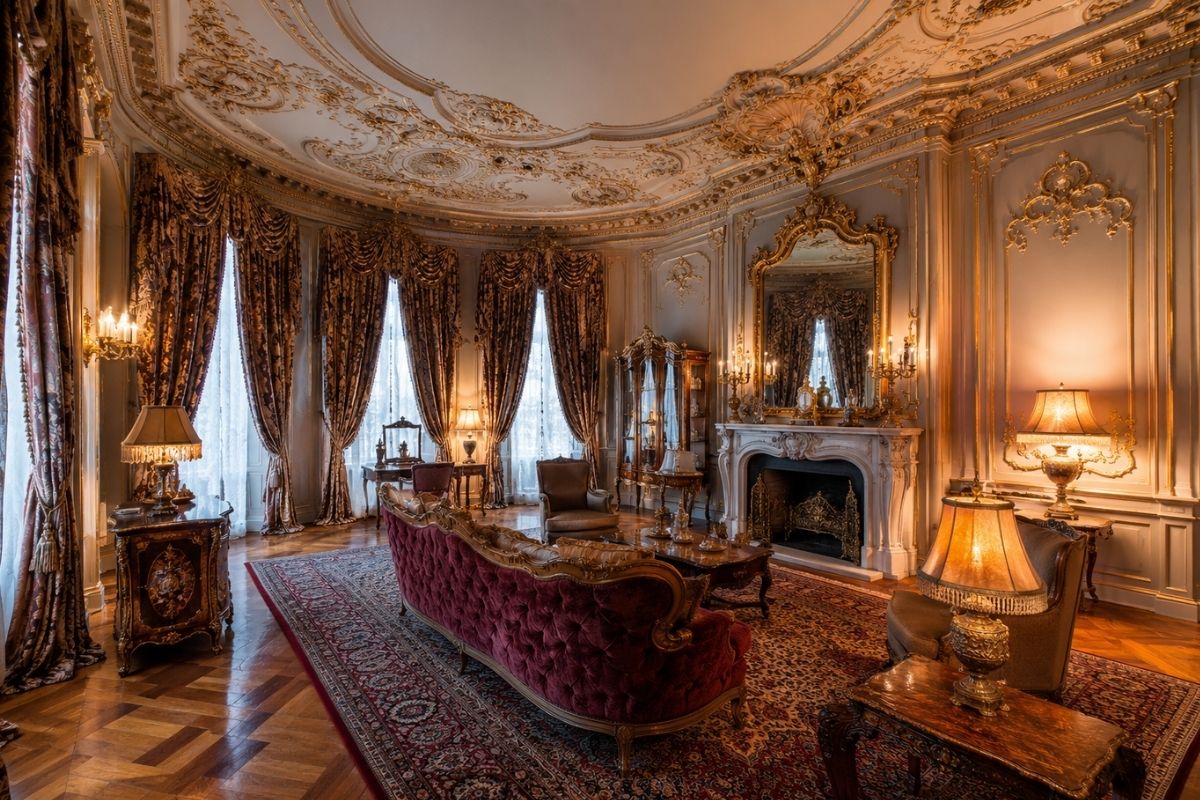
What Was the Rococo Revival?
The Rococo Revival was part of a broader mid-19th-century historicist movement that revived historical styles — Gothic Revival, Renaissance Revival, Baroque Revival, and Rococo Revival — in opposition to the strict classical rationalism of Neoclassicism that had dominated architecture and design from the 1760s onward.
Rococo was revivedpartially because it was associated with a golden age of French culture and court life (the reign of Louis XV) that the early 19th century viewed with nostalgia, and partially because its curvilinear, organic forms provided a welcome contrast to the straight lines and right angles of Neoclassical design.
The revival began in France in the 1820s–1830s (sometimes called the style Louis XV revival or style rocaille), spread to England and Germany in the 1840s, and reached America in the 1850s where it appeared in the furniture of makers such as John Henry Belter of New York.
By the 1870s–1880s, Rococo Revival was being displaced by other historicist styles (Renaissance Revival, Aesthetic Movement, Japonisme), though elements of it persisted in French decorative arts through the end of the century.
How It Differed from Original Rococo
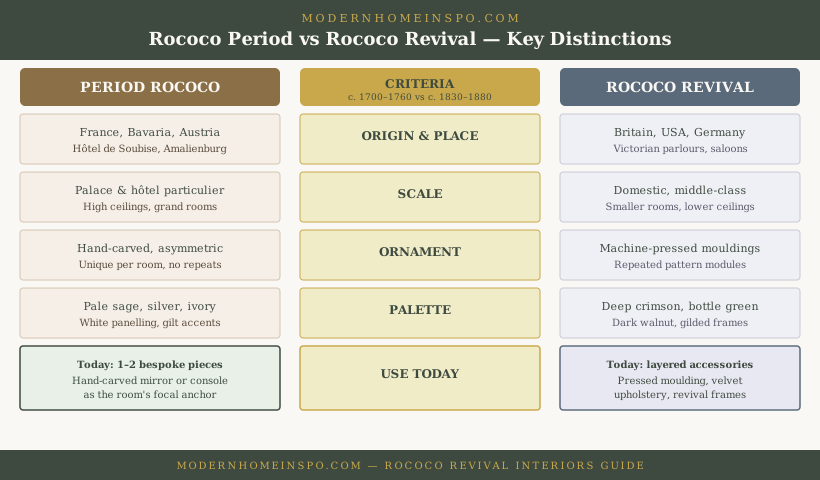
The Rococo Revival reproduced the visual vocabulary of 18th-century Rococo — shells, scrolls, cabriole legs, gilded ornament, curved forms — but with several significant differences in character:
Symmetry replaced asymmetry. The defining formal innovation of original Rococo was intentional asymmetry. Rococo Revival ornament is almost always symmetrical — the 19th century applied Rococo motifs within classical symmetrical frameworks rather than allowing the flowing asymmetry of the original. This is one of the clearest ways to distinguish the two styles: symmetrical shell-and-scroll ornament = Revival; asymmetrical = period.
Heavier proportions. Victorian aesthetics and Victorian rooms (with higher ceilings and more floor area than 18th-century French rooms) prompted a heavier, more elaborate version of Rococo ornament. Revival pieces are often more massive than their 18th-century equivalents.
Richer colors. Original Rococo used pale, light palettes. Rococo Revival interiors used richer, more saturated Victorian color schemes — deep reds, warm burgundies, dark greens — behind the gilded ornament.
Industrial production methods. Original Rococo furniture and ornament was hand-carved and hand-finished by specialist craftsmen. Rococo Revival used machine-assisted production: cast ornament, machine-cut joints, laminated and bent wood (Belter’s signature technique). This reduced cost and increased availability.
Larger scale. Revival Rococo pieces are often larger than period equivalents — chairs with taller backs, commodes with more elaborate superstructures, mirrors with more extensive carved frames.
Key Interior Examples
Buckingham Palace State Rooms (redecorated 1831–1840): The principal state rooms of Buckingham Palace were redecorated under the direction of Edward Blore for William IV and Victoria, using a Rococo Revival ornamental scheme. The Music Room, the White Drawing Room, and the Blue Drawing Room show the British version of the Revival — ornate plasterwork ceilings, gilded carved ornament, and rich textile upholstery.
The Palace of Fontainebleau (Napoleon III apartments): Napoleon III’s private apartments at Fontainebleau were redecorated in a Second Empire style that drew heavily on Rococo Revival, with elaborate gilded plasterwork and rich crimson and gold interiors.
American Gilded Age mansions: The Newport “cottages” and Fifth Avenue mansions of the American Gilded Age (1870s–1900s) incorporated Rococo Revival ornament in their principal rooms — gilded plasterwork ceilings, carved white marble overmantels with mirror above, and Rococo Revival furniture by American and French makers.
Opera houses and public buildings: Many mid-19th-century European opera houses and concert halls incorporated Rococo Revival ornament in their foyers and auditoriums — gilded tiers, elaborate plasterwork boxes, and ornate chandelier installations.
Rococo Revival Furniture
John Henry Belter (American, 1804–1863)
The most significant American Rococo Revival furniture maker. Belter developed a patented laminated rosewood bending technique that allowed elaborately pierced and carved ornament on curved chair backs and other surfaces that solid wood could not achieve. Belter’s chairs, sofas, and tables are characterized by:
- Heavily pierced and carved rosewood cresting rails and back panels
- Symmetrical shell, flower, and scroll ornament in high relief
- Cabriole legs on chairs and sofas
- Laminated construction (layers of rosewood veneer bent over forms)
Documented Belter pieces are collected and valued; many non-Belter Rococo Revival pieces are attributed to Belter for marketing purposes. True Belter pieces have the specific laminated construction visible at cut edges.
French and English Makers
European Rococo Revival furniture was produced by numerous makers throughout France and England. French pieces are sometimes difficult to distinguish from period Louis XV Revival — both using walnut or rosewood in similar forms. English Rococo Revival is heavier in proportion and often uses mahogany rather than walnut.
Identifying Rococo Revival
In architecture and interiors:
- Symmetrical Rococo-vocabulary ornament on ceilings and walls
- Richer, more saturated color schemes than original Rococo
- Heavier plasterwork with deeper relief
- Combination of Rococo ornament with classical architectural framing
In furniture:
- Symmetrical ornament (carved and pierced backs, aprons, and cresting)
- Machine-assisted or cast ornament (uniform repetition, no hand-variation)
- Laminated construction (visible at cut edges as layered veneer)
- Heavier proportions than equivalent 18th-century forms
- Rosewood or walnut rather than painted wood or lighter Louis XV woods
- Gold paint rather than gold leaf on gilded elements
Note
Rococo Revival pieces are frequently described as “Louis XV” in antiques markets — particularly when the seller is unfamiliar with the distinction or when the piece is visually similar to period Louis XV work. Before purchasing any piece sold as “period Louis XV,” examine the construction (joints, secondary wood, gilding technique) to establish its actual age.
Rococo Revival in Modern Homes
Rococo Revival furniture and objects are more accessible to most buyers than period 18th-century Rococo. They appear regularly at antiques fairs, estate sales, and regional auction houses at price points well below comparable period pieces.
Using Rococo Revival in contemporary rooms:
Rococo Revival pieces share the basic Rococo visual vocabulary — curved forms, shell and scroll ornament, gilded or carved wood — and work in contemporary rooms in the same way period Rococo would. A Rococo Revival carved mirror above a console table, or a Rococo Revival carved chair in a corner of a living room, reads as an ornate historical reference that adds character.
The heavier proportions of Revival pieces can actually be an advantage in larger contemporary rooms where the lighter scale of period Rococo furniture would read as fragile or undersized.
What to watch for: Rococo Revival pieces in dark mahogany or heavily figured rosewood may need repainting (in cream or pale sage) or partial regirding to integrate with a contemporary pale Rococo room scheme. The dark wood tone that was appropriate in a Victorian interior can work against the pale palette of a modern Rococo room.
Frequently Asked Questions
- What is the Rococo Revival?
- The Rococo Revival was a mid-19th-century design movement (approximately 1830–1880) that revived the ornamental vocabulary of 18th-century Rococo — shell and scroll ornament, curved forms, gilded details — in a heavier, more symmetrical, and more elaborate interpretation suited to Victorian tastes and production methods.
- How do I tell Rococo Revival from original Rococo?
- Original 18th-century Rococo uses asymmetrical ornament (the defining innovation of the style), hand-carved wood, gold leaf gilding, lighter proportions, and pale palettes. Rococo Revival typically uses symmetrical ornament (asymmetry was rarely replicated accurately), machine-assisted production, heavier proportions, richer colors, and gold paint rather than gold leaf.
- Is Rococo Revival furniture valuable?
- Rococo Revival furniture is a legitimate antiques category with its own collecting market. Major pieces by documented American manufacturers (John Henry Belter, Charles Baudouine) or European makers command significant prices. Standard Victorian-era Rococo Revival pieces in good condition are typically more affordable than period 18th-century Rococo but are genuine antiques in their own right.
- What buildings have Rococo Revival interiors?
- Rococo Revival interiors appear in Victorian-era palaces, country houses, opera houses, and public buildings throughout Europe and the United States. Notable examples include the Vienna State Opera (exterior and foyer), several rooms in Windsor Castle redecorated in the Victorian era, and many American mansions of the Gilded Age (Newport cottages, Fifth Avenue mansions).