Layering Rugs in Living Rooms: How to Do It Correctly
Quick Answer
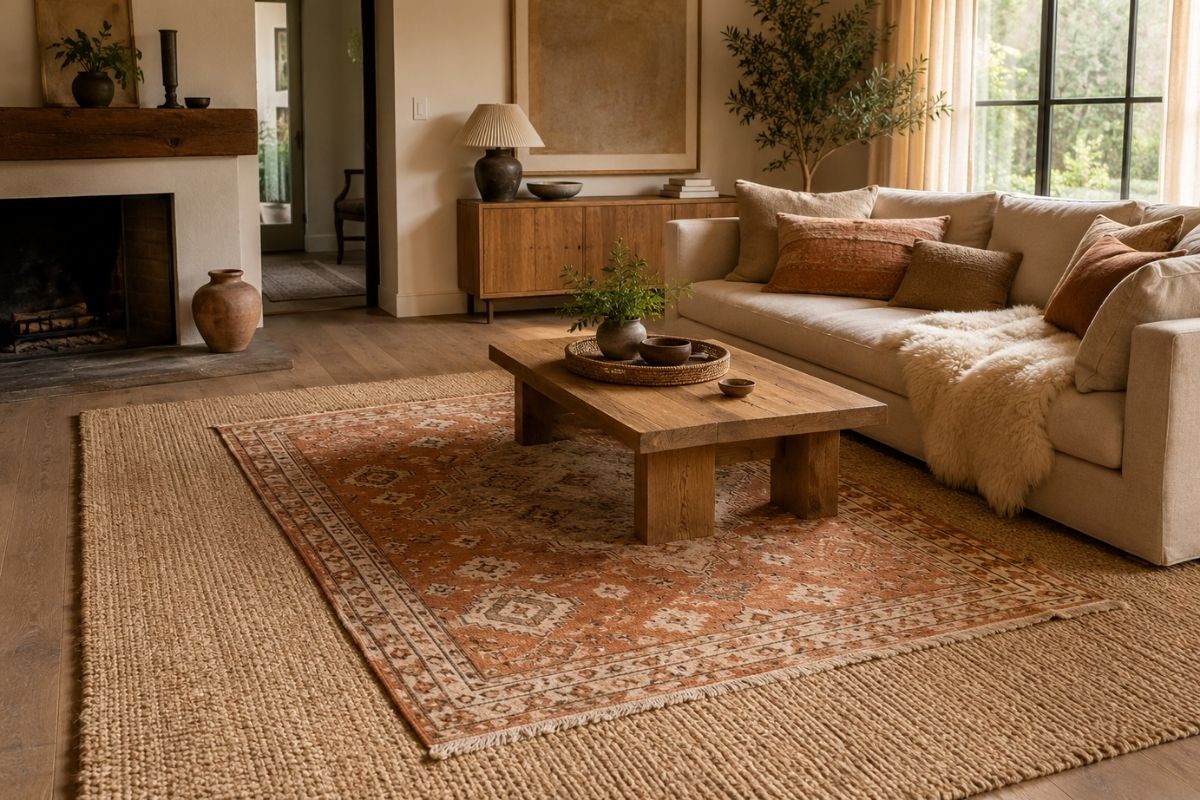
To layer rugs in a living room correctly: use a large neutral flat-weave or jute rug as the base (sized so sofa front legs rest on it), then layer a smaller textural or patterned rug on top, positioned under the coffee table. The top rug should be smaller, higher-pile or more textural, and should not replicate the base rug's pattern or color.
When Layering Adds Value
Rug layering is not a decorative technique for every room or every situation. Used correctly, it adds depth, textural richness, and a sense of layered comfort to a living room. Used incorrectly, it creates visual clutter and a sense that two rugs ended up in the same place without a plan.
Layering adds value when:
- You have a large neutral base rug that adequately sizes the seating group but lacks visual interest on its own
- You want to add pattern, color, or a contrasting texture without replacing the whole rug
- The room uses a neutral or minimal palette where the layered rug provides the primary visual texture
- You are working with an existing rug that is correctly sized but too plain on its own
Layering does not add value when:
- The base rug is already well-chosen and interesting on its own — adding a second rug creates competition rather than layering
- The room already has significant pattern in upholstery, wall treatments, or other textiles
- The base rug is the wrong size — layering a top rug on an undersized base rug does not fix the sizing problem; it compounds it
- The furniture arrangement does not allow the top rug to sit flat and stable without creating a tripping hazard
Base Rug: Sizing and Material
The base rug in a layered arrangement does the structural work — it defines the seating group and creates the foundation for the top rug.
Sizing the Base Rug
The base rug must be correctly sized for the seating group before any layering is considered. The standard rule:
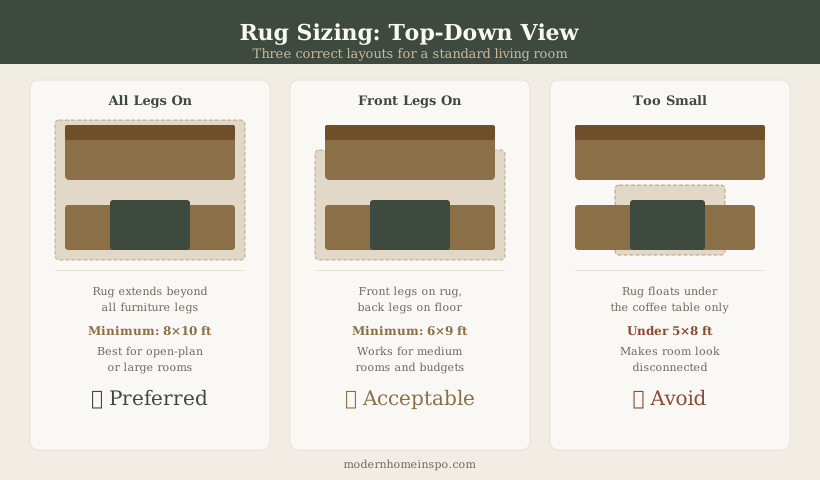
Front legs of all seating furniture (sofa and chairs) should rest on the base rug. The rug should extend at least 12–18 inches beyond the sofa front. A rug that sits only under the coffee table — with all sofa legs floating on bare floor — is the wrong size for the room and adding a top rug will not make it look right.
Standard sizes for common living rooms:
| Living room size | Base rug |
|---|---|
| Small (under 12x12 ft) | 6x9 ft minimum, 8x10 preferred |
| Medium (12x15 to 15x18 ft) | 8x10 minimum, 9x12 preferred |
| Large (over 18 ft in any direction) | 9x12 minimum; consider two rugs at different zones |
Use painter’s tape on the floor to mark the rug dimensions before buying. This is especially important for the base rug in a layered arrangement, because it is the larger, more expensive piece and the hardest to return.
Base Rug Materials
Jute and sisal: The most common and most functional base rug choice for layering. Jute and sisal are flat enough to lie stable under a second rug, add natural texture and warmth, and are neutral enough to work with almost any top rug choice. Their limitation: they are not soft underfoot and can be rough on bare skin.
Flat-weave wool or cotton (kilim, dhurrie): Flat-weave rugs lie very flat under a second rug — no pile height to cause instability. They can be patterned or solid. A solid-color flat-weave in a neutral tone is a strong base rug choice. A patterned kilim as a base requires more care in selecting a compatible top rug.
Low-pile wool: A low-pile wool rug in a solid neutral tone works as a base rug. The slight pile height is manageable for most top rugs but check stability if the top rug is large.
Avoid as base: High-pile rugs, shag rugs, and deeply textured rugs. These cannot support a second rug — the top rug will slide, and furniture placed on the combination will feel unstable.
Top Rug: Selection and Placement
The top rug is the character rug in the layered arrangement. It provides the pattern, the color accent, or the additional texture that the base rug does not.
Size
The top rug is typically 4x6 or 5x8 feet in a standard living room, positioned to sit under the coffee table with its edges within the perimeter of the base rug. It should not extend to the sofa legs (which should already be on the base rug) — the top rug floats in the center of the arrangement.
In a larger living room with a 9x12 base rug, the top rug can be larger — a 6x9 or similar, sized to fill the central zone between the sofa and the chairs.
Position
The top rug should be centered relative to the coffee table and the seating group, not centered on the room. If the sofa is off-center in the room, the top rug floats with the furniture, not with the architecture.
Avoid: Placing the top rug at an angle to the base rug. Unless the furniture itself is angled, diagonal placement of a top rug reads as accidental rather than deliberate.
Material Contrast
The top rug should contrast materially with the base rug — this is what makes layering legible.
- Jute base → wool or woven top rug
- Flat-weave wool base → higher-pile or loop-pile top rug
- Solid-color base → patterned top rug
- Plain low-pile base → textured or hand-knotted top rug
When the two rugs have the same material, texture, and visual density, they read as two rugs lying on the floor rather than as a composed layered arrangement.
Combinations That Work
Jute Base + Patterned Wool Top
The most reliable and most commonly successful combination. The jute adds warm natural texture; the patterned wool rug (Persian, Moroccan, geometric, abstract) adds pattern and color within the neutral palette.
Color principle: The pattern in the top rug should pull colors from elsewhere in the room — from the sofa upholstery, the cushions, or the wall. A top rug with pattern colors that do not relate to any other element in the room reads as isolated rather than integrated.
Natural Fiber Base + Sheepskin or Fur Top
A small sheepskin or faux fur rug on a larger natural fiber base is a texture-on-texture combination that works particularly well in cozy or warm-aesthetic living rooms. The sheepskin adds softness and luxurious tactile quality that the jute base cannot provide.
Sizing note: Sheepskins are irregular in shape — they are typically used as accent layering over a larger base, positioned in front of the coffee table or beside a reading chair, not as a structured centered top rug.
Solid Low-Pile Base + Patterned Flat-Weave Top
Two flat-weave rugs in contrasting patterns — a solid or neutral-texture base with a kilim or dhurrie on top — work when the flat-weave of both rugs is dense enough to grip each other without sliding. This is a more graphic, pattern-forward combination appropriate for rooms with more pattern elsewhere.
Neutral Base + Vintage or One-of-a-Kind Top Rug
A vintage or antique rug as the top layer — a worn Persian, an old Turkish rug, a faded flat-weave — against a new neutral base rug creates a combination with visual character that neither rug would have on its own. The new base rug provides structural size; the vintage rug provides personality and patina.
Combinations to Avoid
Two rugs of similar size. If the top rug is close in size to the base rug, the result reads as two competing rugs on the floor, not as a deliberate layered arrangement. The size contrast should be significant — the top rug should be noticeably smaller (typically by at least 2 feet in each dimension).
Two rugs with competing patterns. Layering a geometric pattern over an organic pattern, or a floral over a striped pattern, in incompatible color palettes creates visual chaos. If both rugs have strong patterns, they need to share enough color that the eye can move between them comfortably.
A high-pile shag base rug with any top rug. High-pile rugs cannot support a second rug. The top rug will slide, the furniture will be unstable, and the combination will look unintentional.
A top rug that extends to the sofa legs. The sofa legs should rest on the base rug, not on the top rug. If the top rug is large enough to reach the sofa legs, it is too large for its role — either use it as the base rug or size down.
Color matching the two rugs too closely. If the base and top rug are both in the same neutral tone (both cream, both tan, both beige), the layering becomes invisible — the top rug disappears into the base. The layering should be visible; some tonal contrast between the two rugs is needed.
Keeping Layered Rugs in Place
Layered rugs move unless secured correctly. The two-layer rug problem: the top rug slides on the base rug, and the base rug may also shift on the floor.
Base Rug to Floor
Use a standard rug pad between the base rug and the floor — a cushioned non-slip pad cut to the base rug dimensions. This prevents the base rug from sliding and provides cushioning.
Top Rug to Base Rug
A standard rug pad will not grip rug-to-rug — it is designed for rug-to-floor. Use a rug-on-rug gripper pad: a thin, open-mesh material specifically designed to grip two fabric surfaces together.
Alternatively: Double-sided rug tape applied at the top rug corners and edges prevents sliding without requiring a separate pad. This works particularly well for small top rugs (4x6 and smaller) where a full pad layer would be excessive.
The furniture method: In many arrangements, the coffee table legs sit on the top rug, which effectively pins it in place. If the coffee table is heavy and centered on the top rug, sliding is typically not a problem even without additional grip layers.
Design Tip
Roll out both rugs flat and leave them for 24 hours before placing furniture. New rugs, particularly jute and natural fiber rugs, often have curl or roll memory from being stored. Furniture placed on a rug that is still trying to curl will eventually shift.
Common Mistakes
Getting the base rug size wrong first. The most common and most damaging mistake. A layered rug arrangement needs the base rug to be correctly sized for the room — a small base rug with a small top rug is still a small rug problem, not a layered arrangement.
Centering the top rug on the room rather than on the furniture. The top rug follows the furniture, not the room perimeter. A top rug centered on the room when the sofa is positioned off-center looks misaligned.
Using two patterned rugs that fight each other. If in doubt, make one rug neutral (plain, textural, or tonal) and let the other carry the pattern.
Ignoring pile height compatibility. If the base rug has significant pile height and the top rug has significant pile height, the furniture on the combined height may be unstable. Test before committing — sit on the sofa with both rugs in place and check for wobble.
Not securing the top rug. A sliding top rug is both a safety hazard and a visual problem. Secure it before the room is used, not after it has been sliding for weeks.
Buying two rugs at the same time without seeing them together. Rug colors and textures look different in store lighting and in different digital photographs. If possible, bring a sample of the base rug when shopping for the top rug, or use a retailer that allows returns so you can test both in the room before committing.
Frequently Asked Questions
- What size rugs do you need to layer in a living room?
- The base rug should be large enough for all seating furniture front legs to rest on it — typically 8x10 or 9x12 for a standard living room. The top rug is typically 4x6 or 5x8, positioned under the coffee table and overlapping the base rug. If the base rug is the right size, the top rug placement determines whether the layering reads as deliberate or as two competing rugs on the floor.
- What type of rug is best as a base layer?
- Flat-weave rugs (kilim, dhurrie), jute or sisal, and low-pile wool rugs work best as base layers. They lie flat under a second rug, don't bunch or shift as much, and don't add so much pile height that the room furniture becomes unstable. High-pile or shag rugs as a base layer cause the top rug to slide and can make furniture feel unsteady.
- Can you layer two patterned rugs?
- It is possible but difficult. Layering two patterned rugs requires one pattern to be significantly smaller in scale than the other, and the color palettes must be compatible. More reliably: use one solid or neutral texture as the base and one patterned rug on top, which creates contrast without visual competition.
- Do layered rugs need a rug pad?
- Yes — both layers. The base rug needs a rug pad between it and the floor (non-slip and cushioning). The top rug needs a rug pad between it and the base rug — a thin rug-on-rug grip pad specifically designed for this purpose. Without this second pad, the top rug will slide on the base rug, particularly in high-traffic areas.
- What is the most common layered rug combination?
- The most common and most reliable combination: a large natural fiber base rug (jute, sisal, or seagrass) with a smaller patterned or textured wool rug on top. The jute base adds texture and warmth; the top rug adds pattern, color, or additional texture. This combination works in nearly any living room palette.