Rococo Living Room: Design Ideas and Practical Applications
Quick Answer
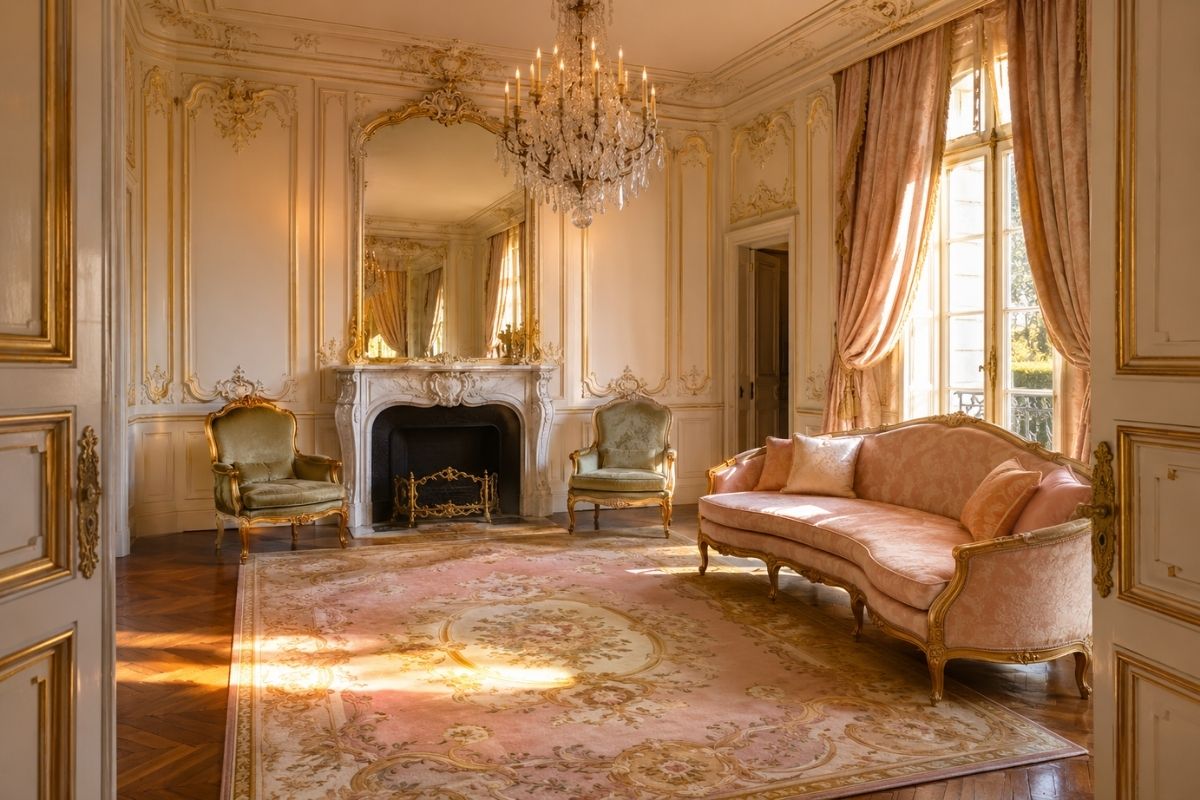
A Rococo living room works around one or two curved, ornamented statement pieces — a curved sofa, ornate fireplace mirror, or bergère accent chair — set against a pale neutral wall in warm cream, off-white, or sage. The room stays calm and neutral; the Rococo character comes from specific chosen elements, not from ornament across every surface.
Rococo Living Room Principles
The historical Rococo salon was designed for conversation and refined social pleasure at human scale — not for grandeur. For Rococo’s full historical context and palette overview, see Rococo Interior Design: A Complete Guide. For the principles of modern Rococo translation (what works, what to avoid), see Modern Rococo Interior Design.
This article focuses on the living room specifically: sofa selection, fireplace and mirror composition, furniture layout, how to handle rooms without fireplaces, and the textile and rug decisions that are specific to a living room rather than the bedroom.
The practical principles for a Rococo living room:
One or two statement pieces carry the character. A Rococo living room does not require every piece to be ornate. A curved sofa in a neutral room, or an ornate mirror above a fireplace with plain walls, is sufficient to establish the design direction. More ornate elements beyond two tend to make the room feel theatrical.
The backdrop must be calm. Pale, neutral walls amplify the impact of ornate pieces. A plain cream or sage wall makes a gilded mirror read as a deliberate statement; a heavily patterned wall makes it disappear into competition.
Curves accumulate. Each choice toward a curved form — rounded sofa arms, oval coffee table, arched mirror, curved lamp base — shifts the room’s character incrementally. Individual curved choices may seem minor; collectively they establish a Rococo atmosphere without any single dramatic element.
Gilded accents, not gilded everything. Muted brass or burnished gold in hardware, lamp bases, and mirror frames introduces the Rococo gilded warmth at the appropriate contemporary scale. The gilding is an accent, not a system.
Walls and Palette
The wall color sets the tone for every other decision in the room.
Off-white and warm cream are the most versatile choices. They reference Rococo plasterwork, reflect light generously, and allow the ornate pieces to read clearly. Under 2700K warm lighting, warm cream walls create the closest contemporary equivalent to a Rococo candlelit interior.
Pale sage green — referencing the painted boiserie panels of French Rococo interiors — creates more color presence than cream while remaining firmly in the neutral-adjacent zone. It works particularly well in rooms with good natural light and pairs beautifully with gilded mirrors and warm wood.
Warm greige is the most practical neutral foundation if the Rococo references are restrained (just a curved sofa and a simple ornate mirror, for example). It reads as a well-chosen contemporary neutral with Rococo accents rather than as a Rococo room with contemporary furniture.
What to avoid: Cool gray walls (fight the warm Rococo palette and make gilding look brassy), dark wall colors (too Baroque in character), and heavily patterned wallpaper (competes with the ornate pieces).
Ceiling: A white or off-white ceiling is appropriate for most Rococo living rooms. An ornate ceiling rose (plasterwork medallion) around a chandelier is a direct Rococo reference and does not require the full boiserie ceiling treatment to read effectively.
The Sofa
The sofa is the dominant piece in most living rooms and the strongest single signal of design direction.
The ideal Rococo living room sofa:
A sofa with curved, padded arms and a slightly curved or tufted back. The silhouette should have no sharp corners — even if the overall form is relatively contemporary. Look for:
- Rounded arm profile (not square)
- A continuous curved seat back (not a flat back with bolster cushions at the ends)
- Upholstered in natural linen, cotton-linen, velvet, or boucle in off-white, warm cream, or pale warm neutral
- Cabriole legs or tapered legs (not chunky square legs or hairpin legs)
- A proportioned scale — not so deep or oversized that it becomes the whole room
Color: The sofa color should be one or two steps different from the wall color. A warm cream sofa against warm cream walls creates one undifferentiated mass; a warm cream sofa against pale sage walls, or a natural linen sofa against warm cream walls, creates the tonal contrast that makes the room legible.
One sofa, one style: In a Rococo living room, the sofa establishes the direction. Pairing an ornate curved sofa with a completely contrasting contemporary armchair creates a visual contradiction. Either all major seating is in the same stylistic direction, or the secondary seating is so neutral (a simple linen chair) that it does not compete with the sofa.
Fireplace and Mirror
If the living room has a fireplace, the fireplace wall is the natural focal point and the best location for Rococo character.
The classic composition: Fireplace surround in pale marble or painted wood → large ornate gilded mirror above the mantel, extending toward the ceiling → simple mantel styling (candelabra, one central ceramic piece, restrained organic element) → optional flanking sconces.
This composition is the most complete living room Rococo reference available without structural renovation. The mirror above the fireplace is simultaneously a light-multiplying practical object, a decorative statement, and an architectural element that anchors the room’s vertical hierarchy.
For full detail on this composition, see Rococo fireplace ideas.
If there is no fireplace: A console table against a wall, with a large ornate mirror above it, creates the same compositional effect. The console provides a horizontal surface for styling; the mirror provides the vertical statement. Flanking sconces or table lamps on the console complete the arrangement.
Mirror sizing: The mirror above the fireplace should fill the chimney breast generously — approximately two-thirds of the chimney breast width, and tall enough to approach the ceiling. See Rococo mirror ideas for sizing specifics.
Supporting Furniture
Coffee Table
A round or oval coffee table is the most Rococo-aligned choice. Round tables reference the Rococo guéridon form and soften the geometry of the seating group. A round table in warm wood (walnut, light oak) or a marble-top round table with warm metal legs both work well.
Avoid: Large rectangular glass coffee tables. They read as contemporary or minimalist and fight the Rococo character of the sofa and mirror. A glass top is acceptable on an ornate or curved base, but a plain glass-top-on-metal-frame table is stylistically incongruous.
Accent Chair
A bergère-style chair — wide upholstered seat, closed upholstered sides, curved legs — introduces Rococo seat furniture character at a scale that does not dominate the room. Position it at an angle to the sofa (not directly opposite, which is too formal for a living room) with a small side table beside it.
If a bergère is too formal for the room, a tub chair with a curved back and tapered legs in a compatible upholstery fabric is a less specific but still Rococo-adjacent alternative.
Side Tables
Small round or oval side tables with tapered or curved legs beside the sofa and accent chair complete the seating arrangement. In warm wood (walnut, beech) or with a marble or ceramic top.
Bookshelf or Display Cabinet
If the room has built-in shelving or a freestanding bookshelf, paint it in a color that complements the walls — off-white or pale sage — rather than leaving it in a contrasting dark wood. Display books and objects in the Rococo palette: pale ceramics, gilded or brass objects, a few plants.
Textiles and Rugs
Cushions and Throws
Layered cushions on the sofa add textile richness within the Rococo palette without requiring period-accurate fabrics.
Effective cushion combinations for a Rococo living room:
- Three to five cushions on the sofa: two in the sofa’s upholstery fabric, one in a complementary texture (velvet in pale gold or soft blush), one in a patterned fabric with the room’s accent colors
- A throw in a lightweight linen or cashmere-blend in a complementary tone (not the same tone as the sofa)
What to avoid: Many mismatched cushions in different patterns and scales — this reads as eclectic or casual rather than Rococo. One or two accent patterns at most, in a coherent palette.
Rug
The living room rug anchors the seating group. In a Rococo living room:
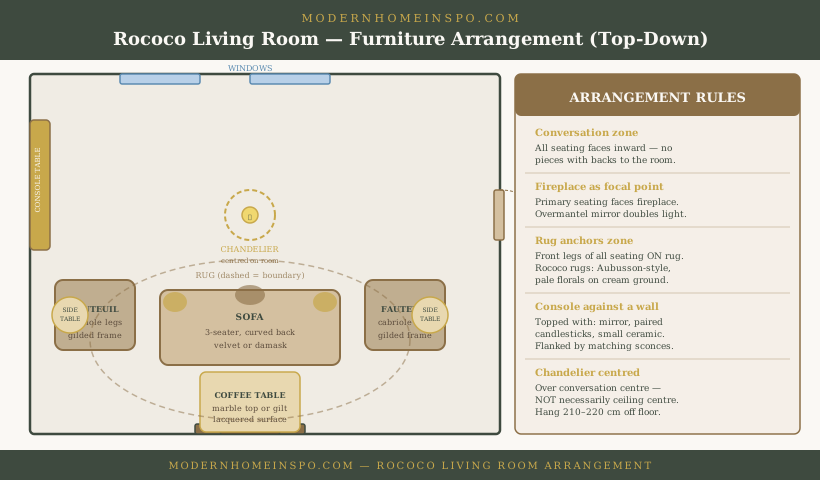
Size: The front legs of the sofa and all chairs should rest on the rug. An undersized rug makes the room feel disconnected regardless of how well other elements are chosen.
Material: A natural fiber (jute, sisal) rug in a neutral tone is the most versatile base and references the natural material richness of historical Rococo floors. A low-pile wool rug in a muted tone is also appropriate.
Pattern: If patterned, use a subtle geometric or organic pattern in two values of the same neutral tone — not a bold high-contrast pattern. The rug should not compete with the ornate mirror or the sofa for visual prominence.
Color: One or two tones different from the wall and sofa — enough contrast to define the seating zone, not so much contrast that the rug dominates.
Lighting
Lighting is where the Rococo living room comes alive or fails. The historical Rococo interior was designed for candlelight — approximately 1800–2200K in color temperature. Contemporary lighting should approximate this warmth.
All bulbs: 2700K warm white throughout the room, without exception. This single specification — applied to the ceiling fixture, all lamps, and any accent sources — transforms a Rococo-palette room from attractive in daylight to genuinely warm and atmospheric in the evening.
Chandelier: The most appropriate ceiling fixture for a Rococo living room. A chandelier with branching arms and small shades, in a muted brass or antique gold finish, fits the Rococo decorative vocabulary and distributes light at multiple points rather than from a single source.
Floor lamps: One floor lamp beside the sofa (providing task light and establishing a warm light zone) and a second at a seating focal point or in a corner. Look for floor lamps with decorative bases — ceramic, metallic, or textured — rather than plain pole forms.
Table lamps: Table lamps on side tables or on a console add eye-level warmth. Match base style to the room — ceramic bases in cream or pale sage, or muted brass metallic bases.
The dimmer: A dimmer on the ceiling fixture allows the room to shift from bright ambient light (for daytime use) to subdued ambient + lamp light (for evening). Without a dimmer, the ceiling fixture at full brightness cancels out the warmth created by the lamps.
Furniture Layout
Where you place the sofa relative to the fireplace, window, and door determines whether the room functions as a room — regardless of style.
With a fireplace: The sofa faces the fireplace at a distance of 8–12 feet (measured from the front edge of the sofa to the hearth). At under 8 feet the room feels cramped and the fireplace dominates; at over 12 feet the conversational relationship between the sofa and the fireplace focal point breaks down. Two accent chairs at 45-degree angles to the fireplace complete a symmetrical seating group. The ornate mirror above the fireplace is visible from every seat in this arrangement — it functions as both focal point and light multiplier.
Without a fireplace: Choose one wall as the Rococo focal wall — typically the wall opposite the main entry point, or the wall with the best natural light angle. Place the console and ornate mirror on this wall. Position the sofa so that it faces this wall from approximately 7–10 feet. The mirror-above-console becomes the room’s focal point in place of a fireplace, and the same viewing distance applies.
The sofa relative to windows: Avoid placing the sofa with its back directly against a window — this creates silhouette lighting on anyone sitting in the sofa and makes the room uncomfortable for conversation. Position the sofa so that windows are to the side or partially in front, allowing natural light to fall on faces rather than on the back of heads.
Traffic flow: Leave a minimum of 36 inches (90cm) of clear walking path around the seating group on at least two sides. In a Rococo living room, the visual richness of the ornate elements should feel deliberate, not cramped. Adequate walking clearance makes ornate pieces feel placed rather than crammed.
Living Room Without a Fireplace
The fireplace wall composition (surround + mantel + ornate mirror) is the classic Rococo living room focal point — but it is not the only valid one. A living room without a fireplace can achieve full Rococo character through a console-and-mirror composition.
The no-fireplace focal wall formula:
- A slim console table (14–18 inches deep is sufficient) against the focal wall
- An ornate mirror above it, sized to fill at least half the wall height from console to ceiling
- Two objects maximum on the console surface — a lamp and a small ceramic, or a ceramic vase and a candlestick
- Flanking wall sconces at the upper third of the mirror (optional, but strengthens the vertical composition)
Scale note: Without the architectural context of a fireplace, the mirror must do more compositional work. Size up — a mirror that might be sufficient above a fireplace should be larger on a plain wall. The minimum effective size for a no-fireplace ornate mirror in a standard living room is 30 inches wide × 48 inches tall.
The ceiling rose alternative: In rooms with standard plasterwork, a ceiling rose (ornamental plasterwork medallion) around the light fitting is a direct Rococo reference that costs relatively little (£60–£200 / $75–$250 installed) and does not depend on a fireplace. A chandelier hung from a ceiling rose creates a strong vertical focal point that a flat ceiling cannot achieve. This is particularly effective in rooms without a fireplace where the ceiling fixture is the room’s primary architectural statement.
Feature wall approach: In a room with no obvious focal point architecture, paint one wall in a deeper tone of the room’s palette — warm sage against cream, or a richer greige against lighter greige. Place the console and mirror on this wall. The tonal contrast makes the wall read as architecturally distinct without structural work.
What Not to Do
Overloading with ornate pieces. Two Rococo-referenced pieces in a living room is enough for most rooms. A curved sofa + ornate mirror reads as Rococo. A curved sofa + ornate mirror + bergère chair + gilded console + chandelier + multiple ornate lamp bases reads as staging.
Cherubs, figurines, and decorative sculptures. Figurative ornament in isolation reads as decoration overload in a contemporary room. A cherub-based lamp, angel figurines on the mantel, and sculpted figures on the console, all in the same room, removes the room from designed and into themed.
Bright gold rather than burnished gold. High-gloss, bright gold reads as inexpensive in most domestic contexts. Burnished, antiqued, or slightly matte gold reads as sophisticated. Apply this standard to mirror frames, hardware, and lamp bases.
Ignoring the floor. A pale neutral sofa, ornate mirror, and sage walls on a dark, strongly-grained hardwood floor can work — warm wood floors and Rococo are compatible. But a heavily stained, dark, or cold-gray floor fights the Rococo palette. If the floor is incompatible, a large rug covering most of the floor area resolves the issue more practically than refinishing the floor.
Cool-colored upholstery. Blue-gray, cool charcoal, or cool white upholstery on the sofa fights the warm Rococo palette. All upholstery should have warm undertones — cream, warm linen, warm beige, velvet in warm muted tones (sage, blush, gold).
Note
The measure of a successful Rococo living room is that a visitor notices the mirror, or the sofa, or the sense of warmth — not that they notice “it’s Rococo.” The style is working correctly when it produces an atmosphere of elegance and comfort rather than a recognizable historical costume.
Frequently Asked Questions
- What does a Rococo living room look like?
- A Rococo living room uses curved furniture silhouettes, an ornate gilded mirror above the fireplace, pale wall color (off-white, warm cream, or sage green), layered soft furnishings in cream and warm tones, and gilded or muted brass accents. The room is calm and neutral overall, with Rococo character concentrated in one or two statement pieces.
- What sofa works best in a Rococo living room?
- A sofa with curved, rounded arms and a curved or slightly bowed back — upholstered in natural linen, velvet, or boucle in off-white, cream, or warm neutral — fits the Rococo aesthetic. Cabriole or tapered legs (rather than block legs) complete the reference. One curved sofa is the most effective single piece for establishing Rococo character in a living room.
- What color should I paint a Rococo living room?
- Pale warm neutrals: off-white, warm cream, or pale sage green. These reference the Rococo boiserie palette while remaining livable. Pale dusty blush is historically appropriate but harder to execute without looking themed. Warm greige works well if the Rococo references are subtle.
- Do I need a fireplace for a Rococo living room?
- No. A fireplace with ornate overmantel mirror is the classic Rococo living room focal point, but an ornate console table with large ornate mirror above it creates the same compositional effect without a fireplace. The important element is the large ornate mirror creating a vertical focal point against a pale wall.