Paint Finishes Guide: Matt, Eggshell, Satin, and Gloss — Which Sheen for Every Room and Surface
Quick Answer
For most interior walls: flat or matt finish — the richest colour depth, hides surface imperfections, but not washable. For woodwork (skirting, doors, architraves): eggshell — low sheen, durable, wipeable. For kitchens and bathrooms: satin or silk — washable, moisture-resistant. For front doors and external woodwork: full gloss. Never use full gloss on interior walls — it shows every surface imperfection and the high reflectance makes colour assessment unreliable. Never use flat/matt on woodwork — it damages and marks immediately.
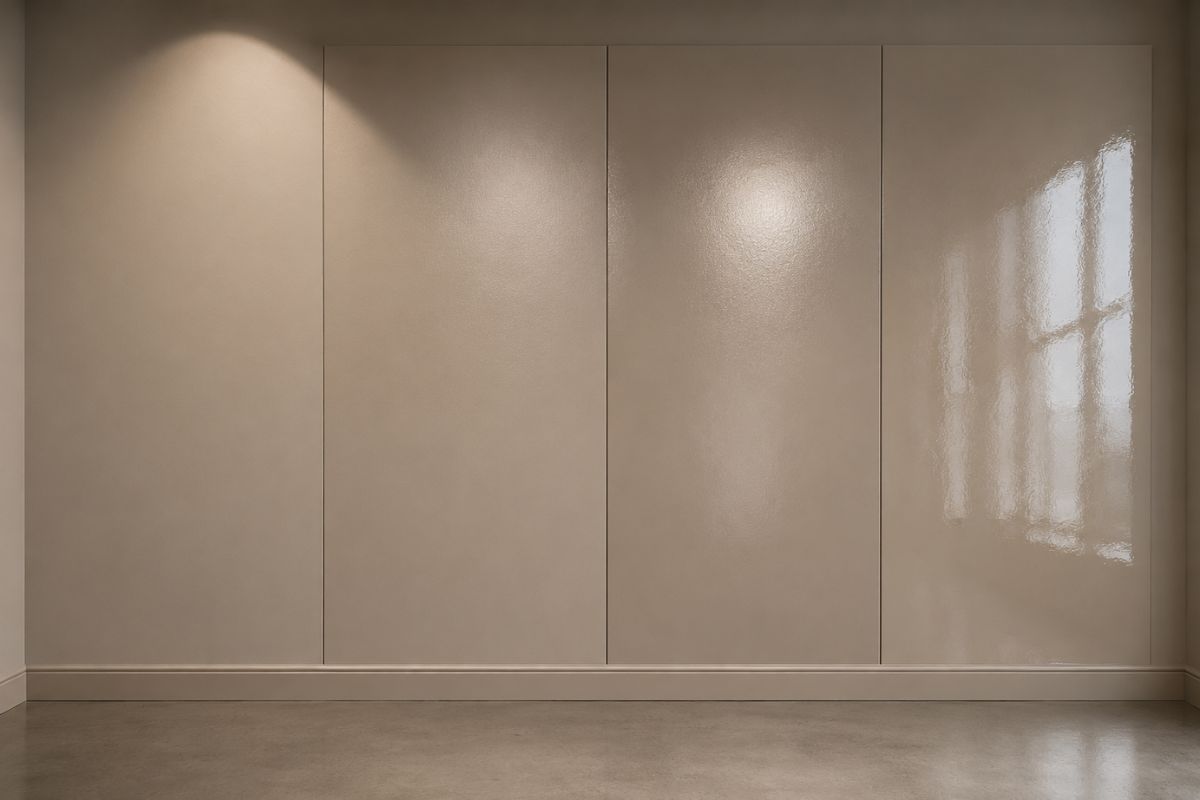
Paint finish selection is the decision most people make last — often by defaulting to whatever the tin in the shop says is “for walls” — and it affects durability, colour appearance, and cleaning behaviour as much as the colour choice itself.
The same paint colour in a dead flat finish vs a satin finish reads differently on the wall: the satin is fractionally brighter, slightly more reflective, and the colour has a different depth quality. In a large room, this difference is visible. In a small room with strong light, it is significant.
The Sheen Spectrum
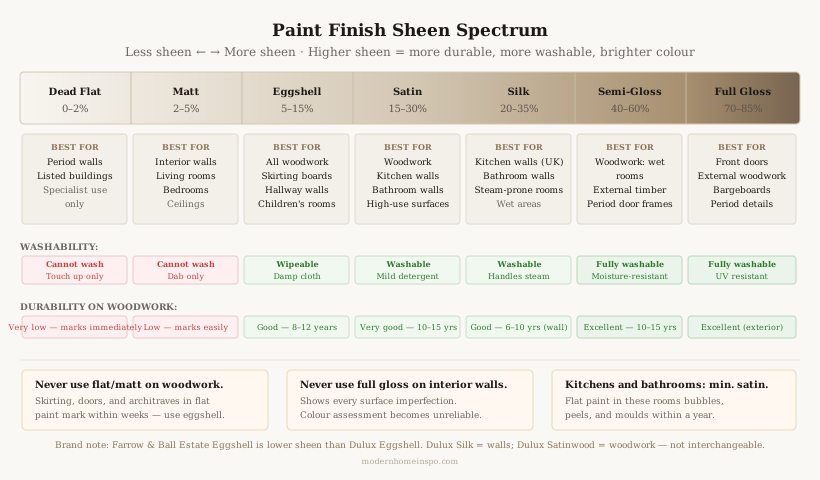
Sheen is measured as a gloss percentage — how much light the surface reflects. Every finish has a specific range.
| Finish Name | Gloss % | Light Reflection | Primary Use |
|---|---|---|---|
| Dead flat | 0–2% | Virtually none | Period walls, listed buildings, specialist use |
| Flat / Matt | 2–5% | Very low | Most interior walls |
| Eggshell | 5–15% | Low | Woodwork, hallway walls, high-contact walls |
| Satin | 15–30% | Medium-low | Woodwork, kitchen and bathroom walls |
| Silk | 20–35% | Medium | Kitchen and bathroom walls (UK term) |
| Semi-gloss | 40–60% | Medium-high | Woodwork in high-humidity rooms, external timber |
| Full gloss | 70–85% | High | Front doors, external woodwork, period details |
How sheen affects colour appearance:
Higher sheen finishes reflect more light — this makes the colour appear fractionally lighter and more luminous than the same colour in flat. A deep sage green in flat reads as rich and matte-saturated; the same green in satin reads as slightly brighter and more surface-quality.
For feature or accent walls: flat/matt provides the deepest, most saturated colour quality — best when colour depth is the intent. Eggshell or satin on an accent wall adds a subtle surface quality distinction from surrounding flat walls — sometimes used deliberately as a secondary signal that this wall is different.
Durability and Washability
The durability hierarchy follows the sheen level. Higher sheen = more durable = more washable.
| Finish | Washability | Durability | Lifespan Before Repainting |
|---|---|---|---|
| Dead flat | Cannot be washed | Very low | 4–6 years (handled carefully) |
| Flat / Matt | Cannot be washed — dab only | Low | 5–8 years on walls |
| Eggshell | Wipeable with damp cloth | Good | 8–12 years on woodwork |
| Satin | Washable with mild detergent | Very good | 10–15 years on woodwork |
| Silk | Washable, handles steam | Good | 6–10 years on walls |
| Semi-gloss | Washable, handles moisture | Excellent | 10–15 years |
| Full gloss | Washable, moisture and UV resistant | Excellent | 8–12 years (exterior) |
The flat paint maintenance reality: Matt wall paint cannot be wiped when marked. Attempting to clean a matt-painted wall with a damp cloth creates a sheen patch — a locally burnished area where the surface has been abraded, which reads as a different colour under light. Marks on flat painted walls must be touched up with the same paint, which only works when the original paint is available and the wall hasn’t shifted in tone.
In rooms with children, pets, or high traffic — hallways, kitchens, children’s rooms — this maintenance model is impractical. Use eggshell or satin on walls in these rooms.
Room-by-Room Finish Guide
Living room: Flat or matt on walls. Low-traffic wall surfaces that receive little direct contact. Eggshell on skirting, architraves, and window frames. The living room is the best candidate for dead flat if using premium paint brands (Farrow & Ball Estate Emulsion, Little Greene Intelligent Matt) where the depth of colour in dead flat is the product’s primary quality.
Bedroom: Flat or matt on walls. Even lower traffic than living rooms — flat paint lasts well and provides the best colour depth for the darker, richer tones often used in bedrooms. Eggshell on all woodwork.
Hallway: Eggshell on walls (not flat). Hallways are the highest-contact surfaces in a home — coats, bags, hands brush against the walls constantly. Flat paint in a hallway will show dirty patches within months. Eggshell on walls is the standard professional specification for hallways.
Kitchen: Satin or silk on walls. Kitchens produce steam, splatter, and food grease — surfaces need to be washable. Full silk or satin (not flat, not eggshell) on kitchen walls is the standard. On kitchen cabinetry: eggshell or satin (not flat — cabinet doors are handled constantly).
Bathroom: Satin or silk on walls — specifically formulated for wet environments, or with added mould inhibitor. Bathrooms produce sustained humidity from showers and baths. Flat paint in a bathroom will bubble, peel, and mould within a year. Moisture-resistant satin or silk is the minimum. Semi-gloss works in shower rooms and wet rooms.
Children’s rooms: Eggshell on walls — the durability advantage outweighs the slight aesthetic difference from flat. Children’s rooms require cleaning with some regularity; flat paint makes this impossible. Many brands now produce specific “kitchen and bathroom” or “tough” ranges that are essentially satin-eggshell hybrids with added durability.
Home office: Flat or matt on walls if not high-traffic. Eggshell if the office doubles as a spare room or gets regular furniture movement. The finish decision in a home office is primarily about how the colour reads on camera during video calls — flat/matt provides a calmer, more uniform surface that reads better on screen than satin.
Surface-by-Surface Guide
Walls (interior): Flat/matt as default, eggshell in high-traffic rooms. Never full gloss on interior walls — it shows every brush mark, dust particle, and surface imperfection, and the strong reflectance makes the colour impossible to assess accurately.
Ceilings: Flat or dead flat. Ceilings are not touched and not cleaned — durability is irrelevant. The zero-sheen of flat paint prevents the ceiling from reflecting light sources back into the room, which would create glare and uneven illumination. A ceiling in eggshell or satin creates a distracting highlight effect from downlights. Specialist ceiling paints are formulated for flat application without drips.
Skirting boards, architraves, door frames: Eggshell (interior), semi-gloss or gloss (exterior-facing or period features). These surfaces are touched, knocked, and cleaned regularly. The paint on skirting boards must survive mopping, vacuuming impacts, and cleaning. Flat paint on skirting boards is the most common DIY finish mistake — it marks within weeks and cannot be cleaned.
Internal doors: Eggshell on panels and face; satin or semi-gloss on edges and top edge (highest contact). Doors are touched on every passage — the handle area and door edge take the most contact. Some painters use eggshell on the flat panels and semi-gloss on the edges for a practical mixed-finish approach.
External woodwork (window frames, external doors, bargeboards): Full gloss or semi-gloss. UV and moisture resistance are the priorities. Modern water-based gloss has largely replaced traditional oil-based gloss — it applies more easily, dries faster, and resists yellowing. Traditional oil-based gloss still provides better durability on front doors in very exposed positions.
Radiators: Radiator paint formulations are specifically designed to resist the heat cycle of heating and cooling. A standard eggshell or satin applied to radiators will yellow and flake within one heating season. Use a dedicated radiator paint or radiator enamel — available in white and off-white from most major brands.
Brand Name Translation Table
The same sheen level has different names across brands. This creates confusion when specifying across different manufacturers or when a paint reference uses one brand’s terminology.
| Sheen Level | Farrow & Ball | Dulux | Little Greene | Sherwin-Williams | Benjamin Moore |
|---|---|---|---|---|---|
| Dead flat | Estate Emulsion | — | Intelligent Matt | — | — |
| Flat/Matt | Modern Emulsion | Matt Emulsion | Matt | Flat Paint | Flat |
| Eggshell | Estate Eggshell | Eggshell | Intelligent Eggshell | Satin (US) | Eggshell |
| Satin | — | Satinwood (woodwork) / Walls: Silk | Intelligent Satinwood | Satin | Satin |
| Silk | — | Silk Emulsion (walls) | — | — | — |
| Semi-gloss | — | Semi-gloss | — | Semi-Gloss | Semi-Gloss |
| Full gloss | Full Gloss | Gloss | Full Gloss | Gloss | High-Gloss |
Critical distinction: Farrow & Ball eggshell vs Dulux eggshell
Farrow & Ball Estate Eggshell has a significantly lower sheen than Dulux Eggshell — more comparable to a Dulux silk on walls. F&B finishes sit at the lower end of their stated sheen range. When specifying F&B paints, the Estate Eggshell is frequently used on walls in kitchens and bathrooms where other brands would specify silk. Both are correct within their respective brand’s sheen calibration.
Dulux “Silk” vs “Satinwood”:
- Dulux Silk Emulsion: wall paint for kitchens and bathrooms — washable, mid-sheen, approximately 25% gloss
- Dulux Satinwood: woodwork paint — harder, more durable, approximately 30% gloss. Not interchangeable — Satinwood on walls leaves streak marks visible from an angle; Silk Emulsion on woodwork lacks durability
Application Considerations
Applying over a different finish:
Moving from a lower to a higher sheen (flat to eggshell) requires sanding the existing surface with 220-grit paper to provide tooth — the higher-sheen paint needs adhesion. Without sanding, the new finish can streak or fail to bond evenly.
Moving from a higher to a lower sheen (gloss to matt) requires more preparation: sand with 180-grit, clean thoroughly, and apply a bonding primer before the flat paint. The old glossy surface prevents adhesion and the new flat paint may peel.
Roller vs brush:
- Flat/matt walls: short-nap roller (4–6mm) for large areas; brush for cutting in at edges. The short nap avoids excessive stipple texture.
- Eggshell woodwork: brush only — rollers leave a textured finish that is visible in the low sheen of the eggshell. Use a good quality 50mm or 75mm brush and work with the grain.
- Full gloss: brush only, using a fine-bristle gloss brush. Work quickly — gloss begins to tack within minutes and re-brushing over partially dried paint creates drag marks.
Re-coating times:
Most water-based paints re-coat after 2–4 hours. Oil-based paints (still used for traditional gloss) require 16–24 hours between coats. Two thin coats always outperform one thick coat — particularly for flat and eggshell finishes where an overlapping thick coat creates a sheen variation visible under raking light.
Two-coat vs three-coat:
Changing from a dark to a light colour, or from one undertone family to another (dark warm green to pale warm cream), typically requires three coats for full coverage. Deep colours (navies, dark charcoals, terracotta) may require a mid-tone base coat followed by two top coats for even, streak-free coverage. Applying two coats over a strongly different colour leaves patchiness — the original colour bleeds through at lower-coverage points.
Frequently Asked Questions
- What is the difference between matt and eggshell paint?
- Matt has no sheen — it absorbs light evenly, hides surface imperfections, and provides the deepest colour appearance. It is not washable — marks must be touched up with fresh paint. Eggshell has a low sheen (approximately 5–10% gloss level) — it reflects a small amount of light, is significantly more durable than matt, and can be wiped clean. Matt is for walls; eggshell is for woodwork and any surface that takes regular contact.
- Can I use eggshell paint on walls?
- Yes — particularly in hallways, children's rooms, kitchens, and bathrooms where walls take regular contact. Eggshell on walls is slightly more reflective than matt, which means surface imperfections show more and the colour reads fractionally lighter and brighter. In rooms where durability matters more than perfect colour depth, eggshell on walls is the correct choice.
- What is the difference between satin and silk paint?
- These terms are used differently across brands and regions, which causes confusion. In UK usage: satin typically refers to a finish with 20–35% sheen (between eggshell and semi-gloss), used for woodwork and high-use wall areas. Silk refers to a slightly lower-sheen wall finish (15–25%) that is washable and moisture-resistant, used for kitchen and bathroom walls. In US usage: satin is the standard mid-sheen finish for walls and woodwork. The difference matters less than checking the specific sheen percentage in the technical data sheet.
- Should I use the same paint finish throughout the house?
- No — vary finish by surface type and room function. Consistent wall finish across rooms (flat/matt throughout) creates visual continuity and is normal practice. But woodwork should always differ from walls (eggshell not matt), and kitchens and bathrooms require a more durable finish than bedrooms. Using flat paint throughout, including on woodwork, is the most common finish mistake — the woodwork immediately marks and cannot be cleaned.