Rococo Fireplace Ideas: Overmantels, Surrounds, and Modern Applications
Quick Answer
A Rococo fireplace is defined by a carved marble or painted wood surround with curved, organic molding profiles, a large gilded mirror overmantel extending to ceiling height, flanking boiserie panels or pilasters, and asymmetrical carved ornament at the keystone and corners. In a modern home, the formula simplifies to: pale surround + large ornate mirror + symmetric flanking detail + warm lighting.

Rococo Fireplace Characteristics
The fireplace was the focal point of 18th-century Rococo interiors. French aristocratic rooms were organized around the fireplace — furniture was arranged to face it, the overmantel mirror reflected the room back into itself, and the flanking boiserie panels integrated the chimney breast into the overall wall composition.
The defining characteristics of a Rococo fireplace composition:
Curved, organic surround profiles. Baroque fireplace surrounds use heavy, sharp-profiled moldings with classical proportions. Rococo surrounds use softer, more curved molding profiles — the transitions between elements flow rather than step. The surround feels lighter and more refined.
Asymmetrical carved keystone. At the center top of the surround opening — the keystone — Rococo fireplaces often carry an asymmetrical carved detail: a shell form, a flowing scroll, or a cartouche with asymmetric rocaille ornament. This asymmetry at the focal point of the fireplace is a clear Rococo identifier.
Large overmantel mirror. The most characteristic element of a French Rococo fireplace. A large mirror — sometimes extending from mantel height to cornice — in an ornate gilded carved frame, positioned above the mantel shelf. The mirror multiplied candlelight and made smaller rooms appear larger and brighter.
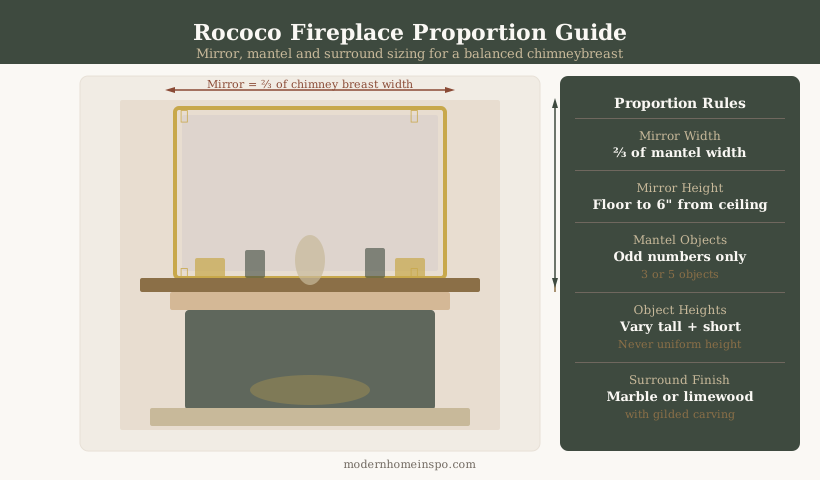
Pale marble or painted wood surround. Rococo fireplaces use light materials: white or pale-veined marble (Carrara, Statuary), pale gray marble, or painted wood in white or off-white with gilded carved details. Dark marble and dark wood belong to Baroque and later Victorian fireplaces.
Flanking boiserie integration. The chimney breast in a Rococo room is typically integrated with flanking boiserie wall panels — the fireplace surround flows into the carved wood panel system of the surrounding wall. The chimney breast does not read as an interruption to the wall treatment but as a compositional element within it.
The Overmantel and Mirror
The overmantel mirror is the element that most defines a Rococo fireplace composition, and the most practically accessible element for modern applications.
In authentic 18th-century French interiors, the overmantel was not a separately framed mirror hung on the wall — it was an integral part of the plasterwork or carved wood composition. The mirror glass was set into a carved frame of gilded plaster or wood that was continuous with the surrounding wall panels.
The effect:
- The mirror appears to be part of the architecture, not applied to it
- The carved frame integrates the mirror into the boiserie or plasterwork system of the whole room
- The scale is typically much larger than what modern rooms use — floor-to-cornice height, extending across most of the chimney breast width
In a contemporary home, the practical equivalent is a large ornate-framed mirror positioned directly above the mantel. The key parameters:
Scale: The mirror should be proportional to the chimney breast. Width: approximately two-thirds of the chimney breast width. Height: fill as much of the wall between mantel and ceiling as possible — a mirror that reaches near the ceiling reads as architectural; a mirror that stops midway reads as furniture.
Frame character: An ornate, carved frame — gilded, partially gilded, or in a burnished/antique gold finish — reads as a Rococo reference. A plain rectangular frame, regardless of finish, does not. The frame can be asymmetrical in its carved detail (more historically accurate) or symmetrical with ornate carved corners (easier to find commercially and reads well in contemporary rooms).
Positioning: Hung directly above the mantel shelf, with the bottom of the mirror frame close to (but not resting on) the mantel surface. Alternatively, for a contemporary interpretation, a large mirror can lean against the wall above the mantel rather than being hung — this works particularly well with oversized mirrors.
The Overmantel Mirror Effect
The reason the large Rococo overmantel mirror was so effective is that it reflected the room at a full-height viewpoint. In the evening, it reflected the candlelight from the room — chandelier, wall sconces, candelabra on the mantel — creating visual warmth and apparent depth. In a modern room, a large mirror above a fireplace reflects the room’s warm lamp light and the fireplace glow in the same way.
Surround Materials and Profiles
Marble
White or pale marble — Carrara, Statuary, or similar — is the most historically accurate material for a Rococo fireplace surround. The pale material keeps the composition light and fits the overall Rococo palette.
Profile characteristics to look for in a Rococo-adjacent marble surround:
- Rounded, soft molding profiles (not sharp-edged rectangles)
- A curved or bracketed jamb section flowing into the frieze
- Minimal applied ornament (the stone carving does the work, not applied rosettes or medallions)
If replacing a surround, a pale marble surround with a curved bracket profile and a clean frieze is a more flexible choice than a heavily carved white marble surround, which can tip toward Victorian rather than Rococo.
Painted Wood
Painted wood surrounds — in white, off-white, or pale gray with gilded carved details — are equally characteristic of Rococo interiors. French Rococo used both marble and painted wood depending on room type: formal salons used marble; more intimate cabinets and boudoirs used painted wood.
For a modern home, a painted wood surround is often more practical than marble (lighter, less expensive, paintable to match a changing scheme). A surround in off-white or warm white with a carved detail at the keystone and at the frieze corners reads as Rococo in character.
Limestone
Pale limestone — unfilled or lightly finished — is a contemporary material that reads appropriately with Rococo overmantel compositions. Its pale, matte surface fits the Rococo palette and lacks the Victorian associations of heavy carved white marble.
Flanking Detail and Wall Treatment
In historical Rococo rooms, the chimney breast was flanked by boiserie wall panels that integrated the fireplace into the overall wall composition. In contemporary rooms, several approaches create a similar effect.
Painted paneling: Board and batten or raised panel molding on the chimney breast wall — painted in the same color as the main walls or in an accent tone (pale sage or off-white if the main walls are warm greige) — creates the visual layering of a boiserie system without requiring carved wood.
Wall-mounted sconces: Two matching sconces, one on each side of the chimney breast at the same height, provide both lighting and the visual flanking structure that the original boiserie pilasters created. Muted brass or antique gold finish sconces fit the Rococo palette.
Matched framed objects: A pair of matched prints, botanical illustrations, or architectural plates in matching frames, one on each side of the chimney breast, creates a formal flanking composition that references Rococo symmetry without requiring architectural changes.
No flanking treatment: If the room’s character is more contemporary, the Rococo fireplace composition can work without flanking detail — a plain-wall chimney breast with an ornate mirror above the mantel and careful mantel styling. The ornate mirror carries the character without additional wall treatment.
Mantel Styling
The mantel shelf is the most practically adjustable element of a fireplace composition — it can be restyled without any structural change.
Rococo-aligned mantel compositions use:
A symmetrical arrangement with one asymmetric accent. The base arrangement is symmetrical — matching candlesticks or candelabra at each end, a central object (a clock, a ceramic piece, a sculptural form). Within that symmetrical base, one asymmetric detail introduces the Rococo quality: a small arrangement of organic forms (branches, botanicals) off-center, or a slightly unmatched pair of candlesticks at different heights.
Candelabra. Multiple-armed candelabra on a mantel are a direct Rococo reference. In a modern room, burnished brass or antique gold candelabra with real or LED taper candles create the closest contemporary equivalent to the Rococo candlelit mantel.
A single large ceramic or sculptural piece at center. A substantial ceramic piece — a large vase, a sculptural form — at the center of the mantel shelf creates a focal point before the mirror begins. Pale or cream-glazed ceramics fit the Rococo palette.
Small organic or botanical elements. A small branch, a moss or stone element, dried botanicals — natural organic forms used as accent beside the main objects. Not a full floral arrangement (which reads as country house rather than Rococo), but a composed, restrained organic detail.
What to remove:
- Multiple small objects creating visual clutter
- Modern decorative objects with no relationship to the palette or character of the room
- Photographs — too domestic and casual for a formal fireplace composition
- Scented candles in containers (the containers don’t fit the palette; decant into proper candlestick holders)
Modern Applications
Most modern homes have fireplaces that are neither Rococo in surround character nor in architectural context. The practical approach is to apply Rococo character through the overmantel and styling rather than through structural changes.
Approach 1: Mirror-and-Styling Only (No Structural Change)
The fastest and most accessible application. Works with any existing fireplace.
- Install a large ornate-framed mirror above the existing mantel — as large as the wall allows, with an ornate carved or decorative frame in a gilded or burnished gold finish.
- Style the mantel with candelabra, one central ceramic piece, and a restrained organic element.
- Place wall sconces flanking the chimney breast at the height of the top of the mirror.
- Paint the chimney breast wall in a Rococo-adjacent pale color (warm cream, off-white, pale sage) if it is currently a neutral gray or white.
This approach works with most existing fireplaces — modern gas fireplaces, contemporary marble surrounds, and even tiled surrounds benefit from the overmantel mirror treatment.
Approach 2: Surround Replacement + Mirror
A more significant intervention. Replacing an unsuitable surround — dark wood, heavy Victorian marble, plain modern limestone — with a pale marble or painted wood surround in a Rococo-adjacent profile changes the base character of the fireplace composition before the mirror and styling are applied.
Priority characteristics in a replacement surround:
- Pale material (white marble, pale limestone, painted wood in off-white or pale gray)
- Curved bracket or softer profiled jamb section (not sharp rectangular column profiles)
- Clean frieze with minimal or restrained carved detail
Approach 3: Built-In Overmantel Composition
For a more complete effect: commission or build a painted wood overmantel surround that integrates the mirror into a panel composition above the mantel. This is how the original Rococo overmantel worked — the mirror was part of a continuous carved and painted panel system, not a separately applied element.
A simpler contemporary version: build a rectangular frame of painted MDF molding around the chimney breast above the mantel, creating a recessed panel into which the mirror is set. Paint the whole composition — frame, panel, chimney breast — in the same color. The mirror sits within the frame rather than floating above the mantel. This creates the integrated quality of the original Rococo composition at lower cost.
Common Mistakes
A mirror too small for the chimney breast. A small mirror above a fireplace reads as decorative furniture, not as an architectural element. The mirror needs to fill the space generously to read as a Rococo overmantel. When in doubt, go larger.
Dark or heavily veined marble with a Rococo scheme. Black marble, dark green marble, or heavily veined dark marble surrounds belong to Victorian and Baroque interiors, not Rococo. A Rococo overmantel composition on a dark surround is a stylistic contradiction that neither element resolves.
A cluttered mantel with many small objects. Rococo mantel compositions were formally arranged — a few large objects in a deliberate composition. Multiple small miscellaneous objects break the composition and obscure the surround detail.
A plain-framed mirror in an otherwise ornate composition. If the surround has carved detail and the mantel has candelabra, a plain rectangular mirror frame breaks the composition. The mirror frame needs to carry comparable ornamental character.
Warm amber or orange firelight clashing with cool light sources elsewhere. Firelight is approximately 1800–2200K — much warmer than even 2700K lighting. If the room uses cool overhead light (4000K+) alongside firelight, the contrast is jarring. Use 2700K lighting throughout the room so that the firelight reads as the warmest element in a warm room rather than as an orange anomaly in a cool room.
Frequently Asked Questions
- What does a Rococo fireplace look like?
- A Rococo fireplace has a curved, organic-profiled marble or painted wood surround (not the sharp rectangular profiles of Neoclassical or Baroque), a carved keystone with asymmetrical shell or scroll ornament, and a large gilded mirror overmantel that typically extends from the mantel shelf to the cornice. The surrounding wall often has boiserie (carved panel) details flanking the chimney breast.
- What is an overmantel?
- An overmantel is the decorative treatment above a fireplace mantel shelf — the space between the mantel and the ceiling. In Rococo interiors, the overmantel is typically a large mirror in an ornate carved and gilded frame, often flanked by carved plaster or wood panels. The mirror extends the apparent height of the room and reflects the candlelight used for room lighting.
- What mirror goes above a Rococo fireplace?
- A large gilded or carved wood mirror frame in an asymmetrical or flowing profile — not a plain rectangular frame. The mirror should be wide enough to fill approximately two-thirds of the chimney breast width and tall enough to extend from near the mantel shelf toward the cornice. Historically, the mirror was integrated into a carved plaster or wood overmantel composition; in modern applications, a large ornate-framed mirror leaned against or hung above the mantel achieves a similar effect.
- Can I add a Rococo-style fireplace to a modern home?
- Yes, through the overmantel and mantel styling rather than replacing the surround. A contemporary fireplace can read as Rococo if a large ornate gilded mirror is placed above it, the mantel is styled with candelabra, a ceramic piece, and asymmetric botanical or organic elements, and the surrounding wall is painted in a pale Rococo-adjacent color. Replacing the surround entirely is also possible but requires more significant renovation.