Rococo Mirror Ideas: How to Choose, Place, and Style Ornate Mirrors
Quick Answer
Rococo mirrors are characterized by ornate carved or moulded frames in gilded or painted wood, with flowing asymmetrical or organic ornament — shells, scrolls, flowers — rather than plain rectangular profiles. They work best above fireplaces, above console tables, or leaning against walls at full height. One large ornate mirror has more impact than several small ones.
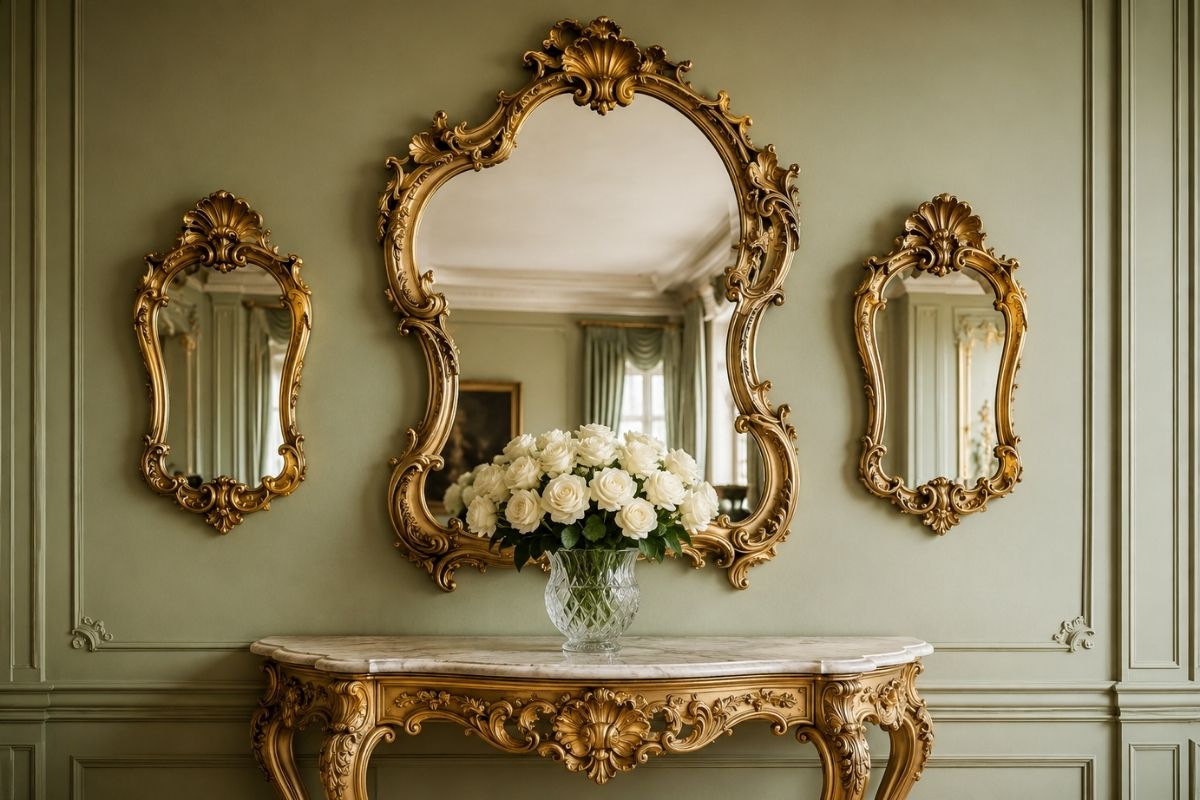
What Makes a Mirror Rococo?
Mirrors were central to Rococo interior design. In 18th-century French interiors lit by candles, mirrors served a practical function — multiplying the available light — and an aesthetic one: creating visual depth, reflecting the decorative richness of the room back into itself, and making intimate spaces appear larger and brighter.
The Rococo mirror is defined by its frame, not by its glass. The glass is clear and flat; the frame is the artistic and design statement.
A Rococo frame is characterized by:
Organic, flowing ornament. Shells, scrolls, rock forms (rocaille), flower clusters, leaves, and asymmetrical flowing transitions between motifs. The ornament appears to grow outward from the frame rather than being applied geometrically.
Asymmetry or asymmetric elements. The most historically authentic Rococo mirrors are asymmetrical — the frame ornament does not mirror on a vertical or horizontal axis. More commercially available Rococo-style mirrors use symmetrical arrangements of ornate elements at corners and centers, which is a 19th-century Rococo Revival convention rather than an 18th-century Rococo one.
Gilded or painted wood frame. Authentic Rococo mirror frames are carved wood covered in gesso and gilded with gold leaf, or painted in pale colors (white, gray, sage) with gilded carved details. Later reproductions use cast resin or plaster ornament, sometimes gilded, sometimes painted.
Non-rectangular shapes. Rococo mirrors often have arched tops, shaped tops with cresting ornament, or entirely irregular silhouettes following the shape of the frame ornament. Simple rectangular mirrors with ornate frames are a later convention.
What is not Rococo:
- A plain rectangular mirror with a gilded frame (that is classically proportioned, not Rococo)
- A mirror with heavy symmetrical architectural ornament and columns (that is Baroque)
- A sunburst mirror (that is a midcentury modern motif)
- A heavily framed mirror with dark wood (that is typically Victorian or Spanish Colonial)
Frame Types and Materials
Carved and Gilded Wood (Period and High-Quality Reproduction)
Period Rococo mirrors used carved limewood (a soft wood ideal for carving fine detail), covered in gesso (a chalk-and-glue mixture that smooths the surface for gilding) and gold leaf. The gold leaf in authentic period mirrors is applied over a red or yellow bole (a clay preparation that influences the warmth of the final gilded tone).
High-quality modern reproductions replicate this process — carved wood, gessoed, then gilded. These are expensive but carry the weight and warmth of the original technique.
How to identify gold leaf vs. gold paint:
- Gold leaf at wear points shows the colored bole beneath (typically reddish-brown) — it wears to reveal the underlayer
- Gold paint shows bare wood or primer beneath wear points and tends to flake rather than wear
Cast Resin or Plaster with Gilding
The most common commercial Rococo-style mirror frame material. Resin or plaster ornament is cast from molds (often taken from carved wood originals), then assembled around a wood backing and gilded.
Advantages: Significantly cheaper than carved wood. The surface ornament can be very detailed and accurate.
Disadvantages: Heavier per unit volume than carved wood. Resin ornament can feel plasticky if not well-finished. Gilding on resin is often gold paint rather than gold leaf.
Quality indicators: Look for crisp detail in the ornament (not blurry or simplified from poor casting), a warm gold tone (not a bright brassy yellow), and a finish that varies in tone across high points and recesses (authentic gilding has this quality; flat gold paint does not).
Painted Wood Frames
Painted Rococo mirror frames — in white, pale gray, sage green, or off-white with gilded highlights — are historically appropriate and work particularly well in bedrooms and bathrooms where full gilding would be too formal.
A painted frame with gilded carved details (partial gilding) is often more versatile than a fully gilded frame and easier to integrate into a neutral contemporary room.
Sizing: The Most Important Decision
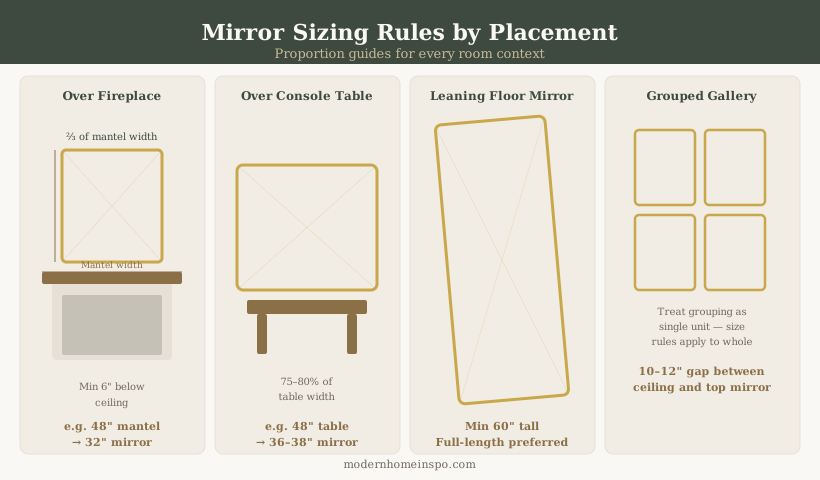
Sizing is the single most important decision in placing an ornate mirror. Undersizing is the most common mistake — a mirror that is too small for its wall reads as a decorative object placed on a wall, not as an architectural element.
Above a Fireplace
The overmantel mirror should fill the chimney breast proportionally — approximately two-thirds the chimney breast width and tall enough to approach the ceiling. For detailed sizing rules and the complete fireplace composition, see Rococo Fireplace Ideas.
Above a Console Table (Entry or Living Room)
Width: The mirror should be approximately the same width as the console table, or within 4–6 inches either way. A mirror significantly narrower than the console creates a visual imbalance. A mirror significantly wider than the console is acceptable if the wall space allows it.
Height: The bottom of the mirror should sit 6–10 inches above the console surface. The top of the mirror should be proportional to the available wall height — for a standard 8-foot ceiling with a console at typical height (30–32 inches), a mirror 30–36 inches tall is usually appropriate.
Leaning Against a Wall (Freestanding)
A large mirror leaned against a wall — typically full-height or near-full-height — has a different scale requirement from hung mirrors. For a leaning mirror, the minimum effective size is 60 inches tall × 24 inches wide. Smaller leaning mirrors read as frameable mirrors placed on the floor rather than as deliberate design decisions.
Bedroom Dresser
A mirror above a dresser should be approximately the same width as the dresser (within 4 inches either way) and tall enough to be functional — a minimum of 24 inches tall for a dresser mirror, with 30–36 inches being more effective.
Key Point
When in doubt about mirror size, go larger. A mirror that is slightly too large for its position reads as confident. A mirror that is slightly too small reads as inadequate. This principle applies especially to ornate framed mirrors, which need adequate size to be fully legible at room scale.
Placement by Room
Entry Hall
The entry hall is the most natural placement for a Rococo mirror. The mirror-above-console combination is a direct Rococo reference — it is the entry treatment in French aristocratic hôtels and remains the most coherent placement for an ornate mirror in any period.
Formula: Console table against the wall → ornate mirror centered above it → sconces or wall lights flanking the mirror (optional but effective). The console holds a single object grouping (a vase, a bowl, a lantern). Nothing else on the wall.
Living Room Fireplace
The most dramatic and architecturally integrated placement. A large ornate mirror above a fireplace integrates into the room as a building element rather than as furniture. It reflects the room, multiplies light sources, and creates the characteristic Rococo overmantel composition.
For the full fireplace composition guide, see Rococo fireplace ideas.
Bedroom
Above the dresser: the most practical bedroom mirror placement. An ornate mirror above a dresser adds Rococo character to the room’s secondary focal point (the dressing area) without affecting the primary focal point (the bed).
Leaning against the wall: a large ornate-framed floor mirror leaned in a corner or beside the dresser is a contemporary staging approach that reads as deliberate rather than dated.
Bathroom
An ornate mirror above a bathroom vanity is highly effective precisely because it is unexpected. Most bathroom vanity mirrors are plain rectangles — an ornate carved frame above a bathroom vanity reads as an intentional design choice.
Practical note: Bathrooms have higher humidity than other rooms. Solid wood frames can expand and crack in high-humidity environments. Look for frames with moisture-resistant construction, or place the mirror where it will not receive direct splash contact. Gold-leaf gilding is less moisture-sensitive than paint.
Dining Room
A large ornate mirror on a dining room wall — opposite a window or opposite the main light source — reflects the room and multiplies the light of candles on the table. This placement directly references the Rococo use of mirrors for light amplification.
Proportion: A dining room mirror should be substantial — at least as wide as the sideboard below it (if any), or scaled to the wall it occupies.
Styling Around Ornate Mirrors
Above a Console or Dresser
Keep the surface below the mirror simple. Two or three objects maximum: a vase, a ceramic piece, a small lamp, a candle holder. The ornate mirror is the statement; the objects below it support it rather than compete with it.
Avoid: Multiple small objects crowding the console surface. Framed photographs (too casual for a formal Rococo composition). Objects in mismatched styles (a modern abstract sculpture below an ornate Baroque mirror creates a jarring juxtaposition that reads as indecision).
Flanking Elements
If the wall space allows, a pair of wall sconces or picture lights flanking the mirror at its upper third creates the formal symmetrical flanking composition associated with Rococo entries and salons. The sconces should be in a finish that complements the mirror frame — muted brass or antique gold with a gilded frame; white or pale painted metal with a painted frame.
What to Put Beside an Ornate Mirror
On the same wall as an ornate mirror, other elements should be subdued. Plain framed prints in matching frames, or no other elements at all. The mirror should be the visual focal point of the wall — adding competing ornate elements alongside it divides the viewer’s attention without adding compositional value.
On adjacent walls, more can be done — but in the sight line of the mirror, simplicity is the rule.
Buying Guide
New Ornate Mirrors
The market for new Rococo-style mirrors ranges from well-made carved wood pieces to thin resin frames with gold paint. Quality indicators:
Frame weight: A substantial, well-made frame feels heavy for its size. Very light frames typically use thin materials that will not hold up to daily use or to the stress of the mirror glass.
Gilding quality: Warm gold tone (not bright yellow). Variation between high points and recesses (burnishing effect). Evidence of actual gold leaf (look for slight irregularity at wear points) rather than flat gold paint.
Back construction: The back of the frame should be a solid wood or MDF backing. The hanging hardware should be heavy-duty (rated for the mirror weight, including the glass).
Glass quality: The mirror glass in a quality piece should be flat and distortion-free. Slight tinting is common in reproduction antique-finish mirrors (a slightly warm or bronze tint); this is acceptable and often adds to the Rococo character. Bubbles or distortion in the glass are manufacturing defects.
Vintage and Antique Mirrors
Vintage ornate mirrors (20th-century reproductions) and antique mirrors (19th-century and earlier) appear regularly at antiques fairs, estate sales, and specialist dealers.
What to check:
- Frame structural integrity — cracks, separations, loose ornament
- Condition of gilding — natural wear is expected and adds character; large bare patches may need restoration
- Condition of mirror glass — antique mirrors often have foxing (dark spots from backing deterioration) or edge silvering. This is normal and often valued; extensive foxing obscures reflection and may be worth factoring into the price
Foxed or aged mirror glass can be replaced by a glazier. The frame is typically more valuable and more difficult to replace than the glass.
What to Avoid
Multiple ornate mirrors in the same room. One large ornate mirror is a statement. Two in the same room create visual competition. Three or more look like a mirror shop rather than a designed room.
A Rococo mirror in a room with no other Rococo references. An ornate gilded mirror in an otherwise stark industrial or brutalist room reads as a mistake rather than a contrast. Some stylistic coherence between the mirror and at least one other element in the room (a curved furniture piece, a warm neutral palette, a gilded lamp base) helps the mirror read as intentional.
Bright gold frames in a warm neutral room. Bright, high-gloss gold reads as cheap gilding in most domestic contexts. Burnished, antiqued, or matte gold reads as sophisticated. Check the finish in your room’s lighting before buying.
Hanging a mirror that is too heavy for the wall fixing. Ornate framed mirrors with large glass panels can be very heavy. Use appropriate wall fixings — toggle bolts for plasterboard walls, screws into studs, or purpose-made heavy-duty mirror fixings. Always check the total weight (frame + glass) against the fixing rating.
Placing an ornate mirror in direct sunlight. Direct, sustained sunlight can cause the gilding on gold-leaf frames to oxidize and the glass backing to degrade (causing foxing). Position ornate mirrors out of direct sustained sunlight, or use UV-filtering glass.
Cleaning and Maintenance
Ornate gilded frames require different care from the mirror glass itself. The two surfaces have entirely different tolerances.
Cleaning the glass: Use a lint-free cloth and a small amount of glass cleaner applied to the cloth — never sprayed directly onto the mirror. Spray mist reaching the frame edge can seep under gilded surfaces and cause delamination or staining. Work from the center outward and dry immediately.
Cleaning a gold-leaf gilded frame: Dust only with a very soft dry brush (a wide, soft watercolor brush or a clean makeup brush). Do not use water, cleaning spray, or damp cloths on gold leaf — moisture causes the gesso beneath to soften and the gold to lift or discolor. Never rub gilded surfaces, even with a soft cloth, as this removes the gilded layer at contact points.
Cleaning a gold-paint or resin frame: More tolerant than gold leaf. A barely damp cloth followed immediately by a dry cloth can remove grime from painted resin frames. Avoid anything abrasive.
Humidity and moisture: Consistently high humidity — as in bathrooms without ventilation — causes wood frames to expand and contract, eventually cracking the gesso or causing the frame ornament to separate. For bathroom placements, choose frames with a moisture-resistant backing, or accept that some deterioration will occur over time. Foxing on mirror glass (dark spots in the silvering) is caused by moisture reaching the mirror backing — it is typical of antique mirrors and cannot be reversed, only replaced.
UV and light damage: Sustained direct sunlight oxidizes gold leaf over years, shifting the tone from warm gold to a dull brownish-yellow. A mirror positioned to receive morning or afternoon sun directly should be moved or protected. Indirect or diffused natural light does not cause this effect.
Design Tip
The most durable placement for a gilded ornate mirror is a wall that receives indirect natural light (not direct sun) and maintains moderate, stable humidity — typically an interior wall in a living room or bedroom. Entry halls and dining rooms are also low-risk. Bathrooms without ventilation and south-facing window walls in warm climates are the highest-risk placements for long-term frame condition.
Frequently Asked Questions
- What does a Rococo mirror look like?
- A Rococo mirror has an ornate carved or moulded frame — typically in gilded or painted wood — with flowing organic ornament: shells, scrolls, flower forms, and flowing rock-like (rocaille) motifs. The frame may be asymmetrical (most historically accurate) or have symmetrical ornate elements. The mirror shape is often irregular or arched, not a simple rectangle.
- What is the difference between a Rococo mirror and a Baroque mirror?
- Baroque mirrors use heavier, more architectural frames with symmetrical classical ornament — columns, pediments, cartouches, and symmetrical acanthus leaf ornament. Rococo mirrors use lighter, more organic frames with flowing asymmetrical shell and scroll ornament. Baroque mirror frames are typically heavier and more imposing; Rococo frames are more delicate and movement-filled.
- How do I make an ornate mirror look intentional rather than dated?
- Place one large ornate mirror as the only major ornate element on that wall or in that room. Keep the surrounding wall and adjacent furniture relatively simple and neutral. The ornate mirror should be a deliberate statement against a calm background, not one of several competing ornate elements. Sizing correctly — the mirror fills the wall space proportionally — makes it read as architectural rather than decorative.
- What size ornate mirror should I use above a fireplace?
- Above a fireplace, the mirror should be approximately two-thirds of the chimney breast width, and tall enough to fill the space between the mantel shelf and the ceiling — or to within 6–12 inches of the ceiling. A mirror that is too small for the chimney breast reads as furniture applied to architecture, not as part of the architectural composition.
- Can I use a Rococo mirror in a modern home?
- Yes — an ornate framed mirror is one of the easiest Rococo introductions to a modern home precisely because it does not require any structural change and can be moved or replaced. One large ornate mirror in a contemporary neutral room creates Rococo character without requiring furniture replacement or period-accurate architecture.