Bathroom Storage Ideas: Every Option by Type, Size, and Placement
Quick Answer
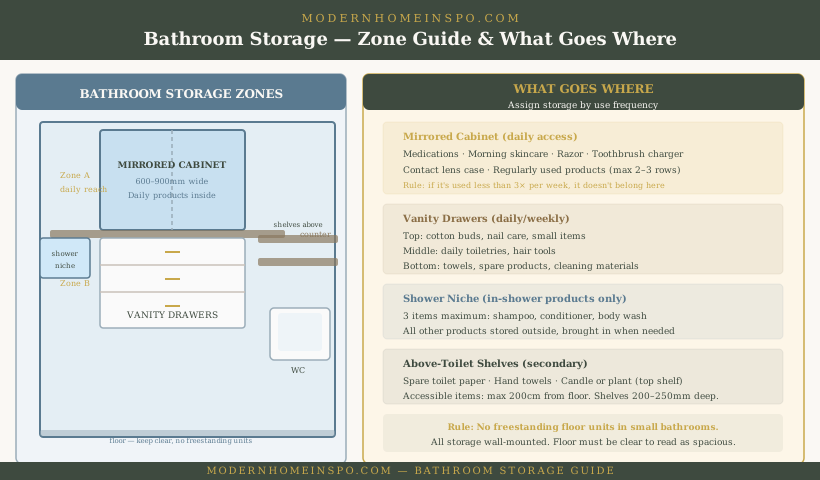
Bathroom storage hierarchy: mirrored cabinet above the basin (daily products, medications — stores more than a flat mirror in the same wall space), under-vanity drawers (towels, cleaning products, daily toiletries), recessed shower niche (3 items maximum in the wet zone), and above-toilet shelving for secondary storage. Avoid floor-standing freestanding units in small bathrooms — they collect dust at the base, obstruct cleaning, and take up the floor space that makes the room read as larger.
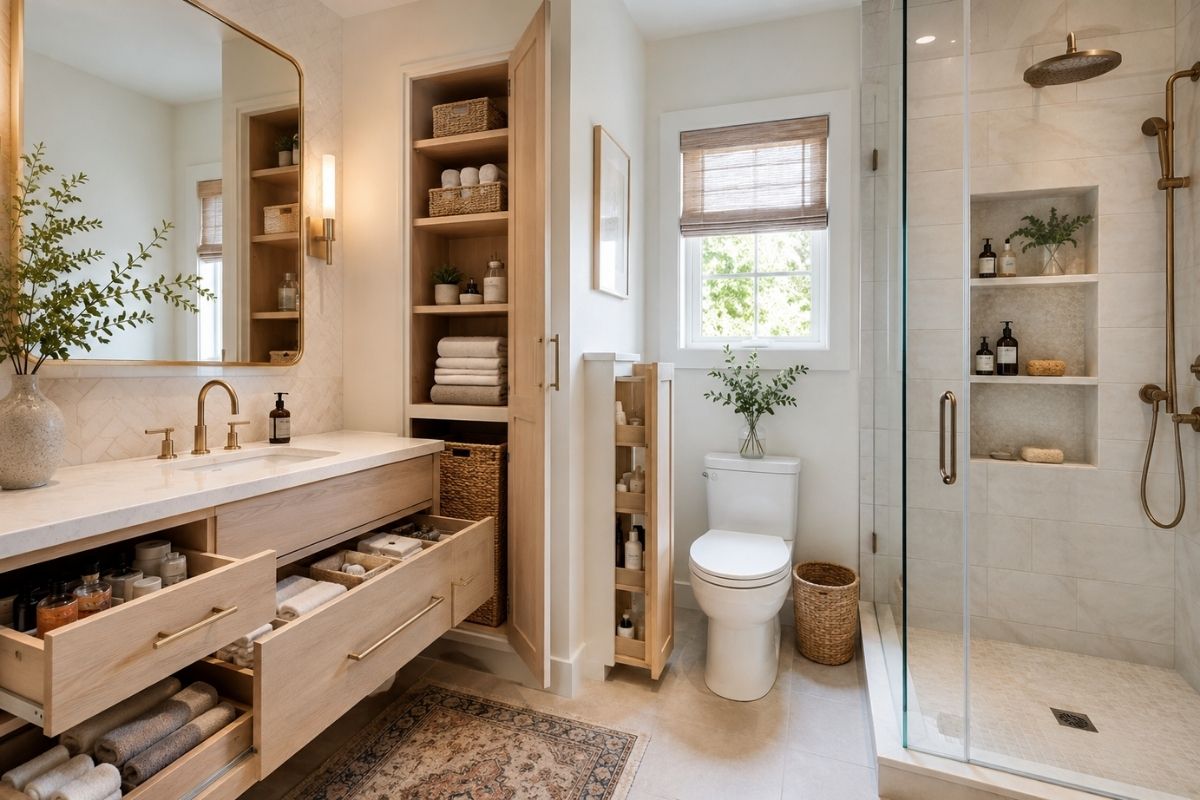
Bathroom storage is often an afterthought — added as freestanding shelving or basket collections after the bathroom is complete. The most effective bathroom storage is planned into the room design from the start: a vanity unit with drawers from the floor to the countertop, a mirrored cabinet above, a recessed niche in the shower wall, and wall-mounted storage in the zones around the basin and WC.
Mirrored Cabinets
A mirrored cabinet is the highest-value storage addition in any bathroom where a flat mirror currently exists. It replaces the mirror function entirely (same reflective surface) while adding internal storage in the same wall footprint.
Sizing
For a single basin: a mirrored cabinet 600mm wide, 150–200mm deep, 700–800mm tall. This provides 3–4 internal shelves and adequate depth for toiletries, medications, and skincare.
For a double vanity: two individual mirrored cabinets (one above each basin) provides each person with dedicated storage. Or one larger cabinet (900–1200mm wide) spanning both basins — less personal storage allocation but a cleaner look.
Placement
Centre on the basin, bottom edge 100–150mm above the countertop (to avoid water splash on the cabinet base). Top edge at convenient reach height — typically 180–200cm from floor.
Internal organisation
Adjustable shelves allow customisation to the actual height of stored items. Fixed shelves in most standard cabinets result in wasted space above short items. If purchasing new, look for fully adjustable internal shelves or an open-shelf interior without fixed dividers.
Lighting integration
Mirrored cabinets with integrated LED strip lighting around the perimeter provide task lighting at face height — the best position for grooming light. More effective than a separate light fitting above the mirror.
Vanity and Under-Basin Storage
Drawer configuration
A deep-drawer vanity unit (three drawers: 200mm, 150mm, 100mm from bottom up) is more efficient than a single-door under-sink cupboard. With drawers, all contents are visible and accessible in one movement. With a cupboard, items at the back require unloading the front first.
For a 600mm wide vanity: two drawers side by side in the lower section, one full-width drawer above. Alternatively, a door cupboard on one side and two drawers on the other — providing both hanging storage (for cleaning products) and drawer storage (for toiletries).
What goes where
- Bottom deep drawer (200mm): towels (folded), cleaning products, spare toilet paper
- Middle drawer (150mm): daily toiletries, hair tools (stored after cooling), spare products
- Top shallow drawer (100mm): cotton wool, Q-tips, nail care, small items
Basin type affects storage
A countertop basin (bowl-on-top style) requires a vanity unit below it for support — and the unit top becomes a display/storage surface. An undermount or inset basin allows the countertop above the unit to be uninterrupted — cleaner for daily use.
A wall-hung basin (no vanity unit) provides no below-basin storage — only the wall and nearby cabinets are available. This is the maximum-visual-space option but minimum-storage option.
Shower Storage
Recessed niche
The most elegant shower storage solution: a niche cut into the shower wall, tiled to match, holding 3 items maximum. No shelving units, no corners visible, no bottles on the shower tray.
Standard niche dimensions: 300×300mm or 300×600mm, 100mm deep. Built between wall studs during construction or renovation — not possible to add after tiling without opening the wall.
Position: at shoulder height on the wall perpendicular to the shower head — accessible without reaching across the water stream.
Corner shelves
A ceramic or stainless-steel corner shelf in the shower corner is the retrofit option when a recessed niche is not possible. More visually prominent than a niche but functional and inexpensive. Limit to 3–5 items; an overloaded corner shelf looks cluttered regardless of the bathroom quality.
Fixed shower caddy
A chrome or brushed steel shower caddy on a tension pole or suction-mounted is the most common addition — and the one that most quickly looks grubby. If used, clean weekly and replace the products it holds rather than accumulating bottles.
What belongs in the shower
Three items maximum in the wet zone: shampoo, conditioner, body wash. Everything else (masks, scrubs, specialist products) is used occasionally and should be stored outside the shower and brought in when needed. A shower with twelve bottles is a storage problem presented as an organisation challenge.
Above-Toilet Storage
The wall above the WC pan is underused in most bathrooms. It has the advantage of being away from the main wet zone (lower humidity) and at a convenient height for secondary storage.
Floating shelves
Two or three floating shelves at heights: 80cm, 110cm, 140cm above the toilet seat. The lowest shelf should be high enough to not feel oppressively close to the WC. Use shelves 200–250mm deep (shallower than kitchen shelving to avoid head-hitting risk).
What to store: spare toilet paper, hand towels, a candle or plant (top shelf), small decorative items. The accessible lower shelves can hold replacement products; upper shelf for display.
Wall cabinet
A recessed or surface-mounted wall cabinet above the WC provides more storage volume than open shelves with the advantage of concealing what’s stored. Less visually interesting than open shelving but more practical for storage of items that don’t look good on display (medications, spare personal care items).
Maximum height
Shelving above the WC should not exceed 200cm from the floor — the seated user should be able to reach the lowest shelf easily, and the highest item on the top shelf should not require a step stool to access.
Wall-Mounted Options
Ladder shelf
A freestanding ladder shelf leaning against the wall (without fixings) is a flexible, non-destructive storage solution for rented bathrooms or bathrooms where wall fixing is impractical. Works as a towel storage and display structure. Limitation: collects dust at the lower rungs; not suitable for storage near the shower.
Robe hooks and towel rings
Wall-mounted robe hooks for daily-use towels — positioned beside the shower exit and near the basin. A single double hook stores two towels in the same space as a towel ring for one. Position at 160–170cm height for easy reach.
Magnetic strip
A magnetic strip (same concept as a kitchen knife strip) on the wall beside the basin holds metal tweezers, nail scissors, nail clippers, and other small metal grooming tools — keeping them accessible and visible without occupying drawer space.
Small Bathroom Storage
No freestanding floor units
A freestanding shelving unit or storage trolley in a small bathroom takes up floor space, collects dust at the base, and makes cleaning difficult. Every storage element in a small bathroom should be wall-mounted — preserving floor visibility and cleaning access.
The vertical principle
Use full wall height: mirrored cabinet above the basin (going up to 200cm), shelving in the space above the WC, a tall slimline cabinet in any narrow gap (300mm wide is usable — that’s enough for a pull-out towel rack, a shelf for toiletries, and a hanging rail for cleaning products).
Behind the door
The back of the bathroom door is unused storage space in most bathrooms. An over-door hook rail or an over-door towel bar adds hanging capacity without any wall fixings. In a small bathroom with limited wall space, the door back is valuable.
Declutter first
Most bathroom storage problems are product accumulation problems. The average bathroom holds 3–4 times the number of products actually used in the daily routine. A bathroom storage audit (removing everything, discarding expired or unused items, and only returning what’s genuinely used) often reveals that the existing storage is adequate for the remaining items.
Principal Bathroom Storage
A principal bathroom used by two people has fundamentally different storage requirements from a single-user bathroom. The same vanity and cabinet footprint must serve two complete daily routines without creating friction.
Allocate storage by person, not by item type
The most effective approach: one side of the vanity unit belongs to each person entirely. Left-side drawer stack = Person A’s skincare, dental, and personal products. Right-side drawer stack = Person B’s. This eliminates the morning coordination that shared drawers create. Mirrored cabinets above each basin follow the same logic — one cabinet per person if space allows.
Drawer configuration for a 1500mm double vanity
Per person (750mm section, typically three drawers):
- Top drawer (8cm): daily-access items — watch/jewellery, phone charger, small products used every morning
- Middle drawer (14cm): skincare products, vitamins, razors, contact lens kit
- Bottom drawer (22cm): spare products, medications, hairdryer, larger items
Towel storage in the principal bathroom
A principal bathroom needs storage for 4–6 towels (two per person, plus spares). Options: a ladder-style heated rail large enough for two full bath sheets (minimum 600mm wide × 1600mm tall), plus an additional rail for hand towels. Alternatively, a dedicated towel cupboard — a narrow 300–400mm deep cabinet built into the run beside the vanity — stores folded towels and removes the need for rail-hanging multiple towels.
Product management at two sinks
The vanity surface between and outside the two basins quickly becomes a clutter zone. The practical resolution: no products stored on the surface. Each person’s morning products start in their top drawer and go back after use. A single soap dispenser and a small tray for one or two display items is the maximum on-surface inventory. See Master Bathroom Ideas for the full double vanity layout and clearance planning.
Frequently Asked Questions
- What is the most efficient bathroom storage?
- A mirrored cabinet above the basin — it combines the mirror function with internal storage, using the same wall space more efficiently than a flat mirror. Pair it with a deep-drawer vanity unit below for towel and toiletry storage, and a recessed niche in the shower for product storage without any floor footprint.
- How do I add storage to a small bathroom with no space?
- Use vertical wall space: a tall slimline cabinet in the gap between the WC and the wall (300mm wide, 1500mm+ tall), wall-mounted open shelving above the WC pan, a recessed niche in the shower wall, a mirrored cabinet above the basin, and a small floating shelf above the door. Each adds storage without any floor footprint.
- What should go in a bathroom mirrored cabinet?
- Daily-use items that need to be accessible without opening a drawer: medications, the most-used skincare products (morning and evening routine items), razor, toothbrush charger, contact lens case. Maximum 2–3 rows of products. A mirrored cabinet full of miscellaneous items provides no benefit over an organised one.
- Are open bathroom shelves practical?
- In a bathroom, open shelves collect steam, dust, and humidity. They work well for items in regular use (towels, hand soap, a candle, one plant) but not for products in packaging that look cluttered. Limit open shelves to 3–5 visible items per shelf and locate them away from the shower where steam is concentrated.