Bathroom Tile Ideas: The Complete Guide to Types, Patterns, Sizing, and Laying Decisions
Quick Answer
For bathroom tiling: large-format tiles (600×600mm+) make rooms look bigger; smaller mosaic and encaustic tiles are best used as feature accents in one zone. In small bathrooms, use one tile type floor-to-ceiling in a light colour with matching grout. In wet zones, all tiles must be R10 slip resistance minimum on floors. The single most regretted choice is dark grout with white tiles in a small room — it creates a persistent visible grid that makes the room read smaller.
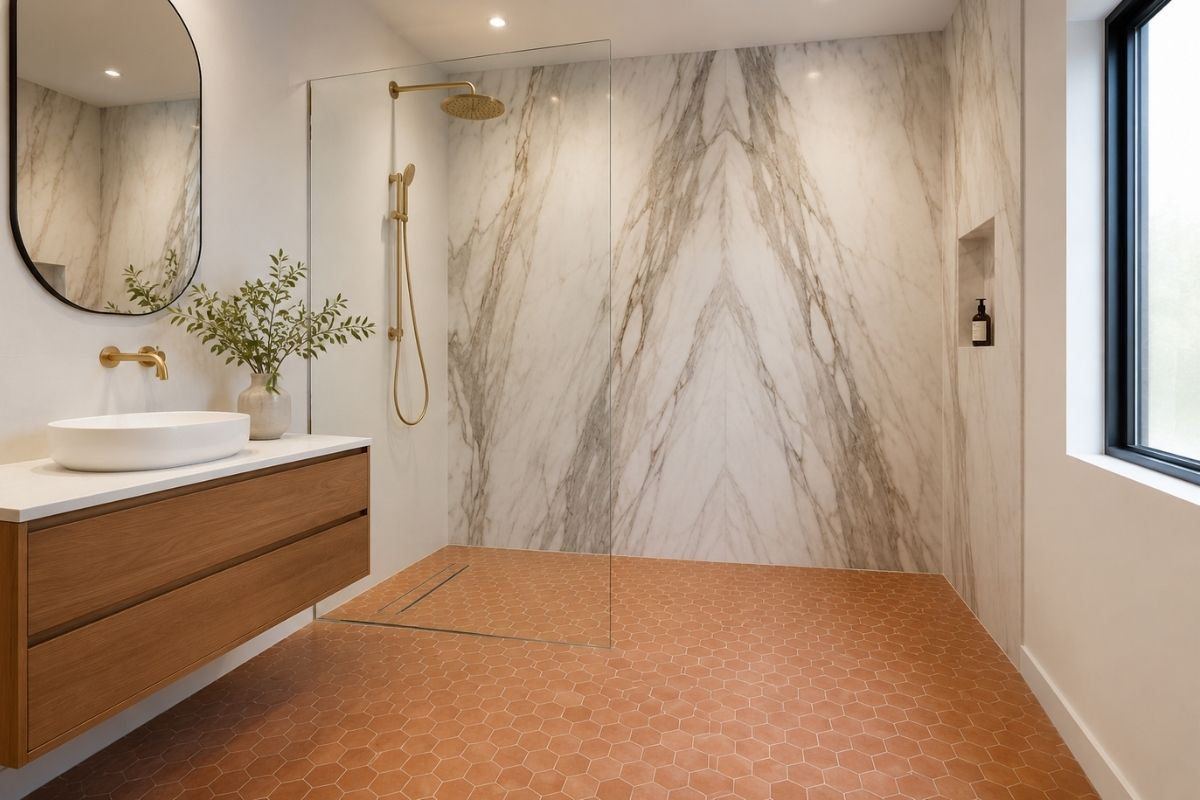
Tile decisions in a bathroom are among the most permanent design choices in a home. Retiling is disruptive, expensive, and often requires replumbing or replastering. This makes the initial tile selection one of the highest-stakes decisions in the bathroom, and one where understanding the options fully before committing has an unusually large return on time invested.
Tile Types and Their Uses
Porcelain
The most practical and versatile bathroom tile material. Fired at higher temperatures than ceramic, making it denser, less porous, and more durable. Suitable for both walls and floors. Available in every finish: matte, satin, polished, stone-effect, wood-effect, concrete-effect.
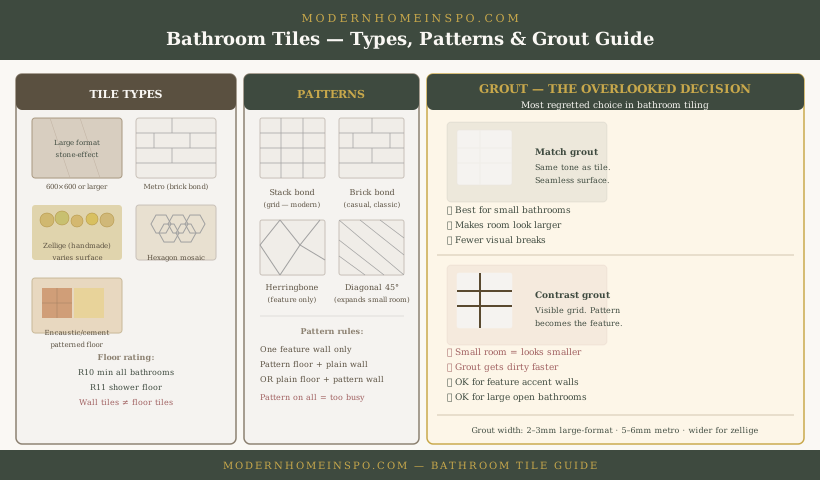
For floor tiles: check the R-rating (slip resistance). R10 is the minimum for wet bathroom floors. R11 is recommended for shower floors.
Ceramic
Similar appearance to porcelain but fired at lower temperature, making it slightly more porous and less durable. Suitable for wall tiles; not recommended for floor tiles in wet areas. Generally less expensive than porcelain for equivalent formats.
Natural stone (marble, limestone, travertine)
Beautiful material with natural variation and depth that no porcelain can fully replicate. Requires sealing before and after grouting and periodic maintenance to prevent staining. Marble is susceptible to acid etching (cleaning products, citrus). Limestone and travertine are more forgiving but still require care.
Best used in bathrooms with predictable maintenance — principal bathrooms in adult-only households are better candidates than family bathrooms with children.
Metro tile
75×150mm or 100×200mm rectangular tiles in a classic format. Most often in white or off-white gloss ceramic. The brick bond (staggered) laying pattern is the standard. Metro tiles add texture and pattern to a wall without complex design decisions — the challenge is grout colour (see grout section).
Zellige
Hand-glazed Moroccan terracotta tiles with irregular glaze variation that creates surface movement and depth. The surface irregularity makes each tile slightly different, creating a natural, artisanal quality. More expensive than mass-produced tiles, requires skilled fitting (the irregular edges need adjustment), but delivers a quality that no machine-made tile achieves.
Encaustic and cement tiles
Patterned tiles (geometric, Moroccan, or Victorian designs) made from pigmented concrete or cement. Porous — must be sealed before and after grouting. Better suited to bathroom floors than walls in wet zones. Very durable when properly maintained. Creates strong pattern that needs restrained surroundings.
Hexagon tiles
Available in many sizes from small mosaic (5cm) to large-format (30cm). Small hexagon mosaic works well on shower floors (small format accommodates the slope to the drain). Large hexagon tiles as feature floor statements in larger bathrooms.
Tile Sizing Guide
Small bathrooms (under 5m²)
Largest format practical for the room size: 600×600mm or 600×300mm. Large tiles mean fewer cuts at the perimeter and fewer grout lines — both important in a small room. Avoid mosaic and small-format tiles as the primary bathroom tile in a small room.
Medium bathrooms (5–8m²)
600×600mm, 600×1200mm, or 300×600mm — all work. The longer 600×1200mm format creates a more dramatic, hotel-like quality. In a medium bathroom, either large-format or medium-format tiles are appropriate depending on the design intention.
Large bathrooms and principal bathrooms (8m²+)
Any size works, including very large format (800×800mm, 1200×1200mm). Large-format stone-effect porcelain slabs (up to 1200×2400mm) can be used for wall applications in generous-sized principal bathrooms, creating a nearly seamless stone appearance.
Shower floor
Small-format tiles in wet zone floors accommodate the slope to the drain: mosaic tiles (2–5cm), small hexagon, or 10×10cm tiles. Large tiles can be used on shower floors with a linear drain (eliminating the multi-directional slope to a central point drain), but this requires more precise laying.
Laying Patterns
Brick bond (offset/staggered)
The most common laying pattern for rectangular tiles. Each row offset by half a tile width. Works for metro tiles (standard), large-format rectangles, and wood-effect planks. The offset creates a visual rhythm that reads as casual and natural.
Stack bond (straight)
All tiles aligned vertically and horizontally, creating a grid. More formal and contemporary than brick bond. Works particularly well with large-format tiles where the continuous grout line creates a consistent grid pattern.
Herringbone
Two tiles at 45° angles to each other in a V-pattern. Creates significant visual interest — best used as a feature wall or shower floor. Requires more cutting and fitting time (higher labour cost). Very effective with metro tiles and wood-effect planks.
Diagonal/45°
Standard tile laid at 45° to the room walls. Visually expands small rooms by drawing the eye diagonally across the space rather than across the shorter dimension. Increases material waste (more cutting at perimeter) by 15–20%.
Book matched
Two tiles placed as mirror images of each other, with the pattern running as if folded from a single stone. Requires careful selection of paired tiles. Works best with stone-effect tiles with significant veining — creates the look of a continuous stone slab across two tiles.
Grout Decisions
Grout colour is a palette decision as much as a technical one — whether to match or contrast grout to tile colour, and how that choice reads across a full room, is covered in detail in Bathroom Colour Ideas. The technical specifications are below.
Epoxy grout vs cement grout
Epoxy grout is harder, more stain-resistant, and does not require sealing. More expensive and more difficult to apply (requires faster working time — usually 20–30 minutes before it begins to set). Best for high-use areas: shower floors, areas with coloured grout where staining is a concern. Cement grout is more common, easier to work with, and requires sealing in wet areas — reseal annually in shower zones.
Grout width
Standard: 2–3mm for large-format porcelain tiles (minimum required to accommodate manufacturing variation in the tile dimensions). Metro tiles: 5–6mm for the classic look. Zellige and encaustic: 8–10mm — the wider joint suits the hand-made character. Finer grout joints push toward contemporary; wider joints toward artisanal.
Feature Walls and Accent Tiles
One feature wall, not all four
A bathroom with a patterned or textured feature tile works best on one wall only — typically the wall behind the bath, the wall at the end of the shower, or the wall behind the WC. Applying a pattern tile to all walls creates visual overwhelm in all but the largest bathrooms.
Feature tile choices that work well
- Zellige in a warm tone behind the bath
- Large-format marble-effect tile as the shower back wall
- Encaustic tile floor with neutral tile walls (pattern at floor level, restraint above)
- Fluted or ribbed tile as an accent behind the basin/vanity
Where to avoid pattern tiles
The floor of a small bathroom with a patterned tile and patterned wall tile creates visual noise — the eye has nowhere to rest. In small bathrooms, use pattern on the floor only (with neutral walls) or on one wall only (with neutral floor).
Floor Tile Rules
Slip resistance
Floor tiles in wet zones must meet minimum slip resistance ratings. In the UK, the relevant standard is DIN 51130:
- Bathroom floors generally: R10 minimum
- Shower floors (constantly wet): R11 recommended
- Wet room floors: R11 required
Check the tile specification sheet — the R-value is listed. If not listed, ask the supplier. Do not assume a tile is slip-resistant because it looks matte.
Underfloor heating compatibility
Most porcelain and ceramic tiles are compatible with underfloor heating. Natural stone tiles require specialist adhesives with flexible properties to accommodate thermal movement. Always check the tile manufacturer’s specification for UFH compatibility and follow the recommended adhesive specification.
Expansion joints
Tiled floors require expansion joints at perimeter walls, doorways, and at least every 5–6m in large rooms. In a typical bathroom, a flexible perimeter bead (silicone rather than grout at the junction of floor and wall) accommodates the thermal movement of the tile and prevents cracking at the joint.
Frequently Asked Questions
- What tiles make a small bathroom look bigger?
- Large-format tiles (600×600mm or 600×1200mm) in light tones with matching grout colour. The fewer grout lines, the more unified the surface reads. Running the same tile from floor to wall to ceiling in one light colour removes all horizontal boundaries that truncate space.
- What is the most durable bathroom tile?
- Porcelain tiles (fired at higher temperatures than ceramic) are the most durable bathroom tile. They are denser, less porous, and harder than ceramic — appropriate for both walls and floors. Natural stone (marble, limestone, travertine) is beautiful but requires sealing and regular maintenance to prevent staining and etching.
- Can I use wall tiles on the floor?
- Not unless they are specifically rated for floor use with an R10 slip resistance minimum. Wall tiles are generally thinner and not rated for the weight and foot traffic of floor use. Always check the tile specification: floor-rated tiles have a PEI rating and an R-value (slip resistance). Wall tiles have neither.
- How do I choose between metro and large-format tiles?
- Metro tiles (75×150mm or 100×200mm) work best as feature wall tiles in small to medium bathrooms — they add texture and pattern without overwhelming the space. Large-format tiles (600×600mm+) work best when continuity and a sense of space are the priority. In a small bathroom, large-format tiles on the floor and walls will feel more spacious than metro tiles throughout.