Bedroom Lighting Ideas That Actually Work
Quick Answer
Effective bedroom lighting uses four layers: ambient (overhead, 2700K), task (bedside lamps at shoulder height), vanity/mirror lighting (3000K for accuracy), and accent (LED strips, uplighters at 2200–2700K). Every circuit needs a dimmer. The single most-used light is bedside — invest there first.
Why Most Bedroom Lighting Fails
The typical bedroom arrives with one ceiling fitting, one overhead bulb, and no thought given to what happens when you actually live in the room. You get dressed under a harsh single light that creates shadows in all the wrong places. You read in bed under a glare that falls directly into your eyes. You try to wind down at 10pm under the same 4000K LED that you’d use in an office.
Bedroom lighting fails because it’s treated as a single decision rather than a system. A bedroom needs to function differently at 7am when you’re getting ready for work than at 10pm when you’re reading before sleep. Those two states require fundamentally different light levels and temperatures — and they’re impossible to achieve with a single overhead fitting and no dimmer.
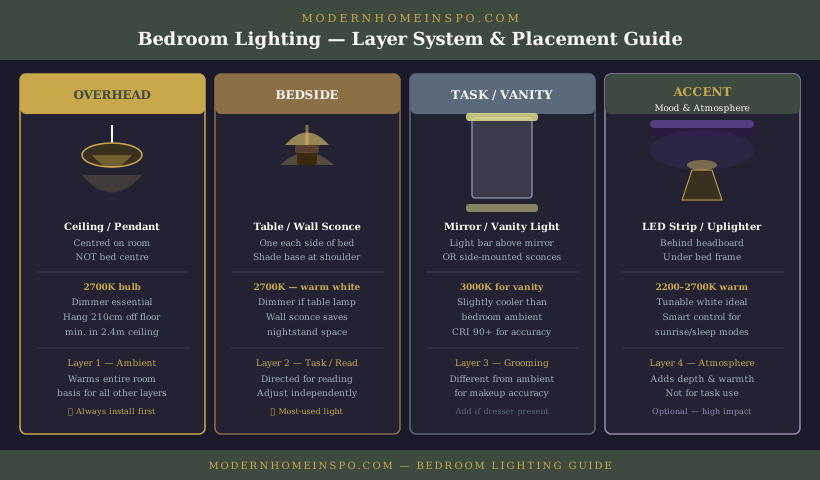
The fix is a four-layer system: ambient, task, vanity, and accent. Each layer serves a different purpose. Each can be controlled independently. Together they give you a bedroom that works at every time of day.
The Four-Layer System
Layer 1: Ambient (Overhead)
Ambient lighting provides general illumination for the room. In a bedroom, this is usually a ceiling-mounted fixture: a pendant, a flush mount, a semi-flush, or a chandelier.
The ambient layer should be on a dimmer and set to around 2700K. Its primary job is to light the room for getting dressed, cleaning, and moving around — not for working, reading, or sleeping.
Placement: Centre the overhead fixture on the room, not on the bed. A fixture centred on the bed puts light behind your head when you’re sitting up, creating an awkward shadow. Room-centred placement gives more even distribution.
Wattage equivalent: For a typical 12–16m² bedroom, 800–1000 lumens of ambient light is enough when supplemented by the other layers.
Layer 2: Task / Bedside
Bedside lighting is the most-used light in a bedroom. It needs to be bright enough to read by, positioned to avoid glare into your eyes, and dimmable for winding down.
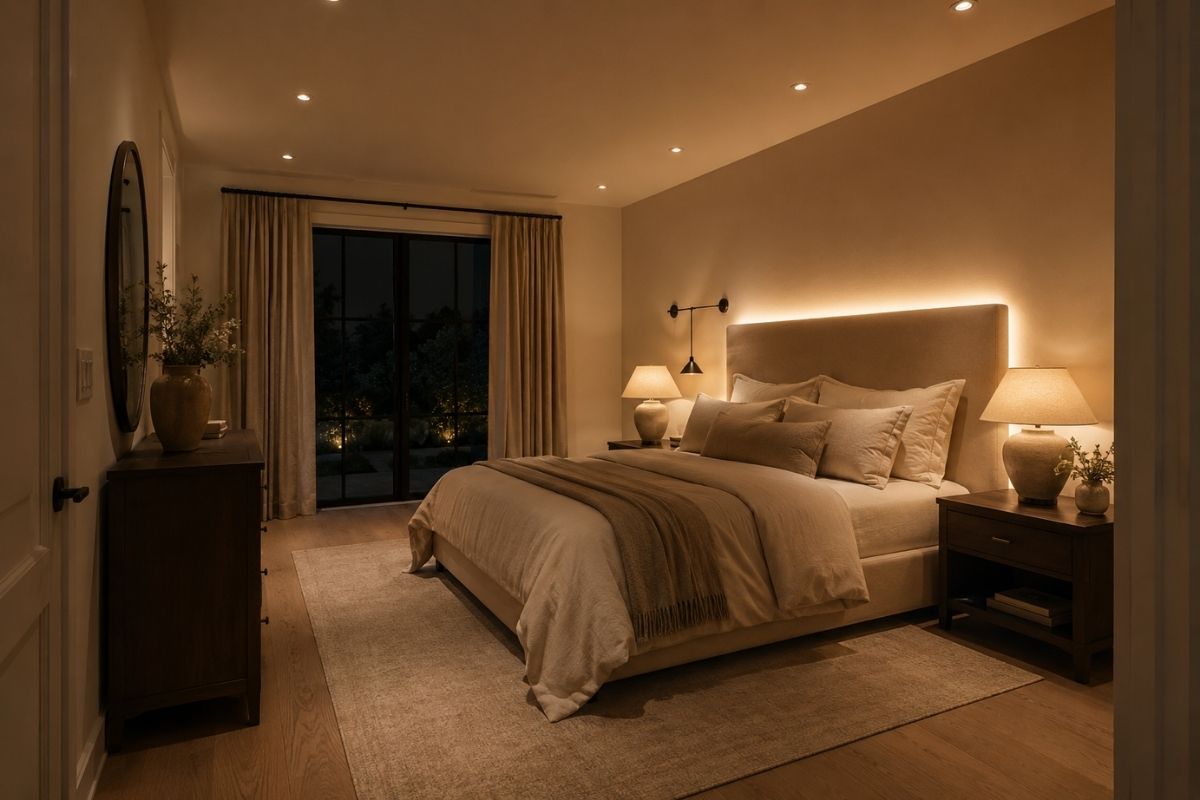
Table lamps: The bottom of the shade should sit at approximately shoulder height when sitting up in bed — around 130–140cm from the floor on a standard bedside table. This prevents the bulb from shining directly into your eyes.
Wall sconces: Mounted at 140–150cm from the floor, with an adjustable arm if possible. Wall sconces keep the bedside table surface clear and can be positioned more precisely than table lamps. They look best when the backplate is centred on the bedside table width.
One each side: Asymmetric bedside lighting — one lamp, one side — is a compromise that creates an imbalanced room and leaves one person in relative darkness. Two lamps, individually switched, is the correct configuration.
Layer 3: Vanity / Mirror
If you dress, apply makeup, or groom in the bedroom, you need dedicated mirror lighting. The overhead ambient light is rarely in the right position for this — it creates shadows under the chin and brow that make it impossible to assess how you look accurately.
Above the mirror: A horizontal light bar or batten across the top of the mirror at 3000K (slightly cooler than bedroom ambient) is the hotel standard. It provides even, face-level light without creating the shadows that overhead-only illumination causes.
Side-mounted sconces: Placing sconces at face height on either side of the mirror is even better, mimicking the front-lit studio mirror. Position the centre of the sconce at approximately 160cm from the floor.
CRI matters here: Use bulbs with a Colour Rendering Index (CRI) of 90 or above for a vanity mirror. Lower CRI bulbs distort colour, making it difficult to judge clothing colours and skin tone accurately.
Layer 4: Accent
Accent lighting adds depth, warmth, and visual interest without adding to the functional light level. In a bedroom this is usually one of:
- LED strip behind the headboard: A warm white strip (2200K) mounted along the back of the headboard creates a soft glow against the wall. Use an indirect mount so the strip itself isn’t visible.
- Under-bed LED strip: Gentle wash of light under the bed frame. Useful as a soft night light that doesn’t disturb sleep.
- Floor uplighter: A small uplighter in a corner creates depth and makes the room feel larger than a single overhead can.
Accent lighting should be the last layer you add, after the functional layers are in place.
Bulb Temperature Guide
Colour temperature (measured in Kelvin) has a significant effect on mood, alertness, and sleep quality.
| Temperature | Appearance | Bedroom use |
|---|---|---|
| 2200K | Very warm, amber | Accent/night only |
| 2700K | Warm white | Ambient, bedside ✓ |
| 3000K | Soft white | Vanity mirror ✓ |
| 3500K | Neutral white | Avoid in bedroom |
| 4000K | Cool white | Never in bedroom |
| 5000–6500K | Daylight | Never in bedroom |
The key number is 2700K for all general bedroom lighting. It is close to the colour temperature of traditional incandescent bulbs and creates the warm, intimate atmosphere most people associate with a comfortable bedroom. It also has significantly less impact on melatonin production than cooler temperatures.
If you want variable control, smart tunable-white bulbs allow you to shift from 2700K in the morning to 2200K in the evening automatically.
Fixture Types and Placement
Pendant lights: Work in bedrooms with 2.7m+ ceiling height. Hang the bottom of the shade at minimum 210cm from the floor. In rooms with lower ceilings, a semi-flush or flush mount is safer.
Flush mounts: The safe choice for standard 2.4m ceilings. Choose a fixture with a good diffuser to avoid seeing the bulb directly. Frosted glass or linen shade materials produce the softest light.
Chandeliers: A traditional chandelier or decorative multi-arm pendant can work in a bedroom with 3m+ ceiling height. The bottom of the chandelier should clear 210cm minimum. In a Rococo or traditional bedroom, a smaller chandelier centred on the room is a strong design statement.
Track lighting: Rarely the right choice for a bedroom. Adjustable track spots are better suited to kitchens and living rooms. In a bedroom they look utilitarian and create harsh pools rather than even wash.
Recessed downlights: If you have recessed downlights, use them for general wash only with a warm-white lamp (2700K), and add bedside lamps and accent lights — recessed downlights alone produce flat, shadowless light that feels clinical.
Dimmer Switches
Every bedroom circuit should be on a dimmer. This is non-negotiable. A bedroom without dimmers is like a kitchen without a hob — technically present but functionally compromised.
What to dim: Overhead ambient (primary dimmer), bedside lamps (secondary), accent lighting (often controlled by smart plug or inline dimmer).
Trailing edge vs leading edge: LED bulbs require a trailing-edge (or universal) dimmer, not the older leading-edge dimmers designed for incandescent bulbs. Using an incandescent dimmer with LED bulbs causes flickering, buzzing, and inconsistent dimming. Check the dimmer packaging — it should list compatible LED wattage ranges.
Two-way dimmers: In a bedroom, a two-way dimmer switch — one at the door and one by the bed — allows you to turn off the overhead light without getting out of bed. Worth the small additional cost.
Lighting by Room Size
Small bedroom (under 12m²): One ceiling fixture plus two bedside lamps is sufficient. Skip accent lighting to avoid visual clutter. Use a mirror to reflect the ambient light and make the room feel larger.
Medium bedroom (12–20m²): Full four-layer approach works well. Wall sconces at bedside are preferred over table lamps to keep the limited surface space clear.
Master bedroom (20m²+): Add vanity lighting and at least one accent circuit. Consider a statement pendant or chandelier as the ambient fixture — at this scale, it reads as a design element rather than a utility fitting.
Smart Lighting for Bedrooms
Smart lighting systems (Philips Hue, LIFX, Lutron Caséta) add scheduling, scene control, and colour temperature adjustment to the bedroom.
Useful bedroom automations:
- Wake scene: Gradually increases from 0% to 80% brightness over 30 minutes, starting 20 minutes before your alarm. Significantly easier on the body than a sudden overhead switch.
- Sleep scene: Shifts to 2200K at 2100 and dims to 10–20% by 2200, preparing your nervous system for sleep.
- Night light: A motion-triggered dim amber light (5–10%) activated between midnight and 6am for bathroom trips without full wakeup.
Smart systems add cost but are most valuable in the bedroom of all rooms, where the relationship between light and sleep quality is most direct.
Frequently Asked Questions
- What colour temperature is best for bedroom lighting?
- 2700K (warm white) for ambient and bedside lighting. This temperature is close to candlelight and supports melatonin production in the evening. Avoid anything above 3000K in a bedroom — cool white and daylight bulbs (4000–6500K) suppress sleep hormones.
- Where should bedside lamps be positioned?
- The bottom of the lampshade should sit at approximately shoulder height when you're sitting up in bed — roughly 130–140cm from the floor when the lamp is on the bedside table. This prevents glare into your eyes while reading.
- Do I need a dimmer switch in a bedroom?
- Yes, on every circuit. Dimmers allow you to adjust light levels through the day: bright for getting dressed, mid-level for reading, very dim for winding down. A bedroom without dimmers forces you to choose between too bright and total darkness.
- What is the best light for reading in bed?
- A directional bedside lamp with a shade that focuses light downward and slightly forward. Wall-mounted reading sconces with adjustable arms are ideal — they keep the bedside table clear and put the light exactly where you need it.
- How many lights do you need in a bedroom?
- Minimum three: one overhead (ambient), two bedside (one per side). Add vanity/mirror lighting if you dress in the bedroom, and accent lighting if budget allows. A single overhead light is never enough for a functional bedroom.