Eco-Friendly Bedroom Decor: Sustainable Choices That Actually Look Good
Quick Answer
The most impactful eco-friendly bedroom choices: organic linen or cotton bedding (avoids synthetic pesticide-intensive conventional cotton), low-VOC paint (significantly better indoor air quality), secondhand furniture (avoids new manufacturing impact), and natural fiber rugs (jute, wool — not synthetic). Sustainable materials in a bedroom also tend to age better and look more refined over time.
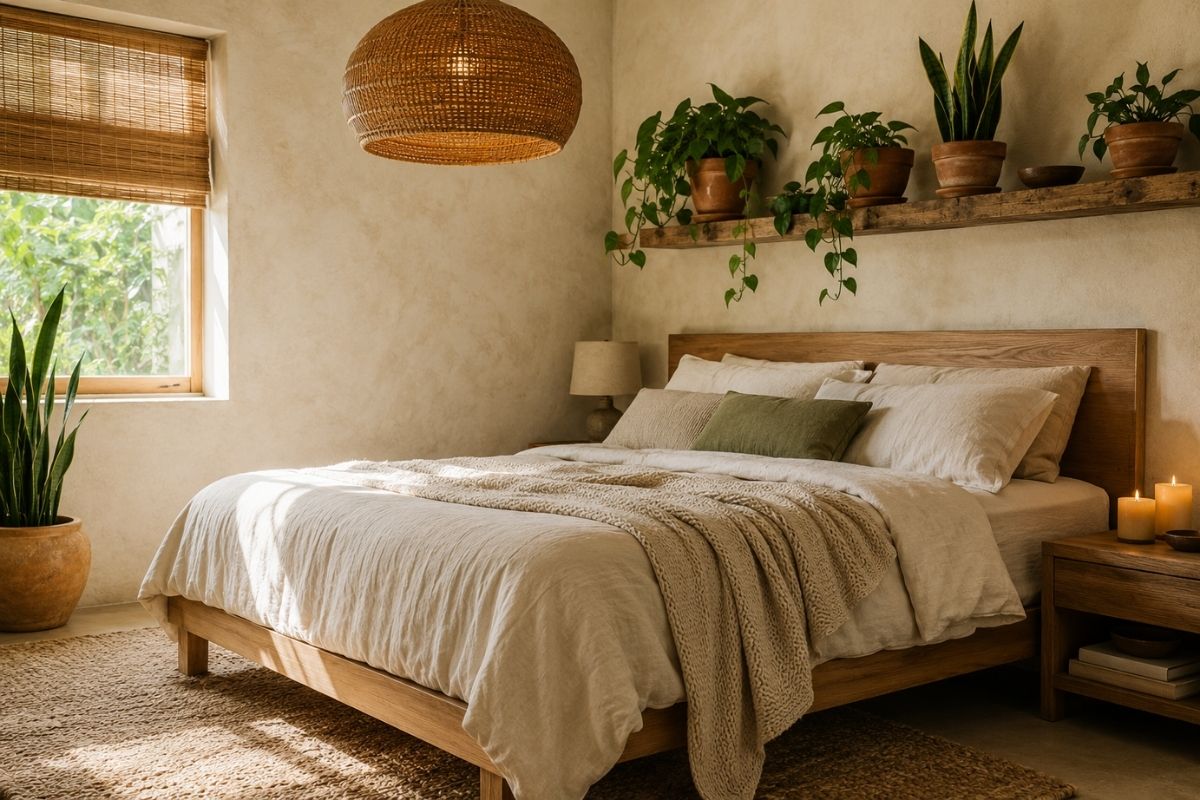
Why Bedroom Materials Matter
We spend approximately a third of our lives in our bedrooms, which makes the material choices in this room more consequential for indoor air quality and personal health than choices in any other room.
The specific concerns:
Off-gassing from furniture and paint. New furniture — particularly flat-pack furniture using MDF and adhesives — and conventional paint release VOCs (volatile organic compounds) into the air for months after installation. In a bedroom where you sleep with the door and windows closed, these accumulate.
Synthetic textile chemicals. Conventional cotton bedding is often treated with pesticides during cultivation and flame retardants or finishes during manufacturing. Synthetic textiles (polyester, nylon) shed microplastics during washing and do not biodegrade.
The sustainable-aesthetic overlap. Fortunately, the most sustainable material choices in a bedroom — solid wood, natural linen, wool, jute, ceramic — also tend to age better, look better over time, and produce a more refined aesthetic than their synthetic or composite alternatives.
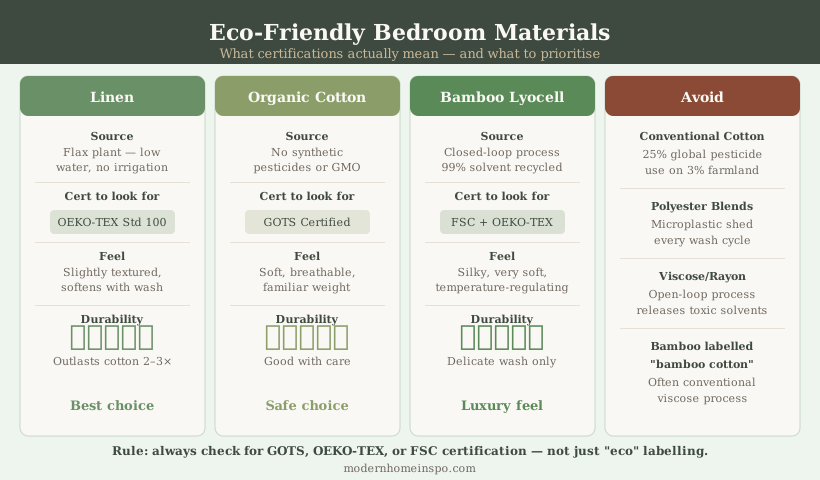
Sustainable Bedding
Linen
Linen (from the flax plant) is the most sustainable major textile for bedding. Flax requires minimal pesticides, uses far less water than cotton, grows in temperate climates without irrigation, and most of the plant is used with minimal waste.
Linen bedding also ages exceptionally well — it softens with each wash, develops a natural texture, and can last 15–20 years with proper care. The lifecycle sustainability of linen is therefore stronger than even organic cotton because of its durability.
What to look for: OEKO-TEX Standard 100 certified (ensures no harmful substances), flax sourced from European growing regions (France, Belgium, Lithuania — these have the strongest sustainability credentials), and honest fiber content labeling (some “linen” products contain significant cotton or synthetic content).
Organic Cotton
Conventional cotton is one of the most resource-intensive natural fiber crops — high pesticide and water use. Organic cotton avoids synthetic pesticide application and uses more sustainable growing practices.
Certifications to look for: GOTS (Global Organic Textile Standard) is the most credible certification for organic cotton, covering both growing and processing standards.
Bamboo Lyocell (Tencel)
Bamboo lyocell, produced by the Lyocell closed-loop process, can be sustainably manufactured. The process uses minimal water and recycles solvents. Bamboo grows rapidly with minimal inputs.
Caution: Not all bamboo fabric is produced sustainably. “Bamboo viscose” uses a conventional viscose process that involves harsh chemicals — it is not equivalent to bamboo lyocell/Tencel.
Note
Linen bedding is both the most sustainable option and, for many users, the most desirable in terms of texture, drape, and long-term feel. The sustainability case and the aesthetic case for linen point in the same direction.
Low-VOC Paint
Standard paint contains VOCs in concentrations that vary by formulation. Low-VOC paints (typically under 50g/L VOC content) and zero-VOC paints (under 5g/L) significantly reduce indoor air quality impact.
Recommended low-VOC and zero-VOC paint options:
| Brand / Product | VOC level | Notes |
|---|---|---|
| Farrow & Ball (all lines) | Low-VOC | Water-based, widely available in UK, premium price |
| Benjamin Moore Natura | Zero-VOC | Strong colour range, tintable to full palette |
| Sherwin-Williams Harmony | Zero-VOC | Good colour range, available across US |
| Little Greene (all lines) | Low-VOC | Water-based, UK-focused, strong neutral range |
| Ecos Paints | Zero-VOC | Specialist zero-VOC brand, UK and US availability |
| Auro Organic Paints | Plant-based, minimal VOC | Plant-derived ingredients; most stringent eco credentials |
Off-gassing timeline — when is it safe to sleep in a freshly painted room?
| Time after painting | VOC status | Recommendation |
|---|---|---|
| 0–2 hours | High off-gassing | Do not enter except briefly; max ventilation |
| 2–24 hours | Elevated off-gassing | Keep windows open; do not sleep in room |
| 24–72 hours (low-VOC paint) | Reducing; borderline | Ventilate well; sensitive individuals should wait |
| 24–72 hours (standard paint) | Still elevated | Not recommended for sleeping; ventilate |
| 72+ hours (low-VOC) | Low | Safe for normal use; continue ventilating if possible |
| 2–4 weeks (standard paint) | Tapering | Full off-gassing takes weeks to months |
These are approximate ranges; exact timing depends on paint formulation, ventilation, temperature, and humidity. Higher temperatures accelerate off-gassing. A freshly painted bedroom with windows sealed in winter takes longer to clear than one ventilated in summer.
- Low-VOC paints can be tinted to any color — this is not a functional limitation
- Zero-VOC paints remain zero-VOC when tinted with zero-VOC colorants; standard colorants added at the paint desk may increase VOC levels even in a zero-VOC base — ask specifically about colorant VOC content
Sheen: In a bedroom, eggshell or matte finish is most common. Low-VOC formulations are available in all standard sheens.
Furniture: Secondhand and Solid Wood
Secondhand Furniture
Buying secondhand furniture is the single most impactful furniture sustainability choice. It avoids the manufacturing impact of new furniture entirely: the raw material extraction, manufacturing energy, transportation, and packaging of a new piece are all avoided.
Sources for secondhand bedroom furniture:
- Estate sales and house clearance sales
- Charity shops and thrift stores
- Online marketplaces (Facebook Marketplace, eBay, Gumtree, Vinted)
- Specialist antique and vintage dealers
Secondhand solid wood furniture — dressers, wardrobes, bed frames — is often better quality than new budget furniture and can be repainted, refinished, or reupholstered to suit a current scheme.
Solid Wood (When Buying New)
When new furniture is necessary, solid wood from sustainably managed sources (FSC-certified) is preferable to MDF, particleboard, and composite materials, which use formaldehyde-based adhesives that off-gas VOCs.
Solid wood furniture is also more durable and more repairable than composite furniture — a solid wood dresser can be refinished and repaired; an MDF unit typically cannot be meaningfully repaired when it begins to fail.
Wood certifications: FSC (Forest Stewardship Council) certification is the most widely recognized sustainable forestry credential. Look for it on product labeling when buying new wood furniture.
Natural Fiber Rugs
Synthetic rugs (polypropylene, nylon, polyester) shed microplastics during use and washing and do not biodegrade at end of life. Natural fiber rugs are preferable from both sustainability and indoor air quality perspectives.
Jute and sisal: Both made from plant fibers with minimal processing requirements. Extremely durable and biodegradable. The natural texture and warm color work well in a bedroom neutral palette.
Wool: Naturally durable, naturally flame-resistant, and biodegradable. Wool rugs are more expensive than synthetic equivalents but last significantly longer. Look for wool from certified sustainable sheep farming practices.
Cotton: Washable cotton rugs are practical in bedrooms. As with bedding, organic cotton is preferable to conventional cotton.
What to avoid: Polypropylene rugs marketed as “easy to clean” or “outdoor-indoor” — these are plastic rugs that shed microfibers throughout their life.
Sustainable Lighting
LED bulbs throughout: LED bulbs use approximately 75–80% less energy than incandescent equivalents and last much longer. This is the minimum standard for sustainable bedroom lighting in 2025.
Warm white (2700K): The warmest standard LED temperature, which is also the most aesthetically appropriate for bedrooms. No sustainability disadvantage relative to cooler LEDs.
Natural material lamp bases and shades: Ceramic, natural stone, wood, or rattan lamp bases are preferable to plastic. Natural fiber shades (linen, cotton, paper) are preferable to synthetic fabric shades.
Rattan and bamboo pendants: A rattan pendant light or bamboo ceiling fixture is both sustainable and aesthetically effective in a natural-material bedroom aesthetic.
Plants and Natural Elements
A single plant in a bedroom — a small snake plant, a pothos, or a peace lily — adds organic warmth and low-level air quality benefit. Plants produce oxygen and absorb some indoor air pollutants, though the air quality benefit of a single small plant in a bedroom is modest.
The aesthetic value of plants in a bedroom is more significant: they add a living, organic element that synthetic decor cannot replicate and that integrates naturally with sustainable material choices throughout the room.
Low-maintenance options for bedrooms:
- Snake plant (Sansevieria) — extremely low maintenance, tolerates low light
- Pothos — trailing, low light, tolerates irregular watering
- Peace lily — tolerates low light, produces flowers periodically
What to Avoid
Flat-pack furniture with particleboard construction. MDF and particleboard use formaldehyde-based binders that off-gas in indoor environments. In a bedroom specifically, avoid new flat-pack furniture made primarily from these materials — or allow extensive off-gassing in a ventilated space before bringing into the bedroom.
Synthetic bedding labeled as “natural” without certification. “Bamboo” fabric is sometimes conventional viscose, not sustainably produced lyocell. “Organic” claims without GOTS certification may not be verifiable. Look for specific certifications rather than marketing language.
Fast furniture cycles. Buying inexpensive furniture and replacing it every few years generates significantly more material waste than buying quality pieces less frequently. From a sustainability perspective, it is better to buy fewer, higher-quality pieces (or secondhand) than many inexpensive ones.
Synthetic air fresheners and candles. Paraffin candles and synthetic fragrance products release VOCs and particulates into indoor air. Beeswax candles, soy wax candles with natural fragrance oils, or no-candle alternatives are preferable.
Frequently Asked Questions
- What makes bedding eco-friendly?
- Organic certification (GOTS — Global Organic Textile Standard), natural fiber content (linen, organic cotton, bamboo lyocell), and manufacturing transparency. Conventional cotton uses large quantities of pesticides and water; organic cotton avoids synthetic pesticides. Linen is one of the most sustainable natural textiles — it requires little water or pesticide and uses most of the plant. Bamboo lyocell (Tencel) can be sustainably produced if manufactured using a closed-loop process.
- Is linen more sustainable than cotton?
- Generally yes. Flax (the plant linen comes from) requires significantly less water and fewer pesticides than conventional cotton, grows in a wider range of climates, and uses most of the plant with minimal waste. Linen fabric also has a very long lifespan — quality linen bedding softens with washing and can last decades. Organic cotton is a more sustainable alternative to conventional cotton but still typically requires more resources than flax.
- What is low-VOC paint and why does it matter in a bedroom?
- VOCs (volatile organic compounds) are chemicals released by conventional paint that off-gas into room air, particularly in the first weeks to months after application. Exposure to VOCs is linked to respiratory irritation, headaches, and in high concentrations, more serious health effects. Low-VOC or zero-VOC paints significantly reduce this off-gassing. Since we spend significant time sleeping in bedrooms, paint VOC levels are particularly relevant in this room.
- Is secondhand furniture eco-friendly?
- Yes — buying secondhand furniture is one of the most impactful eco-friendly design choices available. It avoids the manufacturing impact of new furniture entirely and extends the useful life of existing pieces. Solid wood secondhand furniture in particular is often better quality than new budget furniture and can be refinished or repainted to match any scheme.