Farmhouse Kitchen Ideas: Materials, Features, and the Design Rules That Make It Work
Quick Answer
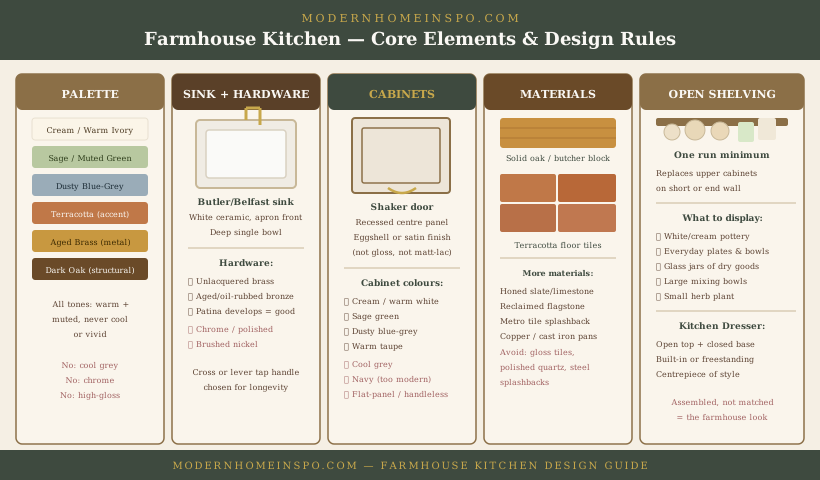
A farmhouse kitchen is built around five defining elements: a butler (Belfast) sink in white ceramic, shaker cabinet doors in cream or sage, open shelving on at least one run, a natural material countertop (oak, butcher block, or honed stone), and unlacquered brass or aged bronze hardware. The palette should be warm and drawn from nature — cream, sage, dusty blue, or warm taupe — and the room should contain visible material wear and patina rather than a perfect showroom finish.
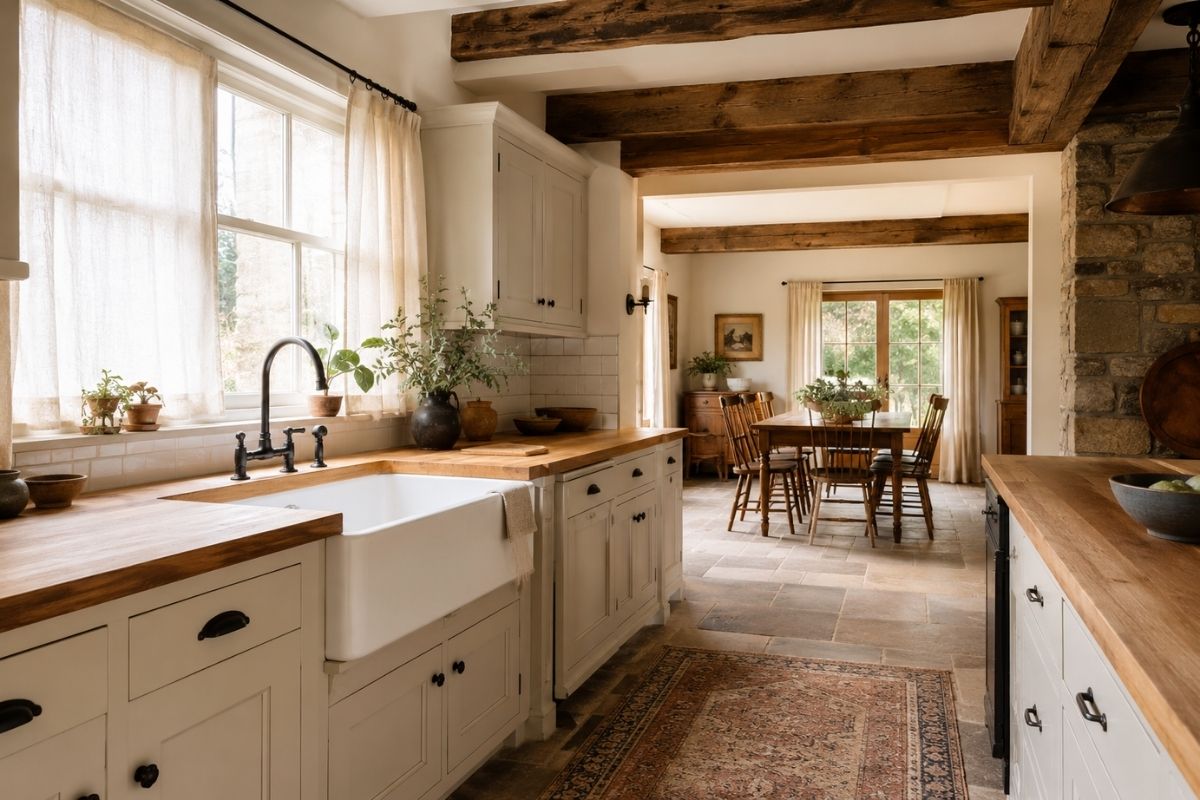
The farmhouse kitchen is built around a contradiction: it’s designed to look like it was assembled over time from practical necessity, but making it look that way requires considerable design intent. The authenticity that makes farmhouse kitchens appealing — the worn wood, the accumulated pottery on open shelves, the aged brass hardware — has to be curated. Left to chance, it becomes clutter. Designed with the right materials and restraint, it becomes one of the most liveable kitchen styles.
The Five Defining Elements
1. Butler (Belfast) sink
A deep, wide, single-bowl ceramic sink in white or cream. The butler sink is the signature farmhouse feature — practical, generous, and immediately recognisable as a working kitchen piece. Standard sizes: 595mm wide (small), 755mm wide (large). The sink is inset into the countertop with the front apron visible.
Tap: unlacquered brass or aged bronze with cross or lever handles. The tap should look chosen for longevity, not style. Chrome is incompatible with the farmhouse aesthetic.
2. Shaker cabinet doors
The five-piece shaker door (recessed centre panel in a simple frame) is the definitive farmhouse cabinet profile. Painted in cream, warm white, sage, or dusty blue-grey. The profile reads as traditional and hand-crafted without being ornate — appropriate for a working kitchen.
In-frame shaker (door sits within the cabinet frame, revealing the frame when the door is open) is more authentic and more expensive than overlay shaker (door sits over the frame, more common in fitted kitchens). For the cost differential between these options, see the Shaker Cabinet Costs section below.
3. Open shelving
At least one run of open shelves, typically where upper cabinets would be on the shorter wall or beside the dresser. Used for practical display: everyday plates and bowls, glasses, a few ceramics, small stored jars. The shelves should look used, not styled.
Open shelving in a farmhouse kitchen functions differently from open shelving in a minimalist or contemporary kitchen — it accumulates over time rather than being a curated set-piece. For the full storage strategy including pantry organisation and corner solutions, see Kitchen Storage Ideas.
4. Natural countertop
Solid oak butcher block, reclaimed timber, or honed natural stone (limestone, slate, or granite). These materials have visible grain, natural variation, and develop patina with use. Engineered quartz is acceptable if it has natural stone characteristics (warm veining, matte finish); polished quartz or anything overly uniform undermines the farmhouse character.
5. Unlacquered brass or aged hardware
Hardware that shows wear and develops its own patina over time — the opposite of hardware that stays bright and consistent. Unlacquered solid brass will darken and develop warm variation over months and years; this is desirable, not a flaw. Aged or oil-rubbed bronze achieves the same quality from the start.
Farmhouse Palette
The farmhouse kitchen palette is drawn from nature: cream, warm white, sage green, dusty blue, terracotta, warm grey. All tones are muted and warm — no vivid saturation, no cool blues or greys. The palette should feel like it belongs outdoors as much as indoors.
Dominant cabinet tones: cream, warm white, sage green. Accent tones: terracotta (in ceramics and textiles), warm rust (in copper pans), aged brass (hardware and accessories), warm wood grain (open shelving, countertop).
For detailed palette-building guidance — how to choose between these options, how to match undertones across cabinet, countertop, and hardware, and specific paint names at every budget — see Kitchen Colour Schemes.
Materials and Surfaces
Floor materials
Terracotta tiles (large-format, unpolished), slate flagstones, or reclaimed limestone are the most authentic farmhouse floor materials. These age beautifully, are hard-wearing, and contribute the worn, original character of the style.
Practical alternatives: large-format matte porcelain tile in terracotta, stone, or concrete tones. High-gloss tiles and polished marble are incompatible with the farmhouse aesthetic.
Splashback
Classic options: white metro tile in a brick bond with warm grout (dark grey or sandy), stone or slate tile, Moroccan zellige tile in cream or terracotta. The splashback in a farmhouse kitchen should have visible texture and natural variation — a flat porcelain slab is too contemporary.
For a period farmhouse kitchen: a range cooker with a brick-arch surround, fired in a contrasting tile.
Ceiling and beams
Original exposed beams, if present, are a farmhouse kitchen asset. Painted in the same cream or white as the wall (not left as dark stained wood in a light kitchen), they add character without dominating. Modern farmhouse kitchens don’t add beams artificially — it reads as theatrical.
Range cooker
A range cooker (Aga, Rayburn, or equivalent free-standing style) in cream, green, or blue enamel is the traditional farmhouse cooking appliance. These are expensive investments (£3,000–£15,000+ for a quality range) but contribute enormously to the character and functionality of the kitchen. A standard integrated oven works — positioned inside the cabinet run with a shaker door front.
Open Shelving in Farmhouse Kitchens
Open shelving in farmhouse kitchens is different from open shelving in contemporary kitchens: it accumulates use and character rather than being a designed composition.
The kitchen dresser
A freestanding or built-in dresser — upper shelves for display storage, lower section of cupboards — is the quintessential farmhouse kitchen piece. It holds the everyday pottery, large serving bowls, glasses, and the collection of items that give a farmhouse kitchen its personality.
A modern fitted kitchen can incorporate a dresser section: a two-metre run of upper open shelves above lower closed cabinets, treated as a unit.
What goes on open shelves
- White or cream pottery in one or two patterns
- A few everyday plates and bowls visible
- Large mixing bowls
- Glasses (heavy everyday glasses, not precious crystal)
- Stored dry goods in glass jars (flour, pasta, rice)
- One or two items of sentimental or aesthetic interest
Not: a perfect identical set of everything. Farmhouse shelves look assembled, not matched.
Modern Farmhouse vs Traditional
Traditional farmhouse
Cream shaker cabinets, butler sink, range cooker, terracotta floor, open dresser, copper pots, natural oak countertop, country-scale. Full expression of the style, best in a room with space and natural light.
Modern farmhouse
Cleaner lines, fewer accumulated accessories, but retaining the key material choices: butler sink, shaker doors, natural countertop, aged brass or bronze hardware. The palette may be slightly more contemporary (sage green or dusty blue rather than cream). Suits smaller kitchens and more recently built homes without period features.
The hybrid approach
Most contemporary farmhouse kitchens are hybrids: shaker cabinet profile with a more modern layout (island, integrated appliances), butler sink with a semi-professional tap, oak countertop but quartz on the island, open shelving on one section only. This is a valid and practical approach — it achieves the farmhouse character without the maintenance demands of a fully traditional kitchen.
Shaker Cabinet Costs and Options
The cabinet specification has the single largest impact on cost and on how authentic the farmhouse result reads. Understanding the options before ordering prevents expensive changes.
Overlay shaker (most common, lowest cost)
The cabinet door sits over the cabinet frame. The frame is hidden when the door is closed. This is the standard UK fitted kitchen approach. Cost: £3,000–£8,000 for a typical kitchen in painted MDF or softwood shaker doors. Reads as farmhouse when painted correctly and accessorised well.
In-frame shaker (most authentic, higher cost)
The door sits within a visible cabinet frame — the same construction as traditional furniture. The frame is always visible, whether the door is open or closed. This is the most authentic cabinet construction for a farmhouse kitchen and is visually distinguishable from overlay at a glance. Cost premium: typically 30–50% above overlay for the same door profile and paint finish, so £5,000–£14,000 for an equivalent kitchen. Available from specialist cabinet makers (Devol, Plain English, Naked Kitchens) and some kitchen retailers.
Painted solid wood vs painted MDF
Painted MDF shaker doors are dimensionally stable (less movement with humidity changes) and less expensive. Painted solid wood has a more traditional quality and is repairable if damaged. For a farmhouse kitchen that will be lived in heavily, painted MDF is the more practical choice; solid wood is the more authentic one.
Handles: cup vs bar
Cup handles (the D-shaped pull mounted at one point on each door) are the most authentic farmhouse hardware — they reference traditional furniture and cottage cabinetry. Bar pulls read more contemporary. Cup handles in unlacquered brass, aged bronze, or pewter are the natural choice for the farmhouse style.
What Breaks the Look
High-gloss cabinets
A shaker door in gloss or super-matt lacquer reads as contemporary, not farmhouse. The farmhouse finish is eggshell or satin — slightly chalky, not reflective.
Chrome and polished steel
Chrome taps, chrome bar pulls, stainless steel splashback — all push the kitchen toward professional or contemporary. Every metal in a farmhouse kitchen should have a warm, aged tone.
Cool grey palette
Cool grey cabinets with a grey quartz countertop and a grey slate floor — even if each element is individually good — produce a colour palette that reads as contemporary-minimal rather than farmhouse. The farmhouse palette is warm without exception.
Flat-panel (handleless) cabinet doors
A handle-less door reads as Scandinavian or modern, not farmhouse. The farmhouse door is always a shaker (recessed panel) with a visible handle. The hardware is part of the style’s identity.
Matched, perfect everything
A farmhouse kitchen has some visual imperfection — different sizes of pottery, a mix of generations of equipment, the patina of actual use. A perfectly matched, uniformly perfect farmhouse kitchen is an oxymoron. If everything is identical and pristine, it reads as a themed restaurant, not a home kitchen.
Frequently Asked Questions
- What is the difference between a farmhouse and a country kitchen?
- The terms are largely interchangeable. Farmhouse tends to emphasise more rustic, practical features — exposed brick, rough-hewn wood, a working quality. Country or cottage kitchen is often a softer version with more painted surfaces and floral elements. Both use the butler sink, shaker doors, and natural materials as the foundation.
- Do farmhouse kitchens need a butler sink?
- Not technically, but a butler (Belfast) sink is the single most defining feature of the farmhouse kitchen style. It signals the utilitarian, work-kitchen character that distinguishes farmhouse from other kitchen styles. Without it, the farmhouse quality depends entirely on materials and palette.
- What colour cabinets are farmhouse kitchens?
- Cream and warm white are the most common. Sage green, dusty blue-grey (Farrow & Ball Mizzle or Cook's Blue), and warm grey also read as farmhouse. Avoid cool grey, navy blue, or any high-saturation colour — these push toward contemporary rather than farmhouse.
- Can a small kitchen be farmhouse style?
- Yes, but restraint is required. The farmhouse look accumulates character through layers — an open dresser, hanging copper pans, a collection of pottery — which can overwhelm a small kitchen. In a small space, choose one or two signature farmhouse elements (butler sink + shaker doors) and keep everything else clean.