Kitchen Storage Ideas: Zone-by-Zone Strategy for Every Cabinet Type
Quick Answer
Kitchen storage works on a zone hierarchy: everyday items at counter height and in arm-reach drawers (Zone A), weekly items in lower and upper cabinets (Zone B), and monthly or seasonal items above 200cm or in deep pantry shelves (Zone C). Deep drawers beat shelves for pots and pans — you see everything at once. Corner cabinets need a carousel or Le Mans pull-out system to be usable. Ceiling-height uppers (not stopping at 200cm) nearly double upper storage capacity.
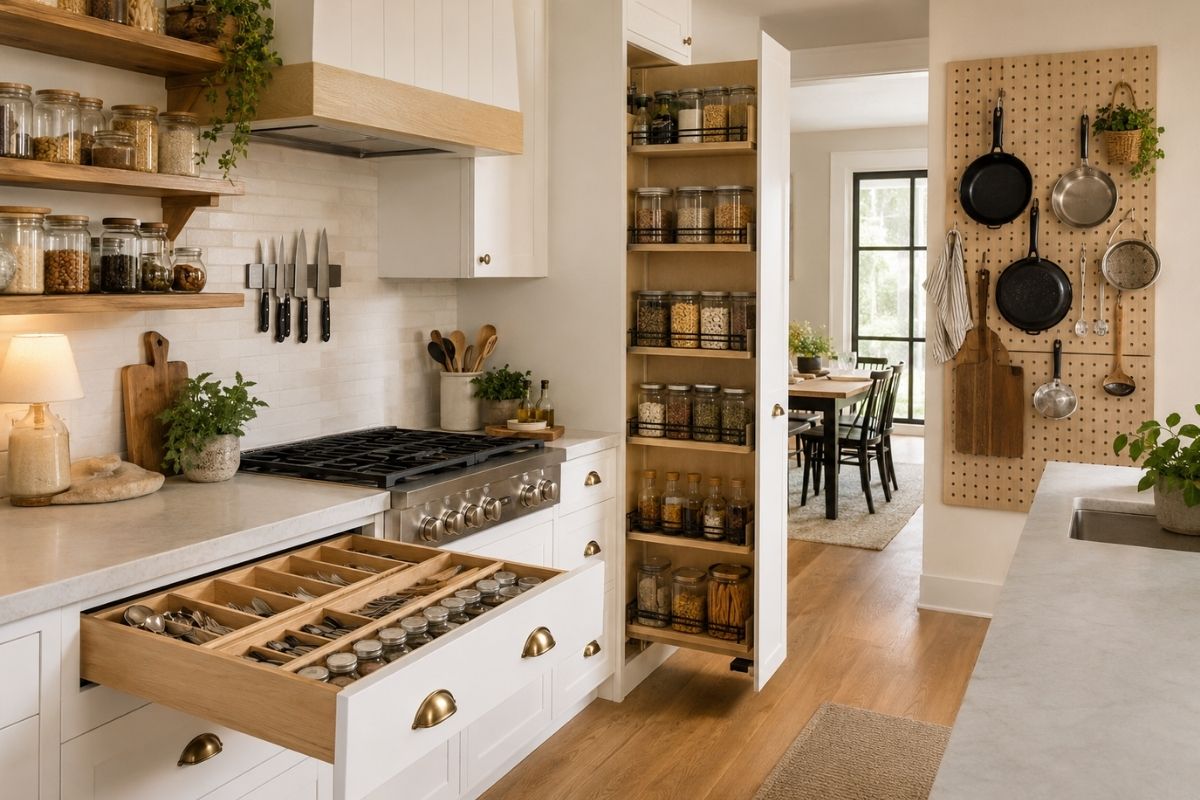
Kitchen storage is one area where the planning done before cabinets are installed is almost impossible to undo cheaply. A kitchen with the wrong internal organisation — too many shelves, not enough drawers, no corner solution, dead upper cabinet space — makes daily cooking frustrating regardless of how good the rest of the design is.
The Zone Hierarchy
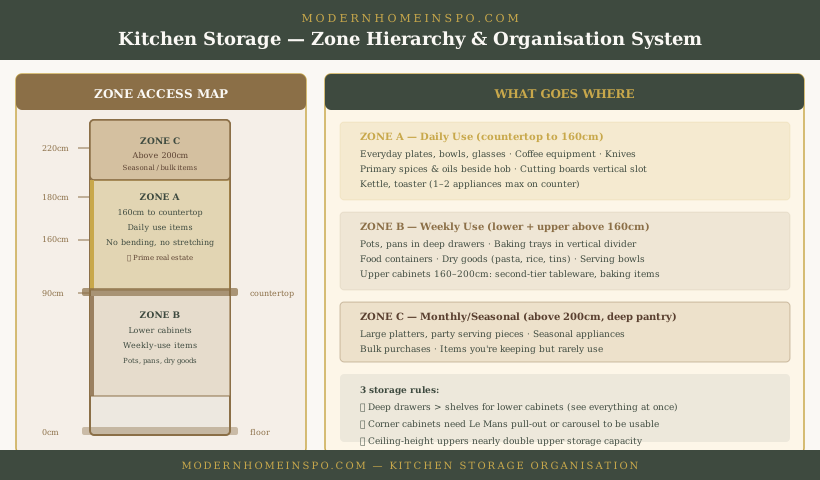
Not all kitchen storage is equally accessible, and not all kitchen items need equal accessibility. Matching item frequency-of-use to storage accessibility is the foundation of an efficient kitchen.
Zone A: Daily-use zone (countertop to 160cm height)
Everything used every day should live here without bending or stretching:
- Everyday plates, bowls, glasses in upper cabinets at 130–160cm
- Coffee equipment, toaster, kettle on the countertop (one or two appliances maximum)
- Knives in block or magnetic strip at counter level
- Cutting boards in a vertical slot beside the hob
- Cooking oil, salt, primary spices beside the hob
Zone B: Weekly-use zone (under counter and above 160cm)
Items used multiple times a week but not daily:
- Pots, pans, and lids in deep lower drawers
- Baking trays and chopping boards in a vertical lower cabinet with dividers
- Food storage containers in a dedicated drawer with lids organised separately
- Second-tier tableware (serving bowls, platters) in upper cabinets
- Tinned goods, dry pasta, and staples in pantry or deep lower cabinet
Zone C: Seasonal-use zone (above 200cm and deep pantry)
Items used monthly or seasonally:
- Party-size serving pieces, large platters
- Seasonal appliances (ice cream maker, pasta machine)
- Extra supplies bought in bulk
- Items you’re keeping but rarely using
Drawer Strategy
Deep drawers over lower shelves
The standard lower cabinet with two shelves is the least efficient storage format in a kitchen. To reach items at the back, you must remove everything in front. To see what’s there, you must squat and peer into a dark cavity.
A deep drawer (20–25cm depth) with the right insert shows everything at a glance and retrieves any item in one movement. The cost difference in cabinetry is modest; the daily impact is significant.
Recommended deep drawer layout in a 60cm-wide lower cabinet bank:
- Top drawer (10cm): utensils, spatulas, tongs — with a divider insert
- Middle drawer (18cm): cutlery with a cutlery tray, or spice jars lying flat
- Bottom drawer (25cm): pots, pans, lids, with a lid holder insert
Soft-close mechanisms
Soft-close hinges and drawer runners are worth the premium in a kitchen — the impact and noise of cabinet doors and drawers slamming is a significant quality-of-life issue in daily use. Most decent kitchens now include this as standard.
Internal drawer organiser types
- Cutlery trays: expandable inserts that fit standard and deep drawers
- Pot lid holders: upright dividers that keep lids visible and accessible
- Knife blocks (in-drawer): safer and more space-efficient than counter-top blocks
- Deep drawer inserts for dry goods: expandable grids that section the drawer
Upper Cabinet Storage
Ceiling-height cabinets
The most common upper cabinet wasted space: the 30–40cm gap between cabinet top and ceiling. Dust, grease, and miscellaneous items accumulate in this no-man’s-land. Extending cabinets to ceiling height eliminates this gap and provides an additional shelf for Zone C items.
The top section (above 200cm) is only accessible with a step stool — fine for items used once a month. The storage volume gained is substantial.
Internal organisation
Upper cabinets with fixed shelves often have one shelf too many (shelves too close together) or one too few (wasted space above short items). Adjust shelf positions to match what’s stored:
- Glasses: 30–35cm between shelves
- Dinner plates stacked: 25–30cm
- Small bowls: 20–25cm
- Mugs: 15–20cm (or use a mug tree in the cabinet)
Glass-front doors
Glass-front uppers reduce the visual mass of a solid cabinet run and can double as subtle display storage for well-organised contents. Best with internal LED strip lighting on a sensor — the light triggers when the door opens.
Corner Cabinet Solutions
The corner problem
Two runs of cabinets meeting at a right angle create a dead corner — space that’s technically accessible but practically impossible to use efficiently with standard shelving. The corner represents potentially 0.3–0.4m² of floor space and significant storage volume that most kitchens either waste or fill with forgotten items.
Le Mans pull-out (best solution)
Kidney-shaped shelves on a dual-arm mechanism that pulls out and rotates forward as the door opens. Provides full access to the corner storage without reaching into the back of a dark cabinet. The most expensive corner solution but the most usable. Typically adds £200–£400 to a corner cabinet cost.
Carousel lazy Susan
A rotating circular shelf on a fixed pole. More affordable than Le Mans, more accessible than fixed shelving. Limitation: the circular shelves don’t use the corner volume efficiently — significant dead space at the corners of the circle. Best for small, lightweight items (spice jars, small food containers).
Diagonal corner cabinet
A 45° corner door instead of two doors at a right angle. The wider door and diagonal interior makes the corner more accessible than a standard configuration, without the mechanism cost of Le Mans or carousel. Works best for items you can stack (mixing bowls, colander, large pot).
Open corner shelf
Remove the upper corner cabinet entirely and replace with a single floating shelf in the corner. Less storage volume, but completely accessible and a visual lightening of the cabinet run. Works well above counter height in kitchens with good natural light.
Pantry Organisation
Pantry cabinet (tall larder)
A 200–220cm tall larder cabinet (60cm deep) provides the equivalent of 8–10 standard upper shelf rows in one floor footprint. Organise by frequency: most-used items at 100–150cm height, least-used at the very top and very bottom.
Internal organisation: adjustable shelves at the front set to the heights of what’s stored. Taller items (oil bottles, cereals) on deeper shelves; shorter items (spice jars, tins) on shallower front shelves or pull-out baskets.
Pull-out pantry in narrow gaps
A 15–20cm gap between a cabinet run end and a wall can accommodate a pull-out pantry tower — essentially a tall column of shelves on a sliding track. This converts otherwise dead gap space into accessible storage for spices, oils, and small tins.
Wire baskets vs solid shelves
Wire baskets in a pantry allow visibility of contents from all angles without removing items. Best for produce (potatoes, onions) and irregular-size items. Solid shelves are better for jars and tins that need a flat base.
Using Vertical Space
Wall-mounted magnetic strip
A magnetic knife strip mounted at the back of the hob area keeps knives accessible without taking up drawer space. The same magnetic strip system works for metal spice tins — a row of magnetic tins on a strip in a narrow wall gap between run end and doorframe is a frequently overlooked storage win.
Pegboard or slatwall panel
A pegboard panel (50×60cm minimum) mounted beside the hob accommodates hooks for utensils, a shelf for oils, and a small herb pot — replacing multiple drawers and counter space in a small kitchen. The system is flexible and rearrangeable.
Over-cabinet storage
A rail system mounted on the bottom of upper cabinets holds hooks for mugs, a rail for hanging utensils, and paper towel rolls. Keeps the countertop clear without requiring drawer space.
Windowsill storage
A deep windowsill above the sink can hold a growing herb garden (practical, reduces grocery runs) or a small collection of condiments and oils that would otherwise sit on the counter.
Upgrades Without Renovation
Not every storage improvement requires a new kitchen. These upgrades work within existing cabinet carcasses and require no structural changes — relevant for renters, those in rented properties, and anyone who wants to improve storage without a full kitchen refit.
Drawer inserts retrofitted into existing shelves
Many lower cabinet carcasses can accept deep drawer boxes as a retrofit — the shelf is removed and drawer runners are mounted inside the carcass walls. Cost: £40–£120 per drawer box depending on quality. IKEA MAXIMERA and Häfele drawer systems are commonly used for retrofits. This converts a deep shelf into a fully accessible drawer without replacing the cabinet.
Under-shelf baskets
Wire or plastic baskets that clip onto the underside of existing upper shelves create a secondary storage level within the cabinet. Useful for mugs (hang below the plate shelf), small containers, or foil and cling film rolls that would otherwise take up drawer space.
Cabinet door organisers
Mounted on the inside of cabinet doors: spice racks, cleaning product holders, recycling bag dispensers. The inside of a door is wasted space in most kitchens. A door-mounted spice rack inside a lower cabinet door frees up a full shelf.
Pull-out bin retrofit
A standard pull-out bin unit (single or double bin, on a door-mounted frame) can be installed in any lower cabinet with a standard door and carcass depth. Cost: £30–£80 for the mechanism. Eliminates the freestanding bin from the kitchen floor — a significant space gain in compact kitchens.
Magnetic spice storage on the fridge
Magnetic spice tins on the side of the fridge occupy zero counter or shelf space. Works only with non-stainless fridge surfaces (stainless steel is non-magnetic). Sets of 20–30 tins cost £20–£50 and replace an entire spice drawer.
Tension rod dividers in lower cabinets
Vertical tension rods mounted inside a lower cabinet create dividers for baking trays, chopping boards, and pan lids at minimal cost (£5–£10 per rod pair). The same trays that were stacked horizontally and inaccessible become individually filed and retrievable in one motion.
Frequently Asked Questions
- Are deep drawers or shelves better in kitchen lower cabinets?
- Deep drawers are significantly more efficient than shelves for pots, pans, and dry goods. With shelves, you must remove front items to reach back items. With deep drawers, all contents are visible and accessible in one movement. The investment in drawer inserts and dividers pays for itself in daily convenience.
- How do I organise a corner kitchen cabinet?
- A corner cabinet without a pull-out system is inaccessible dead space. Solutions in order of effectiveness: lazy Susan carousel (standard fix, wastes some space), Le Mans pull-out (the best solution — kidney-shaped shelves pull forward and rotate), diagonal corner cabinet with wider door (simpler), or remove the upper corner cabinet entirely and replace with open shelving.
- What should be stored in kitchen drawers vs cabinets?
- Drawers: cutlery, utensils, small tools, spices (in a deep drawer), knives (in a block or magnetic strip). Cabinets (lower with shelves): cleaning products, pots and pans (though deep drawers work better), baking trays (with vertical dividers). Cabinets (upper): glasses, plates (daily), food items in regular use.
- How do I add storage to a kitchen with no pantry?
- A tall larder cabinet (200–220cm) in a kitchen with no dedicated pantry provides equivalent storage. If floor space doesn't allow it, use the full height above upper cabinets (with ceiling-height uppers), install a pull-out pantry unit in a narrow gap (as little as 15cm wide for a pull-out spice and tin rack), and add wall-mounted magnetic strips for knives and spice jars.