White Kitchen Ideas: How to Do It Right Without It Looking Cold or Bland
Quick Answer
A white kitchen avoids looking cold by using warm-undertone whites (cream or yellow base, not blue), pairing with a warm countertop (oak, cream quartz, or warm stone), choosing brass or brushed gold hardware, adding a splashback with texture (metro tile, zellige, ribbed glass), and introducing at least one warm-toned material — pendant light shade, bar stools, or open shelving in oak. The most common mistake is pairing warm-white cabinets with cool grey quartz and chrome hardware — the undertone mismatch creates a sterile result that's expensive to fix.
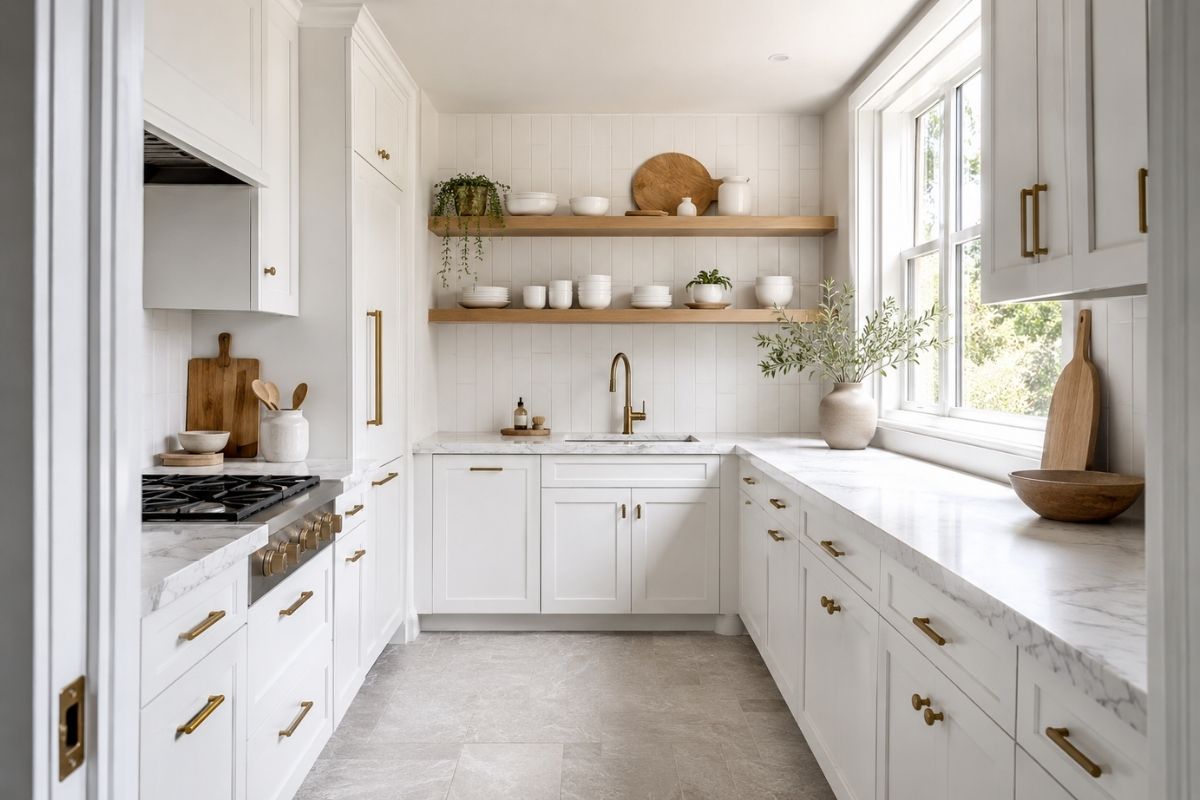
A white kitchen is the most timeless kitchen choice — and also the one most frequently executed badly. The poor versions are sterile, cold, and identifiable immediately: brilliant white cabinets, cool grey quartz countertop, chrome taps and hardware, flat tile splashback. The good versions are warm, layered, and enduring. The difference comes down to undertone matching and texture — not the amount spent.
Choosing the Right White
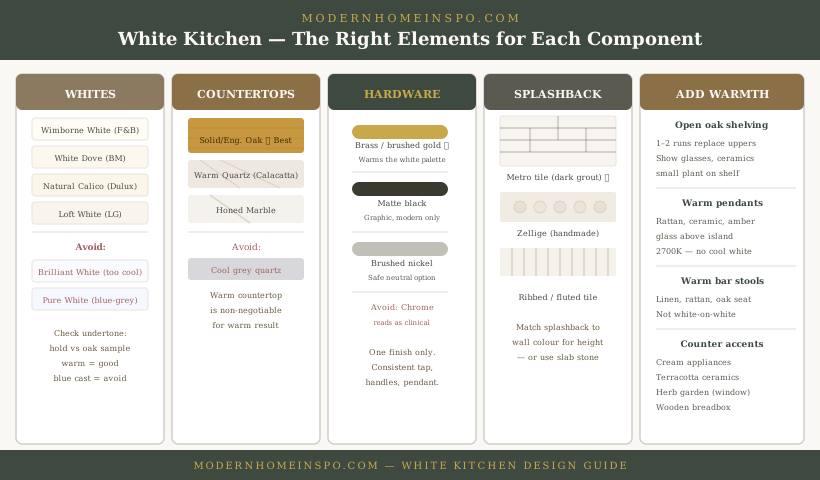
Not all whites are equal. Every white paint has an underlying tint — warm (cream, yellow) or cool (blue, grey). In a kitchen, the undertone of the cabinet white determines what it can pair with successfully. For the full explanation of warm vs cool undertone families and how to test, see Kitchen Color Ideas.
Warm whites to use (recommended)
These whites read as white in normal viewing but produce warmth alongside timber, stone, and brass:
- Farrow & Ball Wimborne White — one of the most popular UK kitchen cabinet whites, warm ivory undertone
- Farrow & Ball All White — slightly warmer than the name suggests
- Dulux Natural Calico — cream undertone, one of the best-value warm whites
- Little Greene Loft White — very pale but visibly warm
- Benjamin Moore White Dove — the standard US warm-white cabinet choice
Cool whites to avoid on cabinets
Brilliant white, pure white, and whites marketed as “crisp” or “pure” typically have blue or grey undertones. Under kitchen artificial lighting these read as stark and cold. They also clash with warm countertop materials (oak, cream quartz, marble) in a way that’s subtle but persistent.
Countertop Pairings
The countertop is where white kitchens gain or lose warmth. The wrong pairing makes the entire room feel unresolved.
Oak and warm wood
Solid or engineered oak butcher block is the warmest pairing with white cabinets. The honey tone contrasts gently with white doors without a sharp colour boundary. Particularly effective with shaker profile cabinets. Oil and maintain oak regularly — high-maintenance but unmatched for warmth and character.
Warm white quartz
Quartz with a cream base and warm beige or gold veining (Calacatta Gold, Calcutta Viola, or similar) reads as white from a distance but introduces warmth through its veining. Durable, low-maintenance, consistent across the full run. Avoid grey-toned quartz — the cool undertone fights warm-white cabinets.
Honed marble
White Carrara or Statuario marble in a honed (matte) finish. The grey veining in Carrara is cool-toned — can work with warm white cabinets if the veining is light, but test carefully. Statuario’s more dramatic gold/grey veining works better with warm whites. Marble requires sealing and careful maintenance — it marks from acid (lemon juice, vinegar) and stains.
Concrete
A warm-toned concrete (the colour of naturally set concrete, not the cool grey of engineered concrete countertops) works well with white cabinets. Has a handmade quality that suits farmhouse and industrial-modern kitchens.
Splashback Options
The splashback is the strongest opportunity to add texture to a white kitchen without disrupting the palette. Texture is what separates a white kitchen with presence from a blank white box.
Metro tile (brick bond)
The classic white kitchen splashback. White metro tile with a dark grout (charcoal or warm grey) adds texture and definition without colour complexity. White tile with white grout reads as seamless — less interesting but works in very small kitchens where texture would overwhelm.
Zellige tile
Moroccan handmade glazed tiles in white or off-white. The imperfect glaze creates a subtly varied surface that catches light differently across the day. More character than metro tile, slightly higher cost. The irregular edges require a skilled tiler — poor fitting reads as DIY rather than deliberate.
Ribbed or fluted tile
A vertically ribbed white tile creates shadow lines that add dimension without pattern. More contemporary than metro tile, particularly effective with flat-panel (handleless) cabinet profiles.
Slab splashback
The same stone as the countertop run as a slab splashback. Creates a unified, seamless look from counter to wall. Works best with distinctive-veined stone (marble, quartzite) where the continuation of pattern reads as a design feature. Requires precise cutting and fitting — not a budget option.
Adding Warmth and Texture
Beyond the countertop and splashback, several elements prevent the clinical result:
Open shelving in oak
One or two floating oak shelves replacing upper cabinets on a short run or end wall. The warm wood tone breaks up the white expanse significantly. Use them for everyday glassware, a few ceramics, and small plants. Not suitable for concealment storage — they only work if what’s on them is presentable.
Warm pendant lighting
A pendant above the island or sink in a warm material — rattan, ceramic, or hand-blown amber glass — adds a warm tone at eye level. Avoid chrome and bright stainless pendants in a white kitchen — they reinforce the clinical palette rather than softening it.
Bar stools with warm materials
The seating at an island or peninsula is an opportunity to introduce warmth: natural linen upholstery, woven rattan backs, warm oak seat, or leather. A white bar stool at a white island disappears; a warm oak or linen stool creates visual contrast and anchors the island zone.
Ceramics and small warm-toned items
A cream KitchenAid, terracotta-coloured ceramic bowls on display, a wooden bread box — small items that collectively warm the counter surfaces without requiring structural change.
Style Variations
Classic/shaker white kitchen
Shaker door profile in warm white + oak countertop or honed marble + brass cup handles + metro tile splashback + oak open shelving. The most used and proven combination. Works across room sizes, in traditional and contemporary schemes alike.
Modern/handleless white kitchen
Flat-panel handleless doors in warm white + warm quartz countertop + matte black hardware (J-pull or push-to-open) + ribbed tile or slab splashback + black pendant. Cleaner and more contemporary than shaker but less warmth-tolerant — the countertop and splashback warmth must compensate for the absence of visible hardware texture.
Farmhouse white kitchen
White or cream painted cabinets in a traditional country door style + butler sink + oak countertop + aged brass hardware + brick-pattern splashback + open dresser shelving. Warmest interpretation of the white kitchen. See Farmhouse Kitchen Ideas for the five defining elements of the farmhouse style and what breaks the look.
Common White Kitchen Mistakes
Understanding what goes wrong is as useful as knowing what works. These are the most frequently occurring white kitchen errors:
Warm white cabinets + cool grey quartz
The most common expensive mistake. The warm cream cabinet and the cool blue-grey worktop fight each other’s undertones. Neither looks right; the effect is “something is off” that the homeowner can feel but not explain. The fix (replacing the worktop) costs more than the original installation. Prevention: test the cabinet paint sample against the actual worktop sample before ordering either.
Chrome hardware on warm-white cabinets
Chrome has a cool blue-white metallic tone that directly conflicts with warm-white cabinets. The combination creates the clinical result most people are trying to avoid. The substitution of brass or brushed gold hardware is the single highest-impact change in a white kitchen, and the cost difference is modest.
Pure brilliant white in poor light
Cool brilliant white in a north-facing or artificially lit kitchen amplifies every shadow harshly. Knife marks, scuffs, and fingerprints all show more clearly on cool white than on warm white. The kitchen reads as sterile in exactly the way the best white kitchens avoid. Warm white conceals minor marks better and handles artificial light more gracefully.
White-on-white-on-white with no texture variation
White cabinets, white quartz, white tile, white walls — a mono-material white kitchen with no texture variation looks flat and unfinished rather than clean and refined. At least one surface needs texture (tile grout lines, wood grain, stone veining) or the kitchen reads as incomplete.
Matching the tap and hardware to different finishes
A brass tap with brushed nickel bar handles and a chrome pendant: three metallic tones create visual noise in a white kitchen where the hardware is very visible against the light background. One hardware finish throughout — including the tap, pendant shade finish, and any visible appliance trim.
Frequently Asked Questions
- What is the best white for kitchen cabinets?
- Warm whites with a cream or yellow undertone: Farrow & Ball Wimborne White or All White, Dulux Natural Calico or Jasmine White, Benjamin Moore White Dove or Chantilly Lace. Avoid brilliant white and pure cool whites — they show fingerprints harshly, create a clinical look, and clash with warm countertops and natural materials.
- What countertop goes best with white kitchen cabinets?
- Warm oak (solid or engineered), warm white quartz (Calacatta or Carrara style with warm beige veining), honed marble, or warm concrete. Avoid cool grey quartz — it fights the warm undertone of most white cabinet paints and creates an unresolved palette that makes both surfaces look worse.
- Will white kitchen cabinets go yellow over time?
- Cheap alkyd or oil-based paints yellow significantly, especially in low-light areas. Water-based eggshell or satin paint from quality brands resists yellowing much better. Quality kitchen cabinet paint formulations (Farrow & Ball, Little Greene, Lick) are specifically formulated to resist yellowing.
- Are white kitchens still in style?
- White is the most consistently popular kitchen colour over any 10-year period — it never goes fully out of style because it is not a trend. What changes is the shade of white (currently warm whites preferred over cool), the door profile, and the countertop and hardware pairings. White as a base is a permanent choice.