Minimalist Kitchen Decor Ideas That Stay Functional
Quick Answer
A minimalist kitchen requires edited countertop surfaces (only items used daily remain out), handleless or simple hardware, a consistent two or three material palette (one cabinet finish, one countertop material, one backsplash), adequate storage so everything else disappears, and lighting that is functional without being harsh.
Core Principles
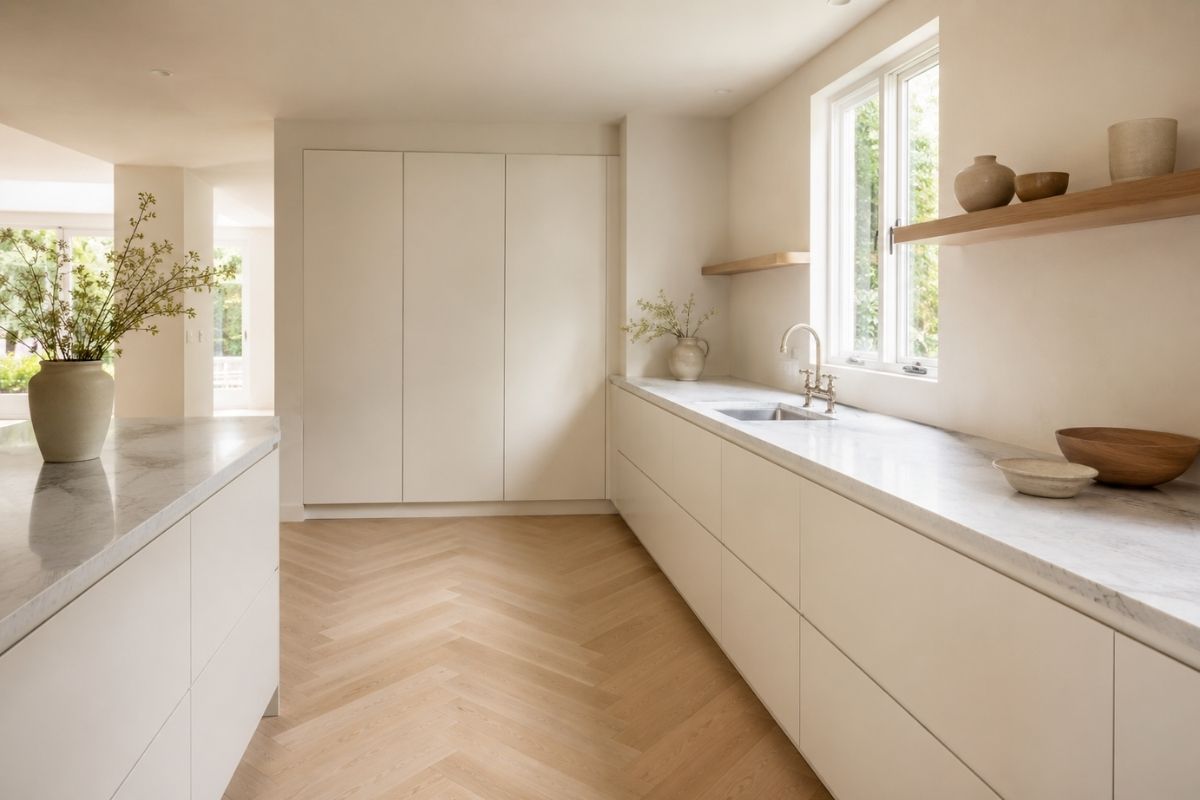
Minimalist kitchen design is not about removing all objects — it is about removing all objects that do not need to be visible. The goal is a kitchen where every visible element is either functional or intentional, and nothing is on a surface because there was nowhere else to put it.
The three minimalist kitchen principles:
1. Everything has a home. Adequate storage is the precondition for minimalist kitchen surfaces. Before any aesthetic decisions, audit storage: is there enough drawer and cabinet space for every item? If not, adding storage (a pantry, cabinet organizers, drawer inserts) is the first step — not cosmetic changes.
2. Surfaces are cleared after every use. A minimalist kitchen requires a behavioral commitment: clearing the countertops after cooking, putting everything away before going to bed. The visual quality of the kitchen depends on this daily habit.
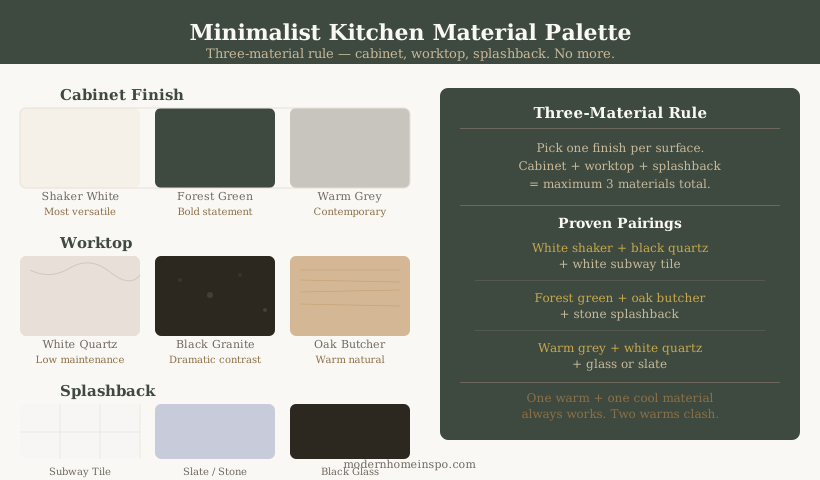
3. Two or three materials, consistently applied. A coherent material palette — one cabinet finish, one countertop material, one backsplash material — creates visual unity. Each additional material adds visual complexity that works against the minimalist effect.
Cabinetry and Hardware
Cabinet doors: Flat-front (slab) doors with push-to-open or recessed groove hardware create the cleanest minimalist surface. Shaker doors (with central panel and visible frame) are a softer, more traditional minimalist option. Avoid raised panel, ornate molded, or glass-front doors — these add visual complexity.
Hardware: Handleless push-to-open or integrated recessed groove handles eliminate hardware entirely. If visible hardware is preferred, bar pulls or small knobs in a single finish (matte black, brushed brass, or brushed nickel) are cleaner than mixed hardware styles.
Cabinet finish: Matte or semi-matte finishes in flat paint or matte laminate read as more minimalist than high-gloss finishes — gloss surfaces reflect everything in the room, including any clutter on adjacent surfaces. For a warmer minimalist kitchen, warm white or off-white matte cabinets pair well with most countertop and backsplash materials.
Color: The cabinet color sets the kitchen’s character. White or off-white (warm or cool depending on the room’s light direction), warm gray, or muted sage green all work. Avoid multiple cabinet colors within the same kitchen — one consistent color for all cabinetry creates visual unity. For undertone matching rules and the full palette decision process, see Kitchen Colour Schemes.
Countertop Editing
The countertop is the primary surface battle in any kitchen. Items accumulate on countertops because they are used frequently (coffee maker, kettle, toaster) or because there is no storage for them.
The daily-use test: Only items used every day belong on the countertop. A coffee maker used daily: stays. A juicer used twice a week: goes in a cabinet. A bread maker used monthly: goes in storage. This single filter eliminates most countertop clutter.
Appliance garages: A dedicated cabinet section with a roll-up door or flipper doors, positioned at countertop height, allows frequently used appliances to be stored at the counter but hidden when not in use.
What can always be removed:
- Paper towel holder (replace with a cloth towel hanging rail)
- Knife block (replace with an in-drawer knife insert or magnetic strip inside a cabinet door)
- Dish rack (dry dishes immediately and put away, or get a discreet under-shelf drainer)
- Decorative items that are not intentional and maintained
Design Tip
Clear the countertops completely — including the items you think “need” to be there — and live with completely clear surfaces for one week. The items you actively reach for and have to retrieve from a cabinet are the ones that genuinely belong out. The items you do not reach for stay in the cabinet.
Materials and Palette
Countertop: Honed stone (marble, granite, limestone, soapstone), matte quartz composite, poured concrete, or solid wood. Honed finishes read as more minimalist than polished; they do not show water marks and fingerprints as clearly and have a quieter visual quality.
Backsplash: A continuous material backsplash — full-height same-material extension of the countertop, large-format tiles, or polished plaster — reads as more minimalist than subway tile (which has visible grout lines that add texture and pattern). If subway tile is used, go with minimal grout lines in a color that matches the tile closely.
Flooring: Polished concrete, large-format porcelain tile (600×600mm minimum), or stone create the cleanest minimalist floor. Standard-sized tiles with many grout lines add pattern that competes with the goal of visual calm.
The two-material rule: If possible, extend one material continuously across multiple surfaces. A countertop material used as a backsplash creates a seamless surface that reads as one element rather than two. This simplification reduces visual complexity more effectively than choosing “compatible” separate materials.
Open Shelving
Open shelving in a minimalist kitchen is a calculated risk: it reduces visual mass and can display beautiful objects, but it requires rigorous maintenance to avoid becoming a clutter surface.
If using open shelving:
- Maximum 5–8 items per shelf, all in a consistent palette (all white ceramics, all natural wood, all clear glass)
- Remove anything that does not contribute aesthetically — mismatched items, old packaging, equipment rarely used
- Every item on an open shelf should be something you would willingly put on display
Materials for open shelves: Solid wood (floating oak, walnut, or pine shelf) or thick stone on heavy-duty brackets. The shelf material and bracket should be chosen with the same care as any visible surface material.
If discipline is a concern: Closed cabinets with interior organization are a stronger minimalist choice than open shelving that accumulates clutter. The goal is the visual result, not the specific method — closed cabinets can produce an equally clean result.
Lighting
Minimalist kitchen lighting serves two functions: task lighting for food preparation and ambient lighting for the room.
Under-cabinet LED strip: Direct task lighting over the countertop from under the wall cabinets eliminates shadows during food preparation and can be very clean in appearance. LED strip hidden behind a cabinet lip is invisible when not in use.
A single pendant or pendant row: A single pendant above an island or peninsula, or a linear pendant above a dining section, provides focused light with a deliberate design presence. Choose a simple form — a dome pendant, a cylinder, or a linear bar — without decorative detail.
Avoiding: Multiple track lights or multiple separate pendant fixtures that create a complex ceiling plane. One clean ceiling fixture type, consistently applied.
Bulb temperature in the kitchen: 3000K (neutral-to-warm white) is more practical in a kitchen than the 2700K used in living and sleeping areas — it is bright enough for task lighting while remaining warmer than the cool clinical daylight (4000K+) of commercial kitchens.
Functional Minimalism
A minimalist kitchen that cannot be cooked in is a design failure. Minimalism in the kitchen must accommodate the reality of cooking: knives, cutting boards, pots and pans, spices, and a substantial amount of equipment.
Organization enables aesthetics. The minimalist kitchen’s clean surfaces depend entirely on good internal organization: drawer inserts for utensils, cabinet organizers for pans and lids, pull-out shelves for deep cabinets, labeled containers for dry goods. Good interior organization allows complete counter clearing in under two minutes. For the full zone-by-zone storage system, corner solutions, and pantry organisation, see Kitchen Storage Ideas.
Quantity editing. Beyond organization, minimalism in the kitchen often requires reducing the quantity of equipment and tableware to only what is actually used. One good set of knives, one set of quality pans, one set of tableware — these replace multiple sets of varying quality and fill cabinets more efficiently.
The minimum usable set: Most home cooks actively use: one chef’s knife, one paring knife, one 10-inch skillet, one 3-quart saucepan, one large stockpot, one baking sheet, and one cutting board. Everything beyond this is specialist equipment used for specific dishes. Identifying the minimum usable set clarifies what actually needs accessible storage and what can go into deep storage or be donated.
Frequently Asked Questions
- How do I keep a minimalist kitchen looking minimalist day to day?
- Adequate storage is the only reliable solution. If every item has a dedicated storage location, clearing the countertops is a 2-minute task. If storage is inadequate, items accumulate on surfaces because there is nowhere else to put them. Before any aesthetic changes, audit whether there is enough cabinet and drawer space for everything in the kitchen.
- What cabinet style looks most minimalist?
- Handleless flat-front cabinets with push-to-open or recessed groove handles create the cleanest minimalist look. Shaker cabinets (with a central panel and frame) are a softer second option that reads as minimalist when painted in a consistent neutral tone. Avoid ornate cabinet doors with decorative molding — these compete with the clean surfaces.
- What is the best color for a minimalist kitchen?
- White and off-white are the most common minimalist kitchen choices — they maximize light and provide the cleanest visual surface. Warm gray (with a warm, beige-adjacent undertone) is a softer alternative. Muted sage green or soft black (in cabinetry only, against white walls and countertop) are more characterful minimalist options. The choice depends on the light available and the adjacent room palette.
- Should a minimalist kitchen have open shelving?
- Open shelving works in a minimalist kitchen only if it is very deliberately edited — 5–10 items maximum per shelf, all in a consistent material palette. Open shelving that accumulates mismatched objects, unused equipment, and dusty items is the opposite of minimalist. If the discipline required to maintain edited open shelving is not realistic, closed cabinets are the better minimalist choice.