Modern Living Room Ideas: The Complete Style Guide With Rules That Actually Hold
Quick Answer
A modern living room uses the 60/30/10 palette rule (60% dominant neutral, 30% secondary tone, 10% accent — typically brass or forest green), clean-line furniture with no exposed carved wood frames, one metal finish only, layered lighting at 2700–3000K with a dimmer, and one statement plant in an architectural form. Chrome, high-gloss lacquer, mirrored furniture, and mixed metal finishes all break the style.
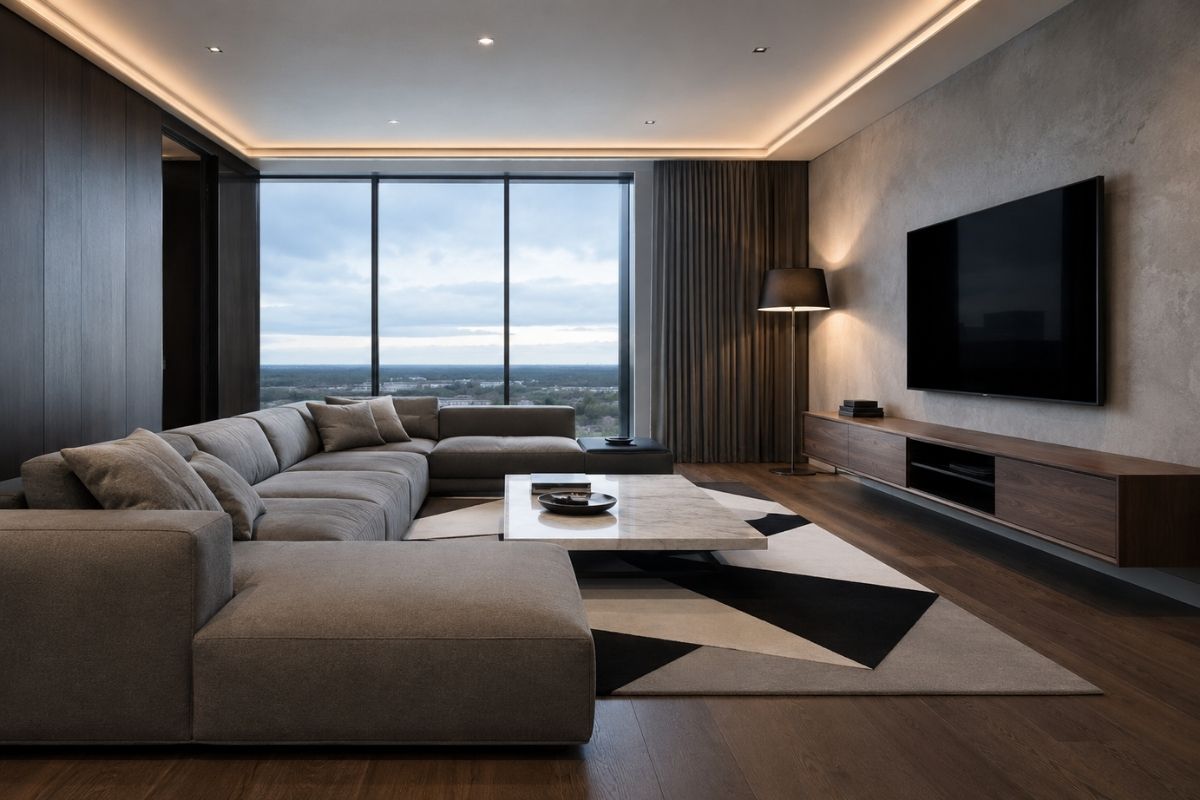
Modern interior design is one of the most misused style labels. It’s applied to everything from minimalist Japanese interiors to sleek American commercial spaces, making it almost meaningless as a search term. In residential context, modern means a specific set of principles: clean lines, restrained palettes, quality materials over quantity, layered warmth within a neutral framework.
It is not the same as contemporary (which just means current), not the same as minimalist (which goes further), and not the same as industrial (which uses different materials and a rawer aesthetic).
The Modern Palette
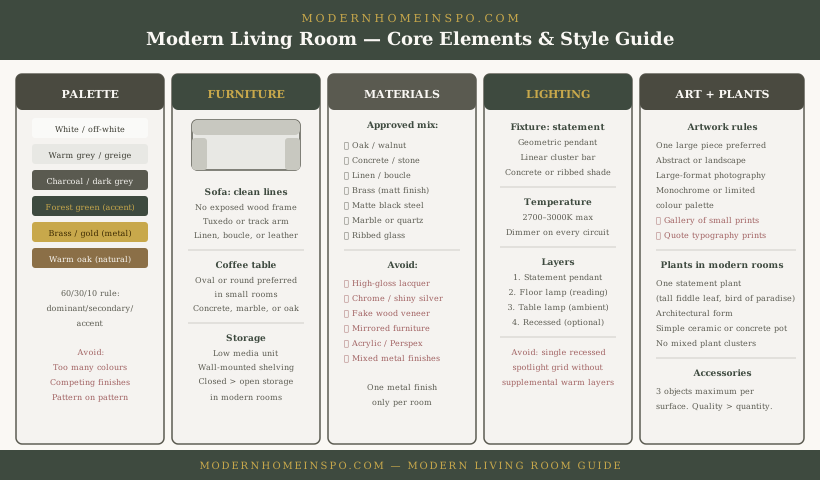
The modern residential palette follows a 60/30/10 structure:
60% dominant neutral
Off-white, warm white, or light greige across walls, ceiling, and the largest furniture piece (sofa or sectional). This is the visual background — it should feel calm and expansive, not stark.
White in a modern room needs warmth. Pure cool whites (with blue or grey undertones) read as clinical or commercial. Look for whites with a yellow or cream undertone: Benjamin Moore White Dove, Farrow & Ball Wimborne White, Dulux White Cotton.
30% secondary tone
Warm grey, greige, or charcoal on: secondary furniture pieces, curtains, rugs, or an accent wall. This is the grounding tone that gives the palette depth without competing with the 60% dominant.
10% accent
This is where a modern room shows personality. The most considered modern living rooms use one of three accent directions:
- Brass (warm gold tones, matte finish preferred over polished)
- Forest or sage green (muted, not vivid)
- Warm black (not cool charcoal — a deep warm tone with brown undertones)
The accent appears in: light fittings, hardware, one or two cushion covers, a single plant pot, and artwork.
Furniture Profiles
Sofa
The defining characteristic of a modern sofa is what it doesn’t have: no carved wood frame details, no rolled arms, no tufted buttons, no skirt to the floor. The silhouette is clean and architectural.
Arm style: tuxedo arm (straight, same height as back) or track arm (slightly lower than back, no padding break). Both read as modern.
Upholstery: linen, boucle (textured weave), or leather. Velvet in a jewel tone works in a modern room only if it’s used as a single accent chair, not the primary sofa.
Leg style: tapered wood legs (oak or walnut) or brushed metal. Both must be visible — skirted sofas to the floor are not modern.
Coffee table
Round or oval is preferred in small to medium rooms — it removes sharp corners from the circulation path. Rectangular works in larger rooms or when the sofa configuration calls for it.
Material: concrete, marble, solid oak, or a glass top with a metal base (this is one of the rare places glass works in a modern room). Avoid: faux wood, high-gloss lacquer, chrome legs.
Storage
A low media unit (max 45cm tall) rather than a tall entertainment unit. Wall-mounted shelving rather than floor-standing bookcases. Closed storage preferred over open shelving — modern rooms keep visual surfaces clean.
Materials That Work
Modern material logic: natural and matt. Processed and shiny reads as dated or corporate.
Approved materials
- Oak or walnut (solid or properly-finished veneer, not faux laminate)
- Concrete and stone (real or high-quality reproduction)
- Linen and boucle (primary upholstery fabrics)
- Brass (matte finish only — polished brass reads as 1980s)
- Matte black steel (furniture frames, light fittings)
- Marble or quartz (coffee table tops, fireplace surrounds)
- Ribbed glass (pendants, vases — adds texture without chaos)
The one-metal-finish rule
Choose one metal finish and use it everywhere: light fittings, cabinet hardware, curtain poles, decorative objects. Mixed metals — even subtle combinations — create visual fragmentation that works against the clean-line intent.
Brass is currently the most versatile choice in warm-modern rooms. Matte black works in cooler, more graphic interpretations.
Lighting Layers
Lighting is where modern living rooms fail most often. A grid of recessed spotlights covering the ceiling is the most common mistake — it produces even, flat, commercial-feeling light that makes the room look like an office.
Modern-specific lighting priorities:
Statement pendant as sculptural object
One pendant fixture chosen for visual form, not just function. Geometric pendant, linear cluster bar, or ribbed concrete shade. Hung lower than most people place it — around 200cm from floor for a pendant in an open living zone. The fixture should be visible and designed; in a modern room it’s part of the material language, not just a light source.
Arc floor lamp
The arc floor lamp — positioned beside the primary seating position and curving over it — is the most characteristically modern lighting piece. It’s functional (reading light), sculptural (the curve reads as a design statement), and warm (pointed down into the seating zone, not up at the ceiling).
Low-level warmth
A table lamp on the media unit or console prevents the TV wall from going dark when the TV is off, grounding that wall in the room’s overall warmth. 2700K throughout — the palette of a modern room (white walls, greige secondary, brass accent) looks right under warm light and reads as clinical under cool white.
For the full three-layer system, dimmer integration, and bulb temperature comparisons, see Ambient Lighting Ideas for Living Rooms.
Modern vs Scandinavian
Modern and Scandi are the two most commonly confused residential design styles — and the most frequently mislabelled. They share some features (clean lines, neutral palettes, natural materials) but differ in emphasis, material choices, and what they prioritise.
| Modern | Scandinavian | |
|---|---|---|
| Primary goal | Visual precision and material sophistication | Warmth, comfort, and hygge |
| Palette | 60/30/10 — structured, intentional | 80/15/5 — lighter, airier, prioritises white |
| Wood tone | Dark walnut or medium oak acceptable | Blonde oak or beech only |
| Metal | Brass or matte black — one finish only | Matte black steel; brass is not Scandi |
| Upholstery | Linen, boucle, or leather | Linen, cotton, light wool — no leather |
| Lighting | Statement sculptural pendant | Pendants secondary; floor lamp primary |
| Candles | Optional, occasional | Non-negotiable, always present |
| Textiles | Restrained — one throw, two cushions | Generous — sheepskin, wool blanket, multiple linen cushions |
| Feeling | Confident and composed | Warm and inhabitable |
A modern room can use Scandi furniture (Danish tapered legs work in both). A Scandi room should not use modern materials like concrete coffee tables or marble — those read as architectural rather than Nordic.
If the room you’re designing must feel warm above all else, Scandi principles serve it better. If it must feel precise and visually resolved, modern principles do. For more detail on Scandi-specific choices, see Scandinavian Living Room Ideas.
Art and Plants
Artwork
One large piece preferred over a gallery wall in a modern living room. The clean-line aesthetic benefits from one strong statement rather than a collection of smaller ones. Abstract or landscape in limited colour palette (pulling tones from the room palette). Large-format photography in black and white or muted tones.
What not to hang: gallery of small 30×40cm prints, typography prints with quotes, anything with a busy pattern or multiple saturated colours.
Plants
One statement plant rather than multiple small ones. Tall fiddle leaf fig, bird of paradise, or olive tree — architectural form that reads as a designed element rather than a pot plant cluster. Place in a simple ceramic or concrete pot.
One carefully chosen plant reads as confident. Five small mismatched plants reads as an afterthought.
Accessories
Three objects maximum per surface. Each should be chosen for form and material quality, not sentiment or novelty. A ceramic vase, a stack of design books, a sculptural object. Quality always over quantity in a modern room.
What Breaks the Style
High-gloss lacquer
High-shine furniture surfaces (lacquered cabinets, gloss-finish media units) reflect light in a way that reads as 2000s suburban rather than considered modern.
Chrome and shiny silver
Chrome hardware, chrome lamp bases, chrome table legs — all push the aesthetic toward commercial or dated. Switch to brass (warm) or matte black (graphic) instead.
Fake wood veneer
Low-quality wood effects — printed-on grain, plastic laminate — are immediately identifiable up close and undermine the material quality that modern design depends on.
Mixed metal finishes
Brass pendant + chrome side lamp + black curtain pole + gold hardware. Even if each piece is good individually, the combination creates visual noise.
Pattern on pattern
A patterned rug under a patterned sofa with patterned cushions. Modern rooms use pattern selectively — on one surface (usually the rug or one set of cushions), kept within the room’s colour palette.
Frequently Asked Questions
- What colours define a modern living room?
- White or off-white as the dominant tone (60%), warm grey or greige as secondary (30%), and one accent — typically brass, forest green, or warm black — as 10%. The palette stays warm and restrained; cool greys with no warm undertones read as corporate rather than modern residential.
- What furniture style is considered modern?
- Low-profile sofas with clean straight arms (tuxedo arm or track arm), no exposed decorative wood frame, in linen, boucle, or leather. Coffee tables in concrete, marble, or oak. Media units low and wall-mounted. Dining chairs with minimal silhouettes and no ornate detailing.
- Can a modern living room feel warm?
- Yes — modern doesn't mean cold. Warm oak, brass, linen, and boucle textures alongside 2700K lighting create warmth within a restrained palette. The mistake is keeping everything in cool grey and white, which reads as clinical rather than modern.
- How many metal finishes in a modern living room?
- One. Choose brass, matte black steel, or brushed nickel, and use it consistently across light fittings, hardware, and accessories. Mixed metal finishes — even subtle ones — create visual noise that works against the clean-line intent of the style.