Scandinavian Living Room Ideas: The Complete Guide to Scandi Style Done Right
Quick Answer
Scandinavian living room style uses an 80/15/5 palette (80% white/grey/sand, 15% warm anchor tone — taupe or warm grey, 5% nature accent — sage or forest green), blonde or untreated light oak, low-profile furniture with Danish tapered legs, hygge elements (candles always present, blankets accessible, real plants), linen curtains, and 2700K pendant or floor lamp lighting. The three rules: function first, nature inside, quality over quantity.
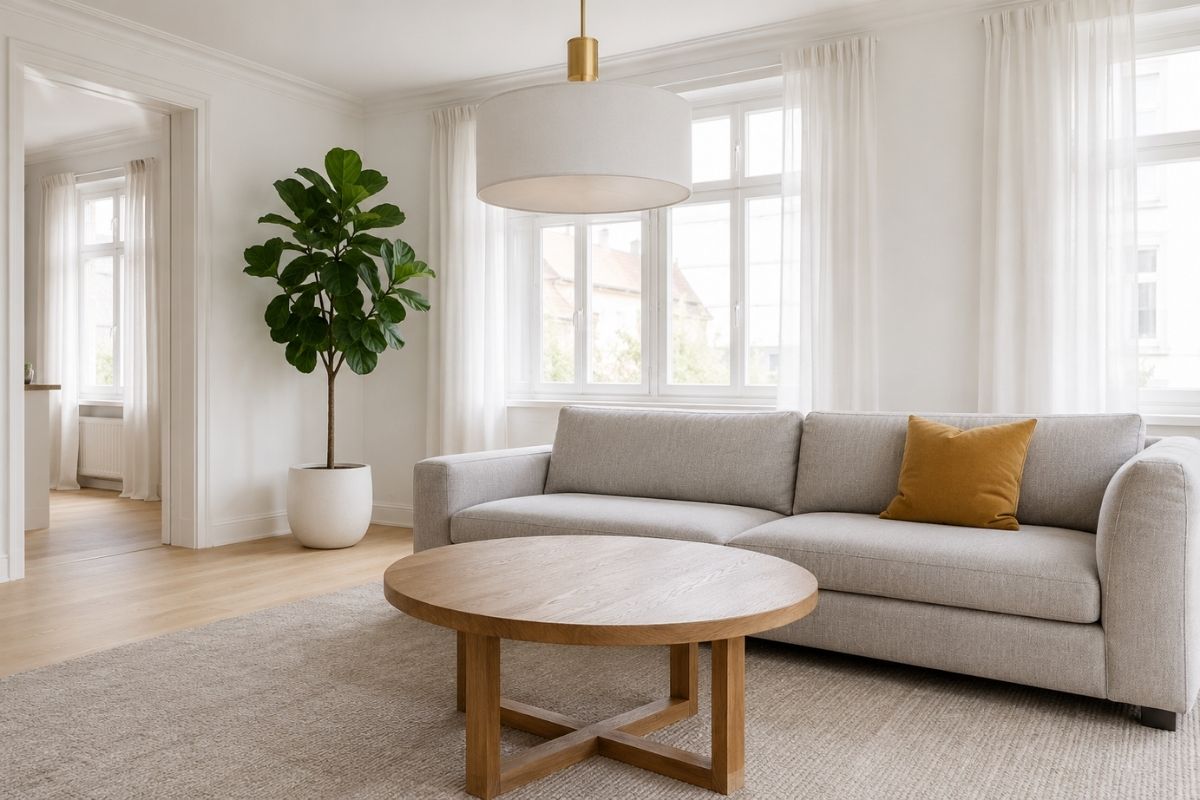
Scandinavian design is built around a specific problem: how to create warmth and comfort in rooms with limited natural light and long, cold winters. Every design principle traces back to that constraint. The light palette maximises available daylight. The warm lighting at 2700K compensates for its absence in the evening. The textiles — sheepskin, wool, linen — provide tactile warmth. The candles are not decorative; they’re functional objects from centuries of Nordic winter living.
Understanding this origin makes the rules easier to apply correctly and the exceptions easier to avoid.
The Scandi Palette
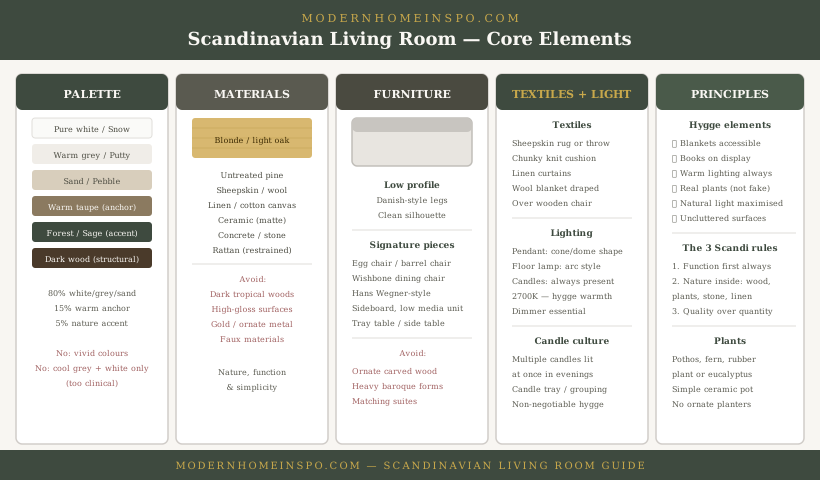
Scandinavian palette structure is 80/15/5:
80%: White, grey, and sand
Walls, ceiling, and the largest furniture pieces. This isn’t pure stark white — it’s a warm white (cream undertone), soft warm grey, or pale sand/putty. The warmth in these neutrals is essential; cool blue-grey and brilliant white undermine the hygge quality and make the space read as clinical rather than Scandinavian.
Recommended whites for Scandi rooms: Farrow & Ball All White (warm), Dulux White Mist, Benjamin Moore Chantilly Lace (warmer end). For grey: warm greige tones rather than blue-grey.
15%: Warm anchor tone
Taupe, warm putty, or sand — slightly deeper than the dominant tone. Appears in rugs, curtains, secondary cushion covers, and wooden surfaces.
5%: Nature accent
Forest green (muted, not vivid), sage, or rust-terracotta. Appears in one or two cushion covers, a plant pot, or a single ceramic piece. The accent should feel like it was brought in from nature, not selected from a colour wheel.
Materials and Surfaces
Light oak — the defining Scandi material
Blonde oak or beech is the signature wood. It should be oil-finished or matte lacquered — never high-gloss. The visible grain and warm honey tone are key; a dark or heavily lacquered wood reads as anything but Scandinavian.
Where it appears: furniture legs, coffee table, dining table, floating shelving, picture frames, candle holders, decorative bowls.
Supporting natural materials
- Sheepskin: draped over armchair or sofa arm, or used as a rug supplement
- Linen: primary curtain fabric, cushion covers, table runner
- Wool: rug (preferably flat-weave or loop pile), blankets
- Ceramic (matte finish only): pots, vases, candle holders
- Concrete and stone: in restrained applications (coffee table, side table top)
- Rattan: in limited use (one basket, not multiple rattan pieces)
Furniture Choices
Low profile with Danish legs
The Scandi sofa signature: low back, slim seat cushions, Danish tapered legs in natural oak or beech. The silhouette is clean and horizontal — the opposite of a deep-seat, high-back English sofa.
Upholstery: linen, cotton, or light wool in warm white, light grey, or pale sand. The sofa reads as part of the wall palette, not as a piece inserted in contrast to it.
Signature pieces
The history of Scandinavian furniture is full of recognisable forms that work in contemporary Scandi rooms:
- Egg chair or barrel chair (Hans J. Wegner, Arne Jacobsen lineage) — as a reading chair in the corner with a floor lamp beside it. This combination is the most complete hygge vignette available: chair, light, implied warmth.
- Wishbone chair (Y Chair, Wegner) — at a dining table in the open-plan space. The distinctive bent back rail and woven seat are immediately Scandi; the chair reads as considered even in modern and transitional rooms.
- Low sideboard — extending along one wall at around 45cm height, providing closed storage and a long horizontal surface for objects. The sideboard is the alternative to wall-mounted shelving and reads as slightly warmer and more furniture-like.
- Tray table or C-shaped side table — small footprint, can be tucked under the sofa when not in use. The movable tray table is a practical Scandi object: it goes where needed and disappears when not.
- Sheepskin stool or low pouf — a wool-covered or knitted pouf serves as footrest, extra seat, or display platform for a plant or candle grouping. At floor level it reinforces the low-profile horizontal emphasis of Scandi furniture.
Buying authentic vs Scandi-inspired: The chairs and sideboards associated with Nordic modernism (Wegner, Jacobsen, Aalto) are widely reproduced. Authentic originals (Fritz Hansen, PP Møbler, Artek) command significant prices. Well-made reproductions in natural oak with visible grain are visually indistinguishable in photographs; the difference is in material quality, joinery, and how they age. For a Scandi room on a budget, a quality reproduction of the right form is more Scandi than an expensive piece in the wrong material or silhouette.
What to avoid in a Scandi room
- Ornate carved wood frames
- Heavy baroque silhouettes
- Matching suites (sofa + loveseat + armchair in identical upholstery)
- High legs that feel mid-century American rather than Nordic
- Dark woods (walnut, mahogany, ebony)
Textiles and Lighting
Textile layering
A Scandi living room without textiles is incomplete. The layering goes:
- Linen curtains — floor to ceiling, unlined or lightly lined, letting light through during the day
- Wool or cotton flat-weave rug — natural tones, simple geometric or no pattern
- Sheepskin throw — over one armchair or draped at the end of the sofa
- Cushion covers — linen base with one or two in a nature accent colour
- Wool blanket — folded but accessible on the sofa
Lighting principles
The Scandi approach to lighting is not a design preference — it’s a response to Nordic climate. Scandinavia averages 6–7 hours of winter daylight. The entire lighting philosophy of Scandi interiors was developed to compensate for that absence, and it shows in every choice: multiple small warm sources, no central overhead flood, candles as working lights not decoration.
Pendant: cone or dome shape in natural material (paper, ceramic, or rattan) hung centrally — but not the primary light source at night. It functions as an ambient base layer kept low on a dimmer.
Floor lamp: arc or column style beside the reading chair. This is the primary evening light source. A Scandi room without a floor lamp beside the reading position is an unfinished room.
The Nordic candle ritual
In Scandinavia, the lykta — a candle lantern placed on the windowsill — is a centuries-old winter tradition visible from the street as a signal of inhabited warmth inside. In a Scandi living room, candles are working light objects, not props.
The standard: three to five unscented white or cream pillar candles grouped on a simple wooden or stone tray on the coffee table or sideboard. Lit in the evening whenever the room is occupied. The grouping creates light quality — the multiple flame reflections across wood, ceramic, and linen — that no LED can replicate.
For technical lighting (bulb temperatures, dimmer installation, the three-layer system), see Ambient Lighting Ideas for Living Rooms.
Hygge Principles
Hygge (pronounced “hoo-guh”) is the Danish and Norwegian concept of coziness, conviviality, and contentment — and it’s the underlying philosophy of Scandinavian interior design. A Scandi living room is designed to produce the hygge feeling.
Hygge checklist
- Blankets accessible, not stored away
- Books on display (on coffee table, on shelving)
- Warm lighting always — dimmable circuits
- Real plants, not artificial
- Natural light maximised during the day (light curtains, no heavy blinds)
- Uncluttered surfaces — selected objects, not collections
The three Scandi rules
- Function first, always. Every piece of furniture and every object must earn its place through use, not decoration alone.
- Nature inside: wood, plants, stone, linen. Materials connect the interior to the natural environment.
- Quality over quantity. One good ceramic pot is worth more than five decorative objects. The Swedish concept of lagom (just the right amount) applies.
What Scandi Excludes
Vivid colours
Scandi design is resolutely restrained in palette. Vivid turquoise, bright yellow, hot pink, or saturated jewel tones are incompatible with the style, regardless of how trendy they are at the time. If colour appears, it’s muted and warm.
Cool grey without warmth
The clinical, blue-grey aesthetic — popular in UK new-build interiors around 2015–2020 — is often mislabelled as Scandinavian. True Scandi grey has warmth. Cool grey without warmth reads as corporate and is precisely what Scandi design reacts against.
Gold or ornate metalwork
Brass is not Scandi. Gold is not Scandi. The metals in a Scandi room are matte black steel (for light fittings) or brushed chrome (for fixtures) — functional and minimal, not decorative.
High-gloss surfaces
Gloss lacquer, mirrored furniture, polished stone — these are the opposite of the matte, natural, understated Scandi material language. Every surface should diffuse rather than reflect light.
Faux materials
Artificial plants, faux fur that reads as plastic, faux wood laminate, fake stone. The Scandi relationship with nature is genuine — materials either are what they appear to be, or they’re not used.
Frequently Asked Questions
- What is the difference between Scandinavian and minimalist style?
- Scandinavian style values warmth and hygge alongside simplicity — it includes textiles, candles, plants, and lived-in comfort. Minimalism takes further reduction; it eliminates decoration and often personal items. A Scandi room has sheepskin throws and a candle grouping; a minimalist room might have neither.
- Does Scandinavian style require white walls?
- Not exclusively, but predominantly light colours — warm white, soft grey, or pale sand. The goal is maximising light in rooms that historically had limited natural light in Nordic winters. Warm whites with cream undertones work better than cool stark whites, which read as clinical rather than Scandi.
- What wood is used in Scandinavian design?
- Light, blonde, and untreated woods — primarily oak, beech, and birch. The grain is visible, the finish is matte or oil-finished (not high gloss), and the tone is warm honey rather than dark walnut or mahogany. Dark tropical woods are incompatible with Scandi style.
- Are plants part of Scandinavian design?
- Yes — real plants are a hygge principle. Pothos, fern, rubber plant, and eucalyptus are common choices. Fake or artificial plants are specifically excluded. The pot should be simple: ceramic in white, grey, or terracotta — no ornate planters.