Multifunctional Living Room for Work and Play
Quick Answer
A multifunctional living room that works for both living and working needs clearly defined zones (not mixed-use surfaces), a dedicated work area that can be closed off or concealed when not in use, adequate task lighting at the work zone, storage that keeps work materials separate from living materials, and some acoustic consideration to make both functions comfortable.
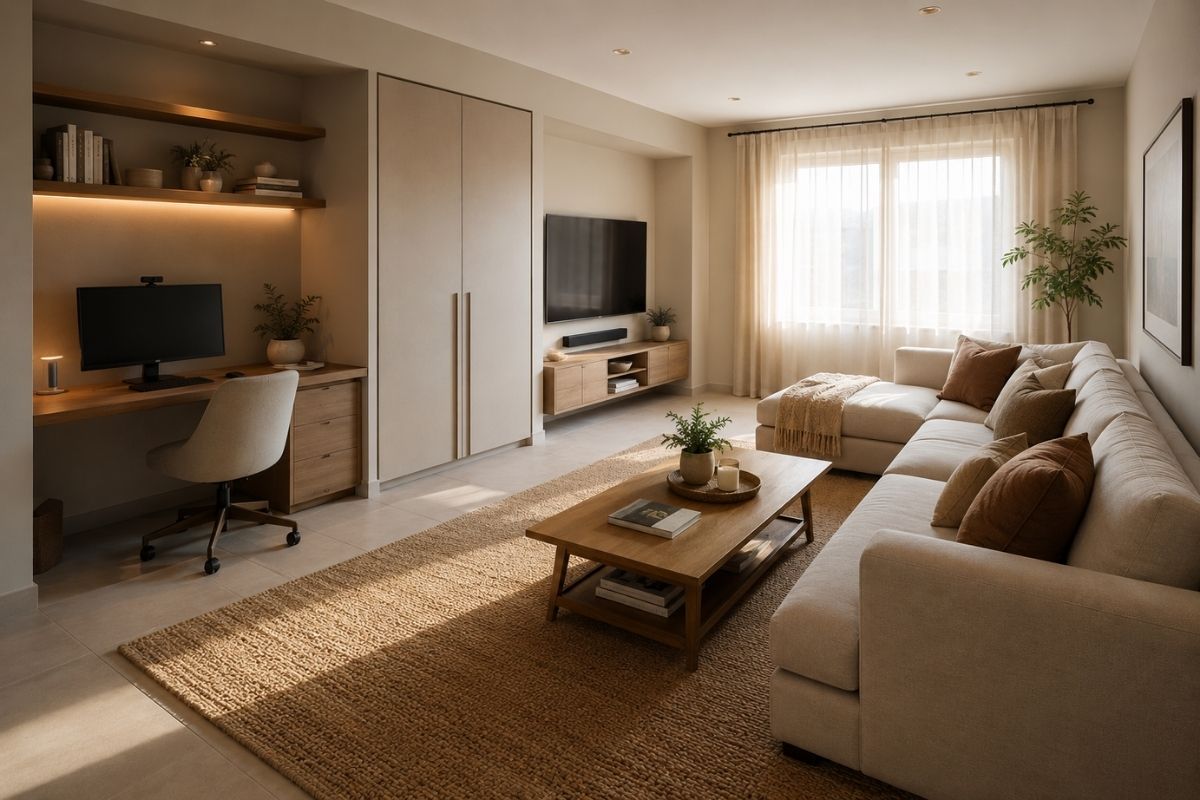
Zoning Principles
A multifunctional room succeeds or fails based on how clearly its zones are defined. When work and living are mixed — papers on the coffee table, laptop on the sofa, a work call taken from the dining chair — neither function is done well and the room feels perpetually incomplete.
The core zoning principle: Define each zone by its primary function and equip it specifically for that function. The work zone has a desk, task lighting, and work storage. The living zone has comfortable seating, ambient lighting, and living-focused objects. The two zones share the room but not the surfaces.
Zone definition methods:
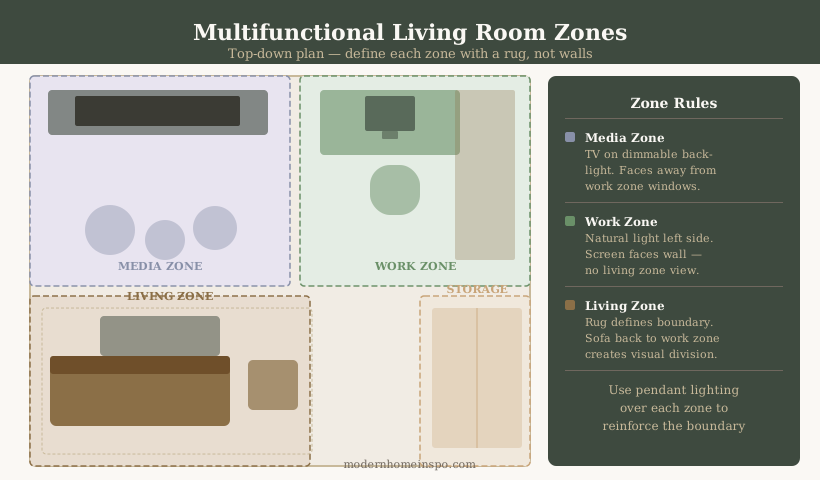
- Physical boundary: A bookshelf, low sideboard, or cabinet placed perpendicular to the wall between zones
- Rug definition: A separate rug for each zone (a work zone rug under the desk, a living zone rug under the seating group)
- Lighting differentiation: Task lamp over the work zone; floor and table lamps in the living zone. The different light character of each zone is the most behaviorally effective separator
- Furniture orientation: Work furniture facing the wall; living furniture facing into the room or toward the TV/fireplace — the different orientation makes each zone feel functionally distinct
Work Zone Design
Desk size: The minimum functional desk for regular computer work: 47 inches wide × 24 inches deep. Narrower desks do not accommodate a monitor with keyboard in front at comfortable working distance.
Monitor height: The center of the monitor should be at approximately eye level when seated — a monitor that is too low causes neck strain; one that is too high causes fatigue. For a laptop-only setup, a separate monitor at the correct height paired with a keyboard and mouse is significantly more ergonomic than working from the laptop screen alone.
Chair: An ergonomic task chair is necessary for regular extended work. In a living room context, the challenge is that task chairs rarely complement the aesthetic of the living zone. Options:
- A task chair that can be rolled away or stored when not in use
- A dining-style chair with a separate lumbar cushion (less ergonomically ideal but more aesthetically integrated)
- A task chair in a material that approximates the living zone aesthetic (an upholstered task chair in a neutral fabric rather than mesh)
Work surface material: Avoid glass-top work surfaces in a living room — they show fingerprints, scratch, and create glare. A wood-top desk (solid or wood veneer) or a painted wood desk integrates more naturally with residential furniture aesthetics.
Concealing the Work Zone
The most effective multifunctional living rooms have a work zone that can be visually closed off or concealed when not in use. This allows the room to function as a clean, relaxing space in the evening and at weekends.
Secretary desk / bureau: A traditional bureau — with a fall-front writing surface that folds up to reveal storage shelves and a work surface — is the most functionally complete concealing solution. When closed, it appears as a piece of living room furniture. When open, it provides a work surface and organized storage. Secretary desks are available across a wide range of styles and price points.
Closet conversion: A deep wardrobe or closet in a living room can be converted into an office nook — shelving above, desk surface at the correct height, task lighting installed inside. The doors close to conceal everything when not in use.
Curtain rail: A ceiling-mounted curtain rail can allow a lightweight curtain to be drawn across the work zone — simpler than doors, and visually effective at separating and concealing the zone.
TV unit conversion: A TV unit or media cabinet with a drop-front drawer at working height can serve as an occasional work surface — suitable for limited daily work but not comfortable for extended sessions.
Design Tip
The ability to close off or conceal the work zone is worth significant inconvenience in furniture choice or room arrangement. When work materials are not visible in the evening, the room genuinely feels like a living space rather than a living room with work in it.
Lighting for Work and Living
Work and living require fundamentally different light: task work needs bright, focused, high-color-accuracy light; relaxation and social use needs warm, ambient, multi-source light at lower intensity.
The switching solution: Design the room’s lighting so that work mode and living mode use different fixtures and different color temperatures.
Work zone lighting:
- A dedicated task lamp on the desk — bright, focused, at the right angle to avoid screen glare
- Color temperature: 3000–4000K for task work (closer to daylight, better for reading and color accuracy)
- The overhead ceiling light in the room may also be on during work hours
Living zone lighting:
- Floor lamps and table lamps at 2700K warm white
- Ceiling light on a dimmer, set to 40–60% in the evening
- The task lamp on the desk should be off when in living/relaxation mode
Behavioral reinforcement: Switching the desk lamp off when work is done and turning on the living zone lamps is a small behavioral trigger that helps mentally signal the transition from work to leisure — reinforcing the zone separation through light rather than requiring any physical movement or rearrangement.
Acoustic Management
Open-plan living rooms are acoustically challenging for work: they lack the acoustic separation that makes offices and dedicated home offices quieter.
The acoustic problem: Hard surfaces (wood floors, painted walls, glass windows) reflect sound — voices, music, and ambient noise reverberate and accumulate. Work calls made in a reverberant room are harder to hear clearly and harder for the other party to understand.
Soft furnishing as acoustic treatment: Upholstered sofas and chairs, rugs, curtains, cushions, and bookshelves full of books all absorb sound and reduce reverberation. A living room with substantial soft furnishings is significantly quieter acoustically than a minimal room.
For video calls: A headset with a noise-canceling microphone addresses most call quality problems from the caller’s side without requiring any room treatment. Combined with soft furnishing in the room, this handles most residential acoustic concerns.
If the room is regularly used for calls with multiple people or for conference calls: A directional microphone positioned to pick up voice from one direction while rejecting room noise is more effective than a standard laptop microphone.
Storage Separation
Work materials and living materials should be stored separately, with dedicated storage for each zone.
Work storage: Desk drawers or a small pedestal for in-use work materials. A closed bookshelf or cabinet section in the work zone for files, reference materials, and work equipment. Everything work-related should have a specific home that is not in the main living zone.
Living storage: Media storage, books read for pleasure, decorative objects, and household items in the living zone. Not mixed with work materials.
Why it matters: When work materials are stored in accessible living zone spaces (the coffee table drawer, the display shelf), the mental boundary between work and relaxation degrades. Retrieving work materials from living storage blurs the functional distinction between the zones.
Furniture Choices
The desk: A secretary desk or bureau (concealing) or a simple floating wall shelf (visible but minimal). Avoid large executive desks that dominate the living room visual space when not in use.
The task chair: A task chair in a neutral upholstery that approximates the living zone aesthetic (linen or cotton fabric, similar color to the sofa upholstery). Remove it or tuck it under the desk fully when not in use.
The bookshelf as zone divider: A bookshelf placed perpendicular to the wall — with books on the work-zone side and decorative objects on the living-zone side — creates a physical zone boundary that also provides storage for both functions.
The sofa: In a multifunctional room, the sofa should not be positioned so that it faces the work desk — sitting on the sofa should not mean looking directly at work materials. Position the sofa to face the room’s social focal point (fireplace, TV, a view) with the work zone to one side or behind.
Frequently Asked Questions
- How do I create a work area in a small living room?
- A desk or work surface that fits against one wall — using a floating wall-mounted desk or a slim secretary desk that can be closed — creates a dedicated work zone without claiming significant floor area. Position it adjacent to or behind the sofa rather than in the main visual field of the room. A dedicated zone, even at small scale, separates work mode from relaxation mode more effectively than working at the coffee table.
- How do I separate a work zone visually from a living area?
- A bookshelf, half-wall, or low sideboard placed perpendicular to the wall creates a physical zone boundary without requiring a full room partition. A rug defining each zone separately (a work zone rug under the desk, a living zone rug under the sofa) also creates visual separation. Lighting differentiation — a focused desk lamp for the work zone, ambient lamps for the living zone — reinforces the separation.
- Is it bad for mental health to work in the same room as you relax?
- Research suggests that working in the same space as relaxing can make it harder to mentally switch off — the space associated with work triggers work-mode thinking. Mitigating factors: a clearly defined work zone that is visually separate from the relaxation zone, the ability to conceal or close off the work area when not in use, and consistent behavioral habits (starting and stopping work at defined times, not checking work materials in the evening).
- What furniture works best in a multifunctional living room?
- A secretary desk or bureau (which closes to conceal work materials) is the most space-efficient and separation-reinforcing work furniture. A simple wall-mounted floating shelf with a drawer pedestal below is a space-efficient alternative. Avoid using the coffee table or dining table as a primary work surface — these blur the zone separation and make clearing for leisure use more effort.