Outdoor Lighting Ideas: How to Light a Garden, Patio, or Balcony
Quick Answer
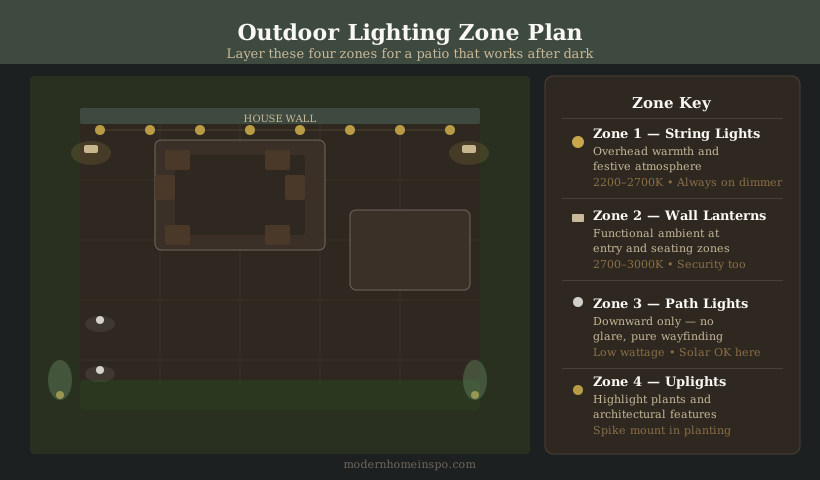
Effective outdoor lighting uses at least three types of light: overhead ambient (string lights or a pendant), path or perimeter lighting for safety and definition, and accent lighting for plants and features. All outdoor bulbs should be 2700K warm white — cold outdoor lighting looks harsh and uninviting. Solar lighting is convenient but inconsistent; low-voltage wired systems are more reliable for regular outdoor living use.
Core Principles
Outdoor lighting design follows the same layered approach as indoor lighting: ambient (overall light), task (functional light for specific activities), and accent (light that creates visual interest). The key difference is that all outdoor lighting must be weatherproof, and the stakes for choosing the wrong color temperature are higher outdoors than indoors.
Color temperature: 2700K warm white throughout all outdoor living areas. This is the single most important specification. Cool white or daylight bulbs (4000K+) make outdoor spaces feel like a commercial car park regardless of furniture and plant quality. Warm white creates an inviting atmosphere that feels safe and intimate rather than exposed and clinical.
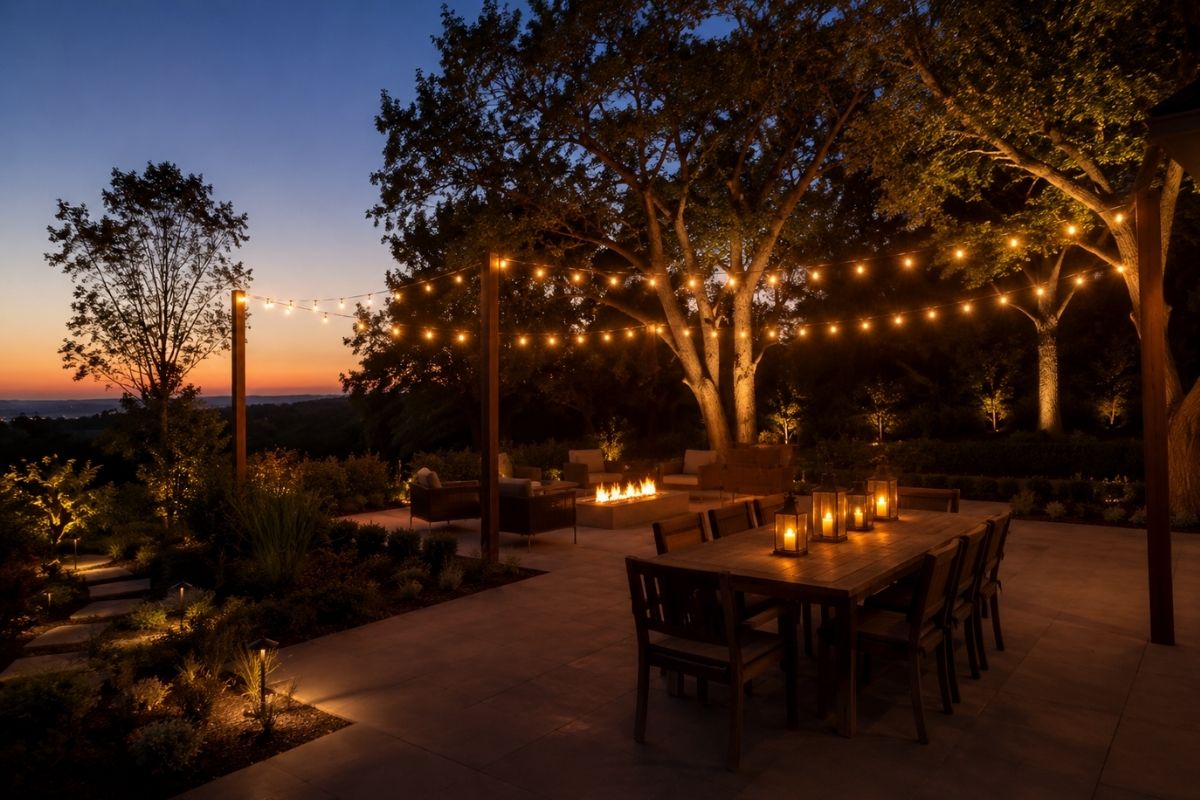
Layers matter outdoors too. A single overhead string light is better than nothing but still flat. Adding path lights at the perimeter, an uplighter on a specimen plant, and a candle on the table creates depth, visual interest, and the sense of a fully considered outdoor room.
Weather ratings: All outdoor electrical fixtures and fittings must be rated for outdoor use. The IP (Ingress Protection) rating system describes weather resistance: IP44 is splash-resistant (suitable for most covered outdoor applications); IP65 is dust-tight and jet-resistant (suitable for fully exposed applications). Check the IP rating of any fixture against its actual installation location.
String Lights
String lights are the most impactful and most versatile outdoor lighting element. A strand of warm Edison bulbs overhead transforms an outdoor space from bare to atmospheric in minutes.
Types:
- Edison (filament) bulb string lights: Warm amber glow, visible bulb element, the most atmospheric option. Available in G40 (40mm globe), G50, and S14 styles. Higher wattage = brighter and warmer.
- LED Edison-style: Same appearance as filament bulbs but more energy-efficient and longer-lasting. LED Edison filaments have improved significantly — look for CRI (Color Rendering Index) above 90 for most natural light quality.
- Fairy lights: Smaller, less visible bulbs. More delicate appearance. Good for wrapping around plants or structures rather than overhead.
Fixing methods:
- Overhead between two fixed points (pergola beam to house wall, two fence posts)
- Wrapped around the perimeter of a pergola frame
- Draped through climbing plants on a trellis
- Hung from hooks screwed into masonry or timber structures
Catenary wire: A stainless steel catenary wire tensioned between anchor points creates a straight, professional-looking overhead support for string lights that eliminates sagging. The lights clip or wrap around the wire.
Outdoor rating: Ensure string lights are specifically rated for outdoor use (typically marked IP44 minimum). Indoor string lights used outdoors will fail at connections and fittings in wet conditions.
Wall and Door Lights
Wall-mounted exterior lights provide ambient light at house or structure walls, functional lighting for doorways, and visual anchoring for the outdoor space.
Placement: Position wall lights at approximately 2m from ground level for a standard domestic exterior. Lower positions create more dramatic downward shadow; higher positions give more even ambient coverage.
Style consistency: Choose wall lights in a style consistent with the outdoor space aesthetic — lantern forms for a traditional or natural aesthetic, clean geometric forms for contemporary spaces. Avoid mixing very different light styles on the same exterior.
Motion sensor vs. continuous: Motion sensor lights work well for functional doorway lighting. For outdoor living area lighting, continuous (with a switch) is more appropriate — you need to control when the light is on rather than having it trigger when someone moves.
Color temperature: 2700K warm white. Even traditional “security” style wall lights can use warm-white bulbs — the warmth creates an inviting approach rather than a surveillance appearance.
Path and Step Lighting
Path lighting defines the perimeter and circulation of an outdoor space, provides safety on uneven or stepped surfaces, and creates the visual structure of the outdoor room at ground level.
Path light types:
- Stake lights: Small fittings on a ground stake positioned beside paths. Solar or low-voltage wired.
- Recessed deck lights: Flush-mounted fittings in decking boards, illuminating the surface from below.
- Step lights: Wall-recessed fittings that illuminate step treads. Essential for stepped outdoor areas used at night.
- Well lights: Recessed ground fittings, often used for uplighting plants and features.
Spacing: Path stake lights are typically positioned every 90–120cm alternating sides of a path. More frequent spacing creates a more even wash of light; less frequent creates an effect of accent lighting rather than path definition.
Solar vs. wired: Solar path lights are adequate for accent and directional guidance. For reliable bright illumination needed on steps or in regularly used paths, low-voltage wired lights connected to a transformer are more consistent.
Uplighting for Plants and Features
Uplighting — placing a light at or near ground level aimed upward at a plant, tree, wall, or architectural feature — creates dramatic shadow and silhouette effects that transform outdoor spaces after dark.
Most effective plants for uplighting:
- Palms (the fan pattern of palm leaves creates striking shadow)
- Banana (large graphic leaves produce dramatic upward shadows)
- Trees with interesting branch structures
- Ornamental grasses (wispy texture creates movement and shadow)
Positioning: Place the uplight slightly to one side of the plant (not directly beneath) to create angle and shadow rather than flat illumination. The distance from the plant determines the spread — closer gives narrower coverage; further gives wider coverage.
Fixture types:
- Adjustable ground spike spotlight: most flexible, repositionable as plants grow
- Recessed well light: more permanent, more elegant in appearance but requires excavation
- Battery-powered LED spotlight: no wiring, rechargeable, flexible placement — lower output than wired but adequate for most garden uplighting applications
Wall grazing: Mounting a spotlight close to and aimed across a textured wall (stone, brick, rough render) creates a grazing light effect that emphasizes the wall texture dramatically. Effective on feature walls in patio spaces.
Solar vs. Wired
| Factor | Solar | Wired |
|---|---|---|
| Installation | No wiring needed | Requires wiring installation |
| Consistency | Variable with weather | Consistent regardless of weather |
| Output | Lower, variable | Higher, consistent |
| Cost | Lower upfront | Higher upfront (installation) |
| Maintenance | Battery replacement after 2–3 years | Bulb replacement only |
| Best for | Path accent lights, secondary lighting | Primary ambient, dining, safety |
Note
Solar lighting has improved significantly in recent years but still cannot reliably replicate the output consistency of wired lighting. For outdoor dining areas and primary living spaces, invest in wired lighting for the key elements (overhead string lights, key uplighters) and use solar supplementally for path and accent lighting.
Low-voltage wired systems: Low-voltage (12V) landscape lighting systems use a transformer plugged into a standard outdoor socket, with low-voltage wiring running to individual fixtures. These are significantly easier to install than standard mains wiring, are safer to DIY install in many jurisdictions (check local electrical codes), and are the standard for residential landscape lighting.
By Space Type
Patio dining area: Overhead string lights (primary) + wall light by the house door (safety) + path lights at the steps (safety) + one or two uplighters on perimeter plants (accent). This four-element scheme covers all functions.
Balcony: String lights from the wall across to the railing opposite (primary) + one or two solar accent lights in plant pots (secondary) + a lantern with candle on the table (atmosphere). No wiring needed for this complete scheme.
Garden path: Low-voltage path lights every 100cm alternating sides, connected to a transformer near the house. Solar stringer lights on perimeter planting provide supplemental atmosphere.
Feature area (specimen tree, water feature): One or two ground-spike uplighters on the feature, positioned to create angular shadow. A low-voltage wired supply is more reliable for features that are permanently lit on a timer.
Steps and changes in level: Recessed step lights or wall-mounted step lights at each step change — non-negotiable for safety. Use the same 2700K warm temperature as the rest of the outdoor scheme.
Smart Outdoor Lighting
Smart control adds automation and scene-switching to an outdoor lighting system that already functions well. It’s an enhancement layer, not a substitute for choosing the right fixture types and positions.
Outdoor-rated smart plugs
The lowest-cost entry to smart outdoor lighting: an IP44-rated outdoor smart plug inserted between a standard exterior socket and the string lights or a transformer. Control via an app or voice assistant; set schedules without needing a separate timer. Brands with reliable outdoor plugs: TP-Link Kasa EP40, Meross MSS630, and Eve Energy (HomeKit-compatible). Key requirement: the smart plug must be rated IP44 or higher — indoor smart plugs used in outdoor sockets are a fire and shock hazard in wet conditions.
Colour temperature scheduling
For outdoor spaces, a progression from warmer to cooler across the evening increases usability and atmosphere:
| Time | Temperature | Effect |
|---|---|---|
| Dusk to 8pm | 2700K | Warm transition from daylight to evening |
| 8pm to 11pm | 2200K | Maximum warmth for dining and socialising |
| 11pm to off | 1800–2200K | Dim, very warm — atmosphere or passage only |
This scheduling requires smart bulbs or a smart dimmer, not just a smart plug. For string lights, smart LED filament string lights (e.g., Govee, Philips Hue Outdoor, or compatible Zigbee string lights) allow colour temperature and brightness scheduling from an app.
Motion sensor integration
Motion sensors serve two distinct outdoor purposes: security (triggering bright white light when triggered) and convenience (turning on a pathway at low level when someone passes). Keep these separate:
- Security zone: PIR sensor triggering a bright wall light at 3000–4000K — effective for the intruder deterrent function
- Pathway/convenience zone: Low-voltage path lights on a motion sensor at 2700K, dimmed to 30–50% — useful without jarring
Smart motion sensors (Philips Hue Outdoor Sensor, Lutron Aurora) allow configuration of what triggers on, at what brightness, and for how long — more useful than basic hardwired PIR switches which are all-or-nothing.
Timer vs. sunrise/sunset automation
A fixed timer is set once but drifts out of sync with seasonal sunrise/sunset times — lights that come on at 6pm in December will come on two hours before dark in June. Sunset-based automation (available in most smart home platforms: Apple HomeKit, Google Home, Amazon Alexa) adjusts the trigger time daily and keeps the outdoor lighting schedule correctly aligned across the year without manual adjustment.
Frequently Asked Questions
- What color temperature should outdoor lights be?
- 2700K warm white is the best choice for outdoor spaces designed for relaxation and socializing. It creates a warm, inviting atmosphere, looks natural in the evening, and flatters plant colors and skin tones. Cool white (4000K+) makes outdoor spaces feel like a parking lot — bright but unwelcoming. Security lighting (which needs to be very bright for visibility) can use a cooler temperature, but keep it to the perimeter and separate from living areas.
- Are solar outdoor lights good enough?
- Solar lights are adequate for accent and path lighting where perfect consistency is not required. They are not reliable enough for primary outdoor living area lighting — the light output varies with cloud cover and season, and the batteries degrade over two to three years. For a dining area, a seating area, or an outdoor space used regularly, wired or battery-powered (rechargeable) lighting is more reliable.
- How do I hang string lights outside?
- String lights can be hung between two fixed points (house wall and a pergola post, fence post, or eye hook screwed into an exterior wall). Use outdoor-rated waterproof string lights. Stainless steel wire can be run between anchor points first to support the lights without sagging. For areas without anchor points, a freestanding light post or shepherd's hook provides a support point.
- What outdoor lights work without wiring?
- Solar path lights, solar-powered spotlights, battery-powered LED string lights (rechargeable), and battery-powered outdoor lanterns all work without wiring. For string lights, battery-powered LED versions with warm white bulbs are now reliable for 6–8 hours per charge. Solar spotlights work for accent lighting but are inconsistent in output. Nothing battery or solar-powered matches the consistency and output of wired lighting for primary use.