Pergola Design Ideas: Styles, Sizes, Materials, and What to Grow Over Them
Quick Answer
A pergola provides structure and partial shade — typically 30–50% light blocking with climbers established. For full shade: add a polycarbonate or Sunbrella fabric roof panel. Minimum useful pergola size: 2.5×2.5m for a bistro set; 3×3m for a 4-person dining set with clearance. Timber (Douglas fir or pressure-treated softwood) is the standard material for DIY; powder-coated aluminium for low-maintenance. A freestanding pergola needs posts at least 600mm deep in concrete; attached pergola connects to the house wall via a ledger board.
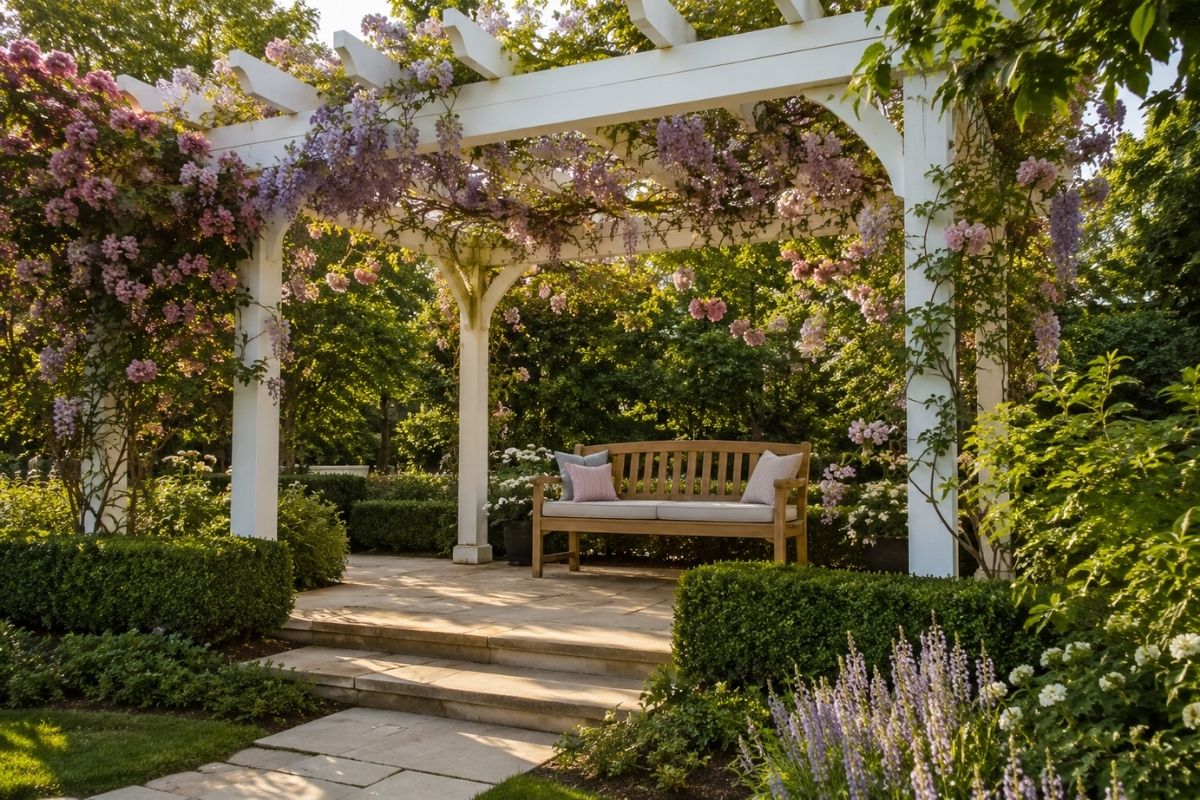
A pergola is one of the most transformative additions to an outdoor space — it converts open garden into a defined room with vertical enclosure and overhead structure. The design range is wide, from a simple pressure-treated softwood frame with climbing plants to a powder-coated aluminium structure with louvred roof panels that can be adjusted remotely.
Freestanding vs Attached
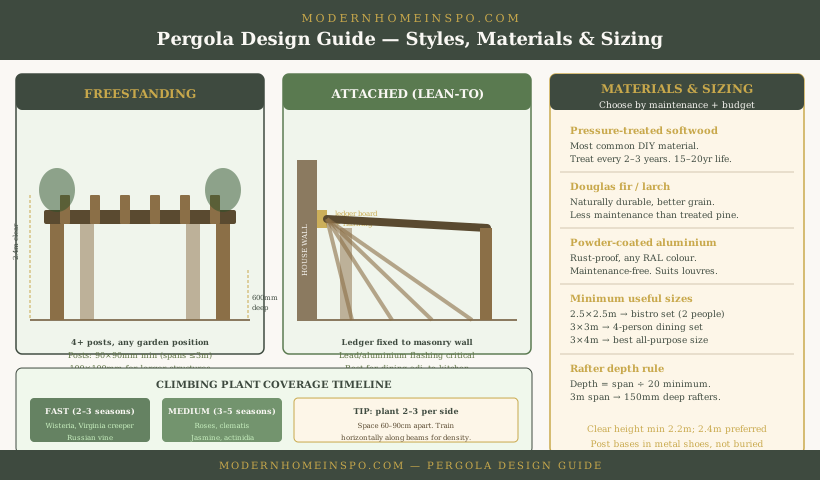
Freestanding pergola
Four or more posts supporting a beam-and-rafter structure, independent of the house. Can be positioned anywhere in the garden — in the middle of a lawn, at the rear boundary, or aligned with a garden feature.
Structural requirement: each post should be set in a concrete footing 600mm deep minimum, or in a post shoe (metal anchor set in concrete) — which allows timber replacement without breaking up concrete. Post size: minimum 90×90mm for spans up to 3m; 100×100mm or 120×120mm for larger structures.
Attached pergola (lean-to)
One side of the structure connects to the house wall via a ledger board. Two freestanding posts support the far end. This configuration creates a covered outdoor room directly connected to the house — the most practical arrangement for outdoor dining adjacent to the kitchen.
The ledger board must be fixed to the house wall using structural fixings (through the external render into masonry) and flashed with lead or aluminium flashing to prevent water ingress behind the board. This is the most critical connection point — poorly flashed ledger boards cause damp problems.
Canopy/sail pergola
A sail shade or fabric canopy suspended from the house wall and two posts — simpler and less expensive than a full pergola structure, and easier to remove for winter. Provides shade without the visual weight of a beam-and-rafter structure. Less suitable for climbing plants (the fabric doesn’t provide adequate support).
Material Options
Pressure-treated softwood (most common)
The standard DIY pergola material — widely available, affordable, and easy to work with. Tanalised softwood (vacuum-impregnated with preservative) will last 15–20 years if maintained. Treat with exterior decking oil or stain every 2–3 years to extend life and maintain appearance.
Appearance: natural light brown initially, greying without treatment, or stained in any exterior wood colour.
Douglas fir and larch
Naturally more durable than treated softwood without preservative treatment. Better grain and appearance than pine or spruce. Available from specialist timber merchants. More expensive than treated softwood but requires less maintenance.
Oak
The premium timber pergola material. Heavy, durable, strong, with a distinctive appearance — particularly as green oak (fresh-cut, lighter to work with than seasoned, and develops character cracks as it dries). Oak pergolas are architectural features in their own right and can last 50+ years.
Powder-coated aluminium
Lightweight, rust-proof, and maintenance-free (no painting, no preservative treatment). Available in any RAL colour. Suitable for louvred roof systems, motorised pergola panels, and contemporary architectural styles. More expensive than timber for equivalent spans. The low-maintenance argument is compelling for a feature that’s difficult to repaint once plants have established.
Steel
Heavier and more architectural than aluminium. Used for industrial or contemporary pergola styles. Requires priming, painting, and periodic repainting to prevent rust — higher maintenance than aluminium for outdoor use.
Sizing and Proportions
Minimum useful dimensions
2.5×2.5m: fits a bistro table for 2 with adequate clearance from posts. 3×3m: fits a 4-person dining set with 30–40cm clearance from posts to chair backs. 3×4m: the most practical all-purpose pergola size — 4-person dining plus side passage, or a small lounge arrangement. 4×5m: comfortable for 6-person dining with a lounge zone beside it.
Height
Minimum clearance height: 2.2m inside the pergola (measured to the underside of the lowest rafter). 2.4m is more comfortable for tall adults. The height of the posts (from ground to beam) needs to account for the beam depth — a 2.4m clearance height with a 150mm deep beam requires posts at 2.55m from ground.
Proportion rule
The depth of the rafters should be approximately 1/20th of the span. For a 3m span: rafters should be at least 150mm deep. For a 4m span: 200mm minimum. Undersized rafters look flimsy and will deflect visibly under plant weight.
Post spacing
Posts at 2.4–3m intervals for timber structures. More frequent posts (1.8m intervals) for steel and aluminium louvred systems that span more tightly. Over-spanning (posts 4m+ apart without intermediate support) risks visible deflection in the beams.
Roof Options for Shade
Climbing plants (partial shade)
The most beautiful long-term option. Established climbers provide 30–60% shade depending on the plant. No shade in the first 2–3 seasons before climbers establish. Shade is natural and dappled — not complete cover from rain.
Polycarbonate or perspex roof panels
Solid translucent panels in a twinwall or corrugated polycarbonate laid across the rafters. Provides full waterproof cover. The principal downside is condensation on the underside and the industrial appearance — particularly corrugated profiles, which read as greenhouse rather than garden room.
Clear panels transmit heat directly — a polycarbonate roof in summer sun becomes uncomfortable. Opal or bronze-tinted panels reduce heat gain significantly.
Fabric canopy panels
Sunbrella or equivalent solution-dyed acrylic fabric panels stapled or clipped to the rafter tops provide shade (60–90% depending on weave) while maintaining a residential appearance. Not fully waterproof (drizzle passes through), but the material dries quickly and is UV-resistant.
Louvred roof system
Aluminium louvres on a motorised or manual pivot allow the roof to be opened (full sun) or closed (rain protection) on demand. The premium option — requires an aluminium frame system, costs significantly more than timber + polycarbonate, but provides full weather protection with the option of complete ventilation.
Shade sail
A simple, low-cost alternative that provides 90%+ UV block in a triangular or rectangular format. Attached to the pergola posts and the house wall. Seasonal — remove in winter. Doesn’t support climbing plants.
Climbing Plants
The right climbing plant makes a pergola — the wrong one either fails to cover it or grows out of control and damages the structure. Plan for how much coverage you want and how much maintenance you’re willing to do before choosing.
Coverage speed guide
| Plant | Mature spread | Time to cover 3×3m pergola | Maintenance level |
|---|---|---|---|
| Wisteria sinensis | 9–10m | 3–4 seasons | High (prune August + January) |
| Russian vine (Fallopia baldschuanica) | 12m+ | 1–2 seasons | Very high (extremely vigorous, hard to control) |
| Virginia creeper (Parthenocissus quinquefolia) | 10m | 2–3 seasons | Low (self-attaches; autumn colour) |
| Rosa ‘New Dawn’ | 5–6m | 3–5 seasons | Medium (annual prune + tie-in) |
| Rosa ‘Compassion’ | 3–4m | 4–5 seasons | Medium (annual prune + tie-in) |
| Clematis Group 3 | 3–5m | 2–3 seasons | Low (cut to ground February, regrows every year) |
| Jasminum officinale | 7–8m | 3–4 seasons | Low (thin after flowering) |
Individual plant notes
Roses — The classic pergola climber. Train horizontally along the beams rather than straight up the posts: roses flower far more prolifically on stems growing at or near horizontal than on vertical stems. For maximum scent and a long flowering season: ‘Compassion’ (pink/apricot, June–October, highly scented) or ‘A Shropshire Lad’ (warm peach, cupped flowers, extremely fragrant). ‘New Dawn’ for the fastest coverage and best disease resistance.
Wisteria — The most visually dramatic pergola climber: hanging racemes of lilac or white flowers in May–June, sometimes again in August. Wisteria floribunda has longer flower racemes (50–60cm) than sinensis (25–30cm). Both require committed pruning: cut all new growth to 5–6 leaves in late August, then cut back again to 2–3 buds in late January. Without this the plant produces foliage at the expense of flowers and becomes impossible to manage within a decade.
Clematis Group 3 — The most practical pergola clematis. Cut every stem to 30cm in late February. New growth covers the structure by June and flowers summer through autumn. ‘Jackmanii’ (deep purple), ‘Perle d’Azur’ (sky blue), ‘Polish Spirit’ (rich purple) all perform reliably. The annual cut-down means zero winter maintenance beyond a quick tidy.
Jasmine (Jasminum officinale) — Heavily scented white flowers June–August. The fragrance is strongest in warm evenings — sitting under a jasmine-covered pergola on a July evening is one of the best garden experiences available. Thin after flowering rather than hard pruning; remove old woody stems gradually over 2–3 years.
Companion planting combinations
Combining two climbers on the same pergola extends the flowering season and creates more visual interest than a single species:
- Rose + Clematis Group 3: Rose flowers May–October; clematis fills the same space with different colour July–September. The clematis grows through the rose — train them separately at the base and allow them to intermingle above.
- Wisteria + Jasmine: Wisteria flowers May–June; jasmine takes over June–August. Complementary scents. Wisteria on the main beams, jasmine woven through on the posts.
- Virginia creeper + Climbing rose: Virginia creeper for rapid coverage and dramatic autumn colour; rose for summer flowers and fragrance. The creeper provides coverage while the rose establishes.
Scent seasonality by plant
| Scent peak | Plant |
|---|---|
| May–June | Wisteria, Rosa ‘New Dawn’ |
| June–July | Rosa ‘Compassion’, early jasmine |
| July–August | Jasmine (peak), ‘A Shropshire Lad’ |
| August–October | Late clematis (no scent), Rosa repeat-flowerers |
| January–March | Jasminum nudiflorum (winter jasmine, yellow flowers, mild scent) |
Heating, Curtains, and Extras
Heater integration
An infrared electric heater mounted to a rafter is the most effective way to extend a pergola’s comfortable season — adding 4–6 weeks into autumn and up to March in mild climates. Key specifications: 1500W infrared covers approximately 3×3m at moderate outdoor temperatures; 2000W for 4×4m zones. Infrared heaters heat objects and people directly (not the surrounding air) — effective even in a light breeze where gas patio heaters lose most of their output.
Fixed rafter installation requires a waterproof outdoor socket rated IP44 minimum — have it installed by an electrician. Position the heater overhead at 2.0–2.4m height, angled 20–30° downward toward the seated zone.
Outdoor curtains
Weather-resistant curtain panels (Sunbrella or equivalent outdoor acrylic fabric on stainless steel wire or a ceiling-mounted rod) on two or three sides of a freestanding pergola transform it from a shade structure into an enclosed outdoor room. Draw them open in good weather for maximum light; close in the evening for wind protection, privacy, and warmth retention.
Curtain width: at least 1.5× the opening width for adequate fullness when drawn. Hem at ground level or 2cm above for a clean finish. Avoid indoor curtain fabric outdoors — it deteriorates within one season.
Lighting
For string lights between rafters, pendant sizing for dining tables, IP rating requirements, and catenary wire for sag-free string light runs, see Outdoor Lighting Ideas. The pergola structure creates ideal anchor points for every element of an outdoor lighting scheme.
Frequently Asked Questions
- Do I need planning permission for a pergola?
- In most UK residential properties, a pergola is permitted development (no planning permission required) if it doesn't exceed 50% of the curtilage of the house, is under 2.5m tall at the eaves (or 4m for a ridged roof), and doesn't cover the front garden. If attached to the house, the permitted development rules for extensions apply. Always check with your local planning authority if unsure — rules differ for listed buildings and conservation areas.
- What wood is best for a pergola?
- Pressure-treated softwood (pine or spruce) is the most affordable and widely available option — treat with exterior stain or decking oil every 2–3 years. Douglas fir or larch are naturally more durable without treatment. Hardwoods (oak, iroko) are the most durable but significantly more expensive. All timber pergolas should have post bases (metal post shoes in concrete) rather than burying wood directly in soil.
- What is the minimum size for a useful pergola?
- 2.5×2.5m for a bistro set. 3×3m for a 4-person dining table plus chairs with pull-out clearance. The pergola should be slightly larger than the furniture zone below — furniture positioned up to the posts looks cramped; 30–40cm clearance from posts to chair backs is comfortable.
- How long does it take for climbing plants to cover a pergola?
- Fast climbers like wisteria, Russian vine, and Virginia creeper can cover a pergola in 2–3 seasons. Roses, clematis, and jasmine take 3–5 years for significant coverage. For immediate cover, plant 2–3 climbers per side of the pergola (spaced 60–90cm apart) and train growth horizontally along the beams as well as vertically up the posts.