Small Backyard Ideas: Zone Planning, Furniture Sizing, and the Tricks That Make Small Gardens Work
Quick Answer
For a small backyard: define one clear zone rather than trying to include multiple functions (dining takes priority over lounging in tight spaces), use compact bistro furniture (60–70cm round table, folding or stackable chairs), build up with vertical planters and climbers rather than ground-level planting beds, use one surface material across the whole space (no pattern breaks), and install low-voltage lighting along the perimeter to extend the garden's usable hours into the evening.
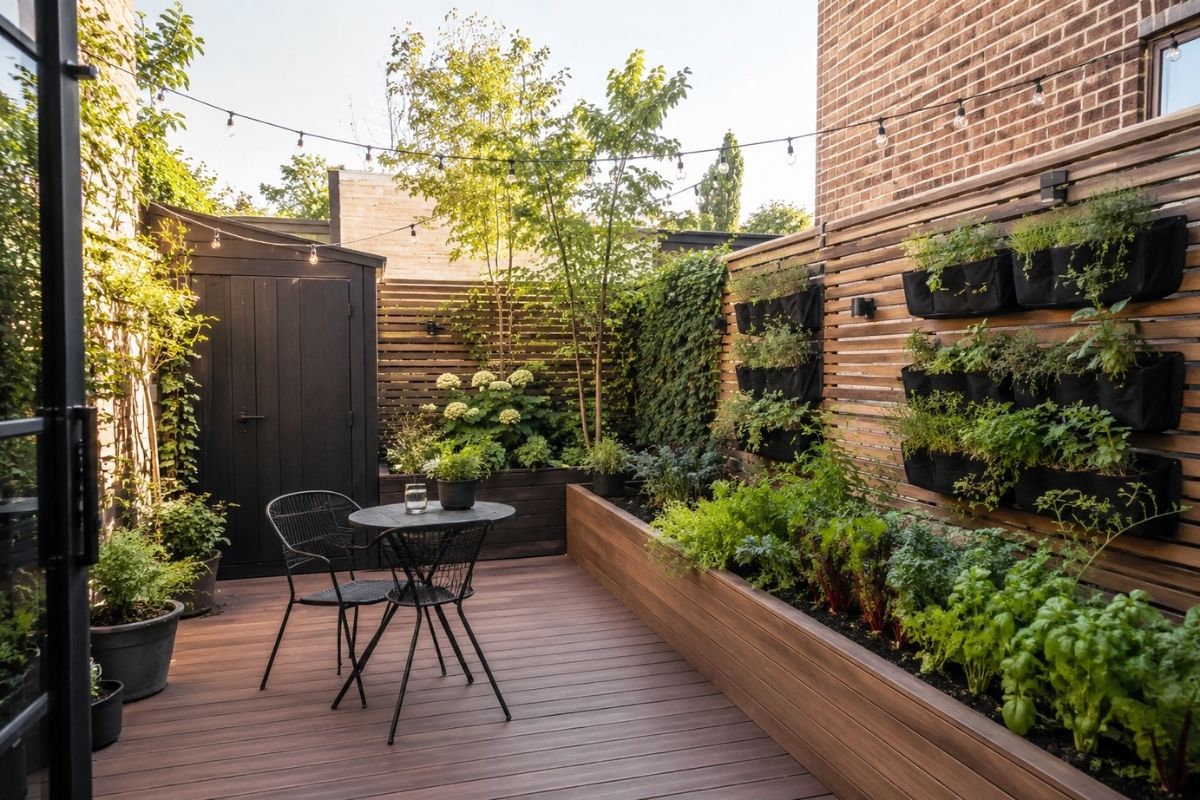
A small backyard — 15–30m² is a typical urban terrace or garden — is one of the most challenging outdoor design problems because the temptation is to include too much. Multiple zones, a full dining set, a sofa set, a built-in barbecue, multiple planting areas: each competes for the limited floor space and the result is a space that feels full of things but not pleasant to be in.
The small garden that works is almost always one that does one thing well.
Zone Planning
One primary zone
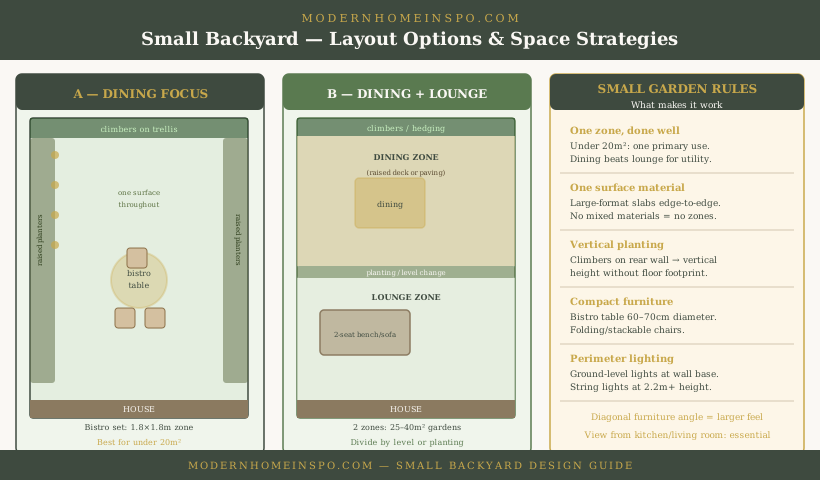
In a garden under 20m², define one primary use zone and design around it. The most practical choice is dining — a bistro table and chairs in the centre or in a corner, paved surface, with planting at the perimeter.
Trying to include both a dining zone and a lounge zone in a space under 20m² results in neither working well. The furniture crowds the usable space, circulation is awkward, and the garden reads as cluttered rather than designed.
Dividing a larger small garden
In gardens 25–40m², two zones become possible: a dining zone near the house (closest to the kitchen for practical access) and a lounge zone further away. Separate them with a change of level (a raised timber deck for the dining zone), a change of planting (a row of grasses or low hedging), or simply by distance. The zones should feel distinct without a hard barrier.
Sightline from indoors
Position the primary zone so it’s visible from the main indoor living or kitchen space. A garden that’s designed to be used becomes used; one that’s hidden around a corner or obscured from the main window gets forgotten. The view from the kitchen sink or the living room door is the garden’s primary audience.
The diagonal trick
Setting furniture at a slight angle to the garden walls (45° to the rectangular plot) makes the garden feel larger and less box-like. The diagonal line draws the eye across the longest dimension of the space rather than across the shorter side wall.
Furniture for Small Gardens
Bistro set
A 60–70cm round table and two folding or stackable chairs is the standard small garden dining solution. It fits in a space as small as 1.8×1.8m (table plus chair pull-out on two sides), folds for winter storage, and is light enough to move easily.
Round tables are more practical in small spaces than rectangular ones — you can fit a third or fourth person more easily (by pulling another chair to the table) and there are no sharp corners in the circulation path.
Four-person outdoor dining table
If the garden is 25m²+ and a four-person dining setup is the priority: an 80×80cm square table (or 90cm round) with folding chairs. The minimum garden floor area for the table zone is 2.7×2.7m once chair pull-out and passage are accounted for. For full clearance specifications by table size, see Outdoor Furniture Ideas.
Folding chairs (Fermob Bistro style, or equivalent) store flat and reduce the visual mass when the table is not in use.
Outdoor sofa in a small garden
A two-seater outdoor sofa or love seat (140–150cm wide) rather than a three-seater (180cm) or an L-shape set. A compact modular set can be rearranged depending on the occasion.
For very small gardens, a garden bench along one wall (built-in or freestanding) provides seating without the floor footprint of chairs plus table.
Material choice
Powder-coated steel and aluminium are the lightest materials — easy to move, weather-resistant, and available in a wide palette. Powder-coated in matte anthracite or sage green rather than bare aluminium reads as designed rather than utilitarian. Rattan-effect (woven polyethylene over aluminium frame) is heavier but more comfortable without cushions.
Planting Strategies
Vertical over horizontal
In a small garden, ground-level planting beds take usable floor space. Vertical planting — trellis with climbers on the rear and side walls, wall-mounted planters, raised planter boxes at the boundary — adds planting volume without reducing the usable central zone.
Climbers for a UK small garden rear wall: clematis (June–August flowering), jasmine (highly scented, June–August), climbing rose (May–September). These cover large areas quickly with minimal ground footprint.
Raised planters as definition
Timber or steel raised planters (400–600mm tall) along the rear or side boundaries define the garden space, add planting height, and allow drainage-controlled growing. They also act as informal seating in a garden too small for a separate bench.
Compact raised planter size: 300mm wide (accessible to weed from outside), 600–900mm long per section, 400mm tall. Stack two to create 800mm planters for taller plants.
Container planting
In a paved garden with no ground planting, large containers (500mm+ diameter) provide the planting interest without commitment. Move them seasonally, change the planting, and position them where the garden needs colour or height at different times of year.
Plants that work in small spaces
- Climbing roses on the rear wall: ‘The Generous Gardener’ (apricot-pink, highly scented, to 4m), ‘Gertrude Jekyll’ (deep pink, very fragrant, repeat-flowering)
- Clematis: armandii for evergreen year-round cover; ‘Perle d’Azur’ for summer blue; Group 3 varieties (cut to the ground in February, re-cover by July)
- Box balls in containers: year-round structure, low water requirement, formal or informal depending on the overall scheme
- Ornamental grasses in planters: Stipa tenuissima for wispy movement, Miscanthus ‘Morning Light’ for height and autumn colour
- Herbs beside the kitchen door: practical, aromatic, and the most used planting in any garden
For species growth rates, coverage speeds, and pruning schedules for climbing plants, see Pergola Design Ideas — the same climbers that work on pergolas work on rear walls and trellis panels.
Surfaces and Paving
One material throughout
The most important rule for small garden surfaces: use one material from edge to edge. A small garden with three different surfaces (gravel, decking, paving) reads as fragmented — the eye sees three zones of material rather than one space. One consistent surface reads as one space.
Surface options for small gardens
Large-format porcelain slabs (600×600mm or 600×900mm): clean and contemporary, low maintenance, available in stone-effect and concrete-effect finishes. The large format has fewer joints, which reinforces the one-material effect.
Natural sandstone or limestone: warmer tone, natural variation, requires occasional resealing. Works particularly well in gardens viewed from a warm-toned interior.
Composite decking: useful for covering an awkward concrete base, provides a warm timber look with low maintenance (no painting, no splinters). Grey or dark brown tones rather than orange pine.
Avoiding gravel in a small space
Gravel scatters into adjacent spaces, migrates into the house on shoe soles, and makes furniture placement awkward. In a small garden, gravel works only in contained beds with solid edging — not as the primary surface.
Lighting the Space
Outdoor lighting is the single most effective investment for extending a small garden’s useful hours — a well-lit 15m² garden is usable from April through October evenings; an unlit one is abandoned at dusk.
The small garden lighting principle: Three types, all 2700K warm white:
- Overhead string lights — from house wall to rear boundary fence at 2.2–2.5m height, loosely draped. This creates a ceiling that makes the garden feel enclosed rather than open and exposed at night.
- Perimeter path lights — low-voltage LED stake lights along the wall base at 60–90cm intervals, angled upward toward planting. Defines the garden edges and illuminates plants without a security-light glare.
- Table lantern — a wind-resistant outdoor lantern with a real candle on the bistro table. The flicker quality is irreplaceable for evening dining atmosphere.
Small-garden-specific note: In a garden with only one zone, run the string lights on a timer or smart plug so they come on automatically at sunset. Coming home to a lit outdoor space is genuinely transformative for how much you use it.
For the complete outdoor lighting system — IP ratings, catenary wire for string lights, solar vs wired comparison, uplighting plants, step lighting — see Outdoor Lighting Ideas.
Paving Costs and What to Budget
Surface material is typically the largest single cost in a small garden project after structural work. Budgeting accurately before choosing avoids the common mistake of choosing a material that exceeds budget and switching to a cheaper substitute halfway through — which usually results in inconsistency.
Approximate supply-only costs per m² (UK, 2024–2025)
| Material | Supply cost per m² | Lifespan | Maintenance |
|---|---|---|---|
| Concrete paving flags (standard grey) | £10–£20 | 20–30 years | Low (occasional jet wash) |
| Porcelain slabs (600×600mm, 20mm thick) | £30–£55 | 25–40 years | Very low (non-porous, no sealing) |
| Natural sandstone (Indian/Raj Green) | £25–£45 | 20–30 years | Medium (reseal every 2–3 years) |
| Natural limestone (Cotswold/pale buff) | £35–£60 | 25–40 years | Medium (reseal annually in wet climates) |
| Composite decking (high quality) | £40–£70 | 15–25 years | Low (annual clean, no painting) |
| Hardwood decking (iroko, ipe) | £55–£90 | 20–30+ years | Medium (annual oil treatment) |
Installation adds 60–100% on top of supply cost for a standard patio — professional laying of porcelain slabs on a full mortar bed typically costs £40–£65 per m² for the labour alone.
Total budget for a 15m² small garden patio:
- Budget (standard flags, DIY): £300–£600
- Mid (porcelain, professional lay): £1,200–£1,800
- Premium (natural stone, professional lay): £1,500–£2,500
The material that gives most value: Porcelain slabs in a warm grey or stone-effect finish. They’re more expensive than concrete flags but have lower long-term maintenance cost, better aesthetics in all weather conditions, and hold their appearance for decades. The cost difference between concrete and porcelain on a 15m² garden is approximately £300–£500 — often worth it over a 20-year lifespan.
The material that disappoints most often: Cheap composite decking (below £30/m²). Low-cost composite decking fades, cups, and develops algae surface growth within 5 years. If budget doesn’t allow high-quality composite (£50+/m²), porcelain slabs are the better choice.
Storage and Utilities
Garden storage unit
A garden storage unit (deck box or garden store, 120–180cm wide, 80cm deep, 80cm tall) provides outdoor storage for cushions, garden tools, and seasonal items without a full garden shed. Positioned against the side wall, it doubles as an occasional seat with cushions on top.
Bin concealment
In a small urban backyard, bins are often stored in the garden. A slatted timber or powder-coated steel bin store (purpose-built to contain standard bins) tidies the most utilitarian garden element. Position against the side wall nearest the house exit, with enough gap for the bin wheels.
Outdoor tap
An outdoor tap on the house wall, positioned at a convenient height (70–80cm from ground), is a quality-of-life addition for any garden — for watering, cleaning furniture, and filling large pots. Requires a plumber for connection to the water supply and should include an isolating valve inside the house.
Frequently Asked Questions
- What size furniture works in a small backyard?
- A bistro table 60–70cm diameter and two chairs fits in a space as small as 2×2m. A four-person dining table needs at minimum 2.5×2.5m for table plus chair pull-out clearance. For lounging in a very small garden: a two-seat bench or a small outdoor love seat rather than a full sofa set, which requires too much surrounding circulation space.
- How do I make a small backyard look bigger?
- Use one consistent paving material across the whole space (no pattern changes or multiple materials that create visual zones). Install vertical greenery (climbers on trellis, wall-mounted planters) to draw the eye upward rather than across the limited ground area. Use small-format furniture and avoid cluttering the floor space.
- What plants work in a tiny backyard?
- Climbers on a rear trellis or wall (clematis, jasmine, roses) add vertical planting without taking ground space. Raised planters at the perimeter define the space and add colour without spreading across the usable area. Compact bamboo (Fargesia, not running varieties) in a raised planter provides screening and height in a small footprint.
- Should a small garden be paved or have grass?
- Paved is usually better in very small gardens (under 25m²). A small lawn requires as much maintenance as a large one (mowing, edging, watering) and in a tiny garden often looks like a patch of green rather than a real garden feature. Paving provides a clean, usable surface in all weathers, with planting limited to raised beds and containers where it can be managed.