Cozy Living Room Ideas: The 5 Layers That Create Genuine Warmth
Quick Answer
A cozy living room requires five layers working together: (1) a warm palette with honey, terracotta, and caramel tones — no cool greys or blue-whites; (2) lighting at 2200–2700K from floor lamps and table lamps, never overhead flood lights; (3) textiles stacked in contrasting fabrics — velvet cushions, chunky knit throw, wool blanket, jute rug; (4) at least four different textures (soft, woven, wood grain, ceramic); (5) atmosphere elements including candles, books within reach, and a live plant.
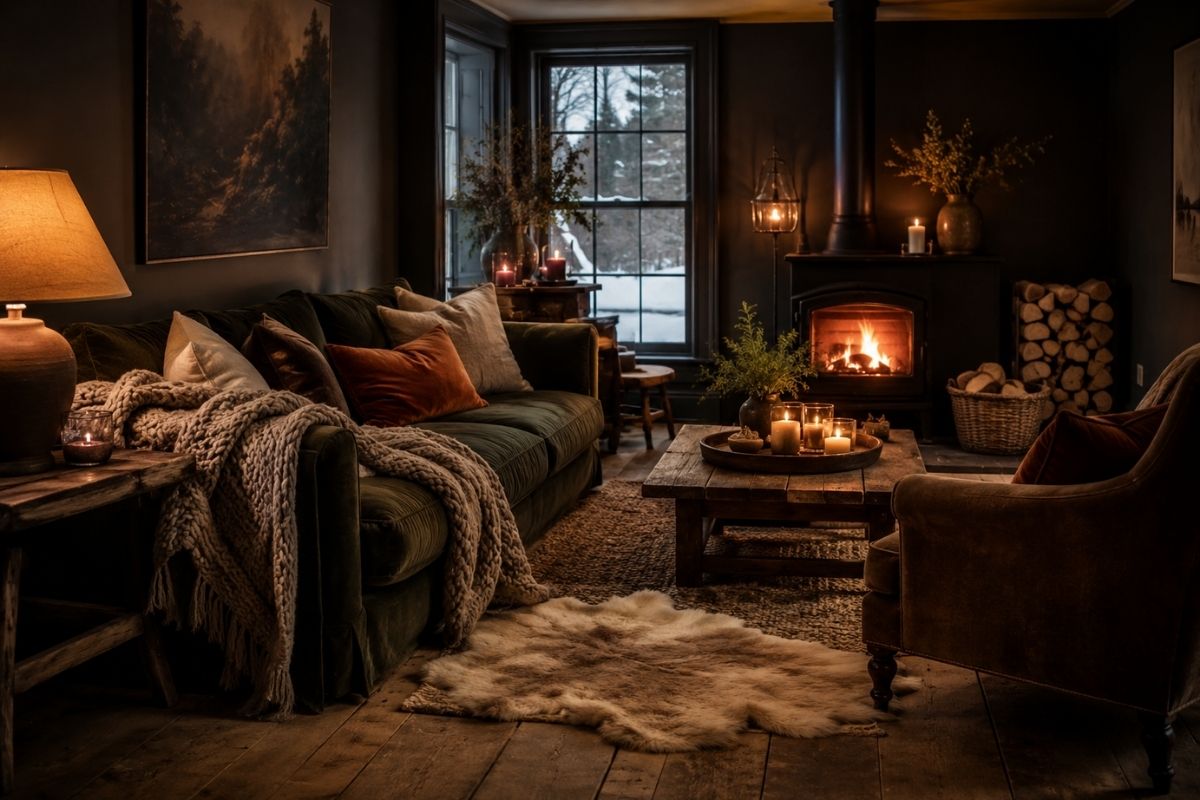
Coziness is not an accident and it’s not just about soft furnishings. A room can have seven cushions and a plush rug and still feel cold — because the lighting is wrong, or the palette has cool undertones, or the space is too clean and staged-looking. Genuine coziness comes from layering specific elements that signal warmth, softness, and life to the nervous system.
Layer 1: Warm Palette
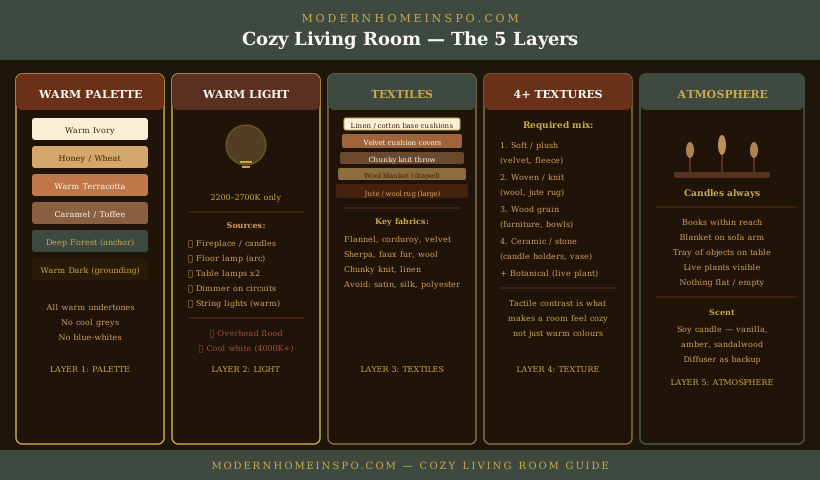
The palette is the foundation — but the reason it matters for coziness is specifically psychological. Warm-undertone colours (honey, amber, terracotta, caramel) trigger a thermal warmth perception before any physical contact. Environmental psychology research consistently shows that rooms in warm-undertone palettes are rated as physically warmer at the same actual temperature. You are designing for how the nervous system reads the space, not just how it photographs.
The cozy palette mechanism
- Honey and amber tones in rugs and wood surfaces — these warm under 2700K lighting like no other tone; they actively glow
- Terracotta and burnt orange in throws, cushions, ceramics — the highest-warmth-signal tone in interior design; even a single terracotta cushion shifts a room’s feel noticeably
- Caramel and toffee in upholstery (velvet or leather) — grounds the room with depth; a caramel sofa reads as an invitation to sit
- Forest or sage green (muted) — the one cool accent that works in cozy rooms because it reads as botanical rather than cold
- Warm ivory walls — the background that lets warm textiles and wood tones read clearly; blue-white walls cancel the warmth that textiles add
Rescuing an existing grey-dominant room: Warm it with terracotta cushions and throw, add warm wooden elements (tray, side table, picture frames in warm wood), and switch bulbs to 2700K. This sequence — textiles first, then bulbs — transforms a grey room substantially without touching walls or furniture.
For undertone identification, LRV guidance, and specific paint names across neutral families, see Neutral Tone Living Room Ideas.
Layer 2: Lighting
Lighting has more impact on coziness than any other single element — more than soft furnishings, more than palette.
The rule: no overhead flood
A single bright overhead light source is the fastest way to destroy coziness. It creates even, flat, directional light that eliminates shadow and depth — the opposite of how candlelight or firelight works. Turn the ceiling light off after dark. This one rule, applied consistently, changes the feel of a room more than most furnishing decisions.
The cozy lighting formula
- Floor lamp (arc or uplighter) in one corner: 2700K, 40–60W equivalent
- Table lamp beside the sofa: 2700K, warm amber or linen shade
- Second table lamp on console or media unit — a second warm pool across the room
- Candles: at least three grouped together (the cluster creates fireplace-equivalent warmth cues)
- Dimmer on any overhead circuit you do keep connected
For bulb temperature comparison, fixture selection, three-layer wiring, and dimmer options, the complete guide is at Ambient Lighting Ideas for Living Rooms.
Layer 3: Textiles
Textiles are the most immediately impactful change you can make to an existing room. The layering logic matters: different fabrics in the same tonal palette, stacked from base through to accent.
The textile stack
Start with base cushions in linen or cotton — these are the structural cushions that stay in shape. Layer velvet cushion covers in terracotta, caramel, or warm rust on top. Add a chunky knit throw draped over one sofa arm (not folded perfectly — draped asymmetrically). A wool blanket folded at the foot of the sofa or over a nearby armchair.
Under the sofa: a large jute, wool, or cotton rug. Front legs of all seating on the rug.
Fabric textures to prioritise
Flannel, corduroy, velvet, sherpa, faux fur, chunky wool knit, washed linen. These are tactile — they communicate softness before you even touch them.
Avoid: polyester, satin, or anything smooth and synthetic. These look cold even in warm colours.
The odd-number rule
5, 7, or 9 cushions. 3 throws maximum (one per seating piece). This prevents the sofa looking either staged or chaotic.
Layer 4: Texture Mix
Texture is distinct from textiles — it’s about the overall material variety in the room. Tactile contrast is what makes a room feel layered and rich rather than flat, even when the palette is restrained.
The four-texture minimum
- Soft/plush (velvet cushion, sheepskin throw)
- Woven/knit (jute rug, wool blanket, rattan basket)
- Wood grain (coffee table, side table, wooden bowls, picture frames)
- Ceramic or stone (candle holders, vase, ceramic pot, stone coaster)
A fifth — botanical (live plant) — adds life and movement that no object can replicate.
Where texture goes wrong
Too many surfaces in the same smooth finish. A glass table, leather sofa, and lacquer media unit in one room — all smooth — reads as sterile. Breaking this with a jute rug and chunky cushion introduces the contrast that registers as warm.
Layer 5: Atmosphere
The atmosphere layer is what distinguishes a cozy room from a styled-but-lifeless room. It’s the evidence of life: things within reach, candles that look like they’ve been lit before, books with a bent spine on the coffee table.
Candles as essential, not decorative
A cozy living room has candles visible in the space — and in the evening, they should be lit. Three to five candles grouped on a tray or clustered on the coffee table creates the same psychological warmth cue as a fireplace: the moving flame, the low-amber light source, the contained heat.
Scent is the most underused cozy lever. The olfactory system processes scent before conscious thought — the right scent triggers a warmth perception independent of the room’s visual temperature. For autumn and winter coziness: cedarwood, sandalwood, oud, and amber resin. These are dry, warm, and resinous — they signal enclosure and depth. Beeswax candles add their own warm honey scent without fragrance oil. For lighter seasons: linen-water, fig, or no scent — the transition matters because seasonal scent reinforces the room’s seasonal identity.
What to avoid: paraffin candles with synthetic fragrance (off-gas VOCs; lose scent quickly); multiple competing scents in the same room (olfactory confusion, not warmth).
Books and objects
Books on display (a stack on the coffee table, a shelf within reach) signal a lived-in space. A tray of objects on the coffee table — small candle, a vase, a stone or ceramic object — grounds the surface as a curated vignette rather than a staging prop.
Nothing should look untouched.
Live plants
One medium plant — pothos, monstera, or fern — brings an organic element that photographs, prints, and ceramics cannot replicate. It introduces asymmetry, movement, and biological presence. Place it in a warm-toned woven or ceramic pot.
The blanket rule
A throw blanket should be draped over the sofa or armchair — not folded in a basket in the corner. The implication that it was used recently and is ready to use again is the coziness signal. A perfectly folded throw in a wicker basket looks like a prop in a home staging photo.
Furniture for Coziness
Sofa profile
Seat depth is the single most overlooked cozy sofa specification. Standard sofas run 55–65cm seat depth — fine for sitting upright, but not for curling up. For a genuinely cozy sofa, look for 90cm+ seat depth. At 90cm you can sit cross-legged or curl your legs up without hanging off the edge. At 100cm+ the sofa becomes a place you genuinely want to spend two hours on a Sunday afternoon.
A tuxedo-arm sofa at 65cm looks architecturally clean but doesn’t invite you to stay. A sofa with a rolled arm, 90cm+ seat depth, and soft cushion fill (feather-wrapped foam or full down) does.
Arm height also matters: high, boxy arms support a lying posture; low or scrolled arms allow you to drape over the side or read with your back against the arm. Match arm profile to how you actually use the sofa.
Upholstery: velvet (warm jewel tones), boucle (textured, slightly rough-soft), or washed linen (soft and casual) in warm colours. Avoid leather for a primary cozy sofa — it reads cool and formal until warm, and is cold to the touch in winter.
Armchair
An oversized armchair or tub chair with a footstool creates a reading corner — the single most cozy element you can add to a living room. Position it with a floor lamp behind-left and a small side table for a cup. This is a hygge vignette complete in itself.
Coffee table with warmth
A solid oak or reclaimed wood coffee table adds warmth that concrete, marble, and glass cannot. If you already have a cold-surfaced table, add a large wooden tray on top — instant warmth with reversibility.
Rug underfoot
The rug is what makes bare feet comfortable — and comfortable bare feet are a cozy living room prerequisite. A large jute rug (160×230cm minimum) or a wool area rug extending under all front furniture legs. Layering a smaller kilim or printed rug on top adds pattern and depth.
Frequently Asked Questions
- What colours make a living room feel cozy?
- Warm tones in the honey, wheat, terracotta, and caramel range. The key is undertone — all colours need a warm (yellow/red/orange) undertone, not a cool one. Warm ivory walls with a caramel sofa and jute rug create a cocoon effect that cool grey and white never achieves.
- What lighting makes a living room feel cozy?
- 2200–2700K light sources positioned at eye level or lower — floor lamps, table lamps, candles. Overhead ceiling lights at full brightness kill coziness instantly. The goal is multiple low-level warm light sources, each creating a small pool of light, rather than one bright source flooding the room.
- How many cushions make a sofa look cozy?
- 5–7 cushions in two or three sizes, mixing fabrics (velvet + linen + knit) and staying within a 3-tone warm palette. Fewer than 4 looks underdressed; more than 9 becomes impractical. The key is mix of textures within a coherent colour story.
- Does a fireplace make a living room cozy?
- Significantly — both visually and psychologically. But you can achieve the same effect without one: a cluster of 5+ candles on the hearth area, a warm-toned floor lamp in the corner, and a soft rug underfoot reproduce most of the warmth cues. The candles are non-negotiable.